
Last reviewed: November 2026
A whole-house generator is a long purchase. Most owners want to know whether they are buying something for 10 years or for 20, and the web is full of confident numbers. This guide sticks to what the manufacturers publish and says what each figure covers.
Here is the short answer. Generac states that “a well-maintained home standby generator can last 20 years or more” (Generac, Home Standby Generators FAQ). That statement is about home standby generators in general and carries a condition: well maintained. It is not a guarantee for one unit, and it is not the same thing as a warranty period. Five years or 2,000 hours is what Generac’s limited warranty covers, not how long a unit runs.
This guide is for owners and buyers in Fort Worth, Dallas, Plano, Frisco, Southlake, Flower Mound and across DFW and North Texas. It covers what the lifespan statement means, why a warranty is a different number, the service clocks that run on years and on hours, how to read your run hours, what affects a unit’s life in North Texas, and when age becomes a reason to ask questions. It does not cover prices, repair costs or portable generators.

1. What Generac states, and what it covers
The sentence comes from the FAQ on Generac’s home standby page, and the next two sentences matter as much as the first. Generac says “most standby generators are designed for thousands of operating hours,” and that “following the manufacturer’s recommended maintenance schedule can help maximize the lifespan” (Generac, Home Standby Generators FAQ). In a separate article on annual maintenance, Generac writes that its home standby generators “are built to last decades” and that letting a generator “fall into disrepair” is much more expensive in the long run (Generac, why annual maintenance matters). See replacement and charger checks.
Read together, the statements say three things. The 20 years is a figure in years, not hours. It assumes upkeep. And it describes what a generator can do with that upkeep, not what any individual unit will do. As worded, the statement is not tied to a model, to air-cooled or liquid-cooled construction, or to a number of run hours.
For Kohler, the published terms in its spec sheets are a warranty: a comprehensive limited warranty of five years or 2,000 hours (Kohler 30RCLA spec sheet G4-304). A warranty period is not a lifespan statement, and the next section explains why that distinction matters. Kohler’s power business now trades as Rehlko, so you may see either name.
2. A warranty period is not a lifespan
The mix-up between the two is the most common error in lifespan articles, so here are the terms. Generac’s limited warranty says its coverage period is “Five (5) years or two-thousand (2,000) hours, whichever occurs first” (Generac 5-year limited warranty for standby generators). Most home standby models carry that five-year term, and the PowerPact and EcoGen models carry 3 years (Generac Help Center, home standby warranty).

Inside those five years the coverage narrows. Under Generac’s air-cooled warranty, years 1 and 2 cover parts, labor and limited travel, year 3 covers parts, and years 4 and 5 cover only the engine short block and the alternator rotor and stator (Generac air-cooled standby generator warranty). The same document says the warranty “will not cover repair when normal use has exhausted the life of a part(s) or engine.” So the warranty ends well before the life of the unit, and it is not meant to cover the end of that life either.
Two other points from the warranty documents are useful for owners. Proof of maintenance is required: “Proof of performance of all required maintenance must be available.” And the warranty is “transferable between ownership of original installation site,” which is relevant when you buy a home with a generator already installed. The brand-by-brand warranty terms are covered in our three-brand comparison and the buyer’s guide.
3. The service clocks: years and hours
“Well maintained” is not a vague phrase in the manuals. Each owner’s manual has a service schedule, and the schedule runs on two clocks at once: calendar years and engine run hours, whichever comes first.

For Generac’s air-cooled units (10 to 24 kW Guardian, 10 to 28 kW Next Generation), Schedule A is every two years or 200 hours and Schedule B every four years or 400 hours, with a break-in oil and filter change at the first 25 hours (Generac owner’s manual, 60 Hz air-cooled generators). The liquid-cooled 48, 60 and 80 kW manual is tighter: Schedule A every year or 125 hours, Schedule B every two years or 250 hours, and a Schedule C every 1,000 hours (Generac Protector owner’s manual). Our guide to air-cooled and liquid-cooled generators sets the two side by side.
A unit that hardly runs still has maintenance due. Generac says the break-in change is “based on engine hours, not calendar time or outage events,” and the same article says it applies whether the hours came from exercise runs or outages (Generac Help Center, low-use maintenance). Because the schedule also counts years, a generator that sits idle between storms is still on a clock. What each visit actually covers is in our maintenance guide, so we will not repeat the task list here.
4. How to read your run hours
You cannot judge a unit’s age by its calendar alone, and the hour count is the other half. Run hours are on the unit and in the app, and Generac documents where.

In the Mobile Link app, log in, tap the generator tile and the hours appear with the other details. On a Guardian Series control panel, with the unit in Auto-Standby and the screen reading “Ready to Run,” press ESC, choose SUB MENUS, then MAINT, then Run Hrs and press ENTER. Next Generation Series units (10 to 28 kW) do not show run hours on the panel; they appear only in the Mobile Link app, on the Mobile Link website or in the Field Pro app (Generac Help Center, run hours). HomeSafe also runs a separate Generac Mobile Link monitoring program, over WiFi or cellular, with a VIP tier that carries priority service within 48 hours of a monitoring-flagged fault, weather permitting.
The weekly exercise adds little. On Guardian air-cooled units it is a non-adjustable 5 minutes (Generac Help Center, exercise run time), so a unit that mostly exercises builds hours slowly, and a long outage is a good moment to look at the count.
5. What affects how long it lasts
None of these figures is a promise, but the manufacturers’ documents point in the same direction. Upkeep comes first, and four things sit beside it.
- Skipped maintenance. Generac ties both its lifespan statement and its warranty to following the maintenance schedule. Its warranty requires proof of the required work, so a log of visits and run hours is worth keeping.
- The starting battery. “On average, home standby generator batteries last for about 3 to 5 years,” says Generac, which recommends asking a service dealer if you are unsure of its condition (Generac Help Center, battery). A dead battery stops a healthy engine from starting. The signs are in when a standby generator won’t start and Generac error codes.
- Water and debris at the enclosure. Generac’s manual asks for shrubs and tall grass to be kept 3 feet back from the louvers, and for sprinklers, roof run-off, downspouts and sump pump discharge to be directed away from the enclosure.
- Enclosure damage. Generac’s Protector and 22 to 28 kW spec sheets list aluminum enclosures, and the Protector sheet adds an electrostatically applied epoxy paint finish (Generac Protector spec sheet). Generac’s air-cooled warranty excludes damage from windstorm and hail, which is why placement counts.
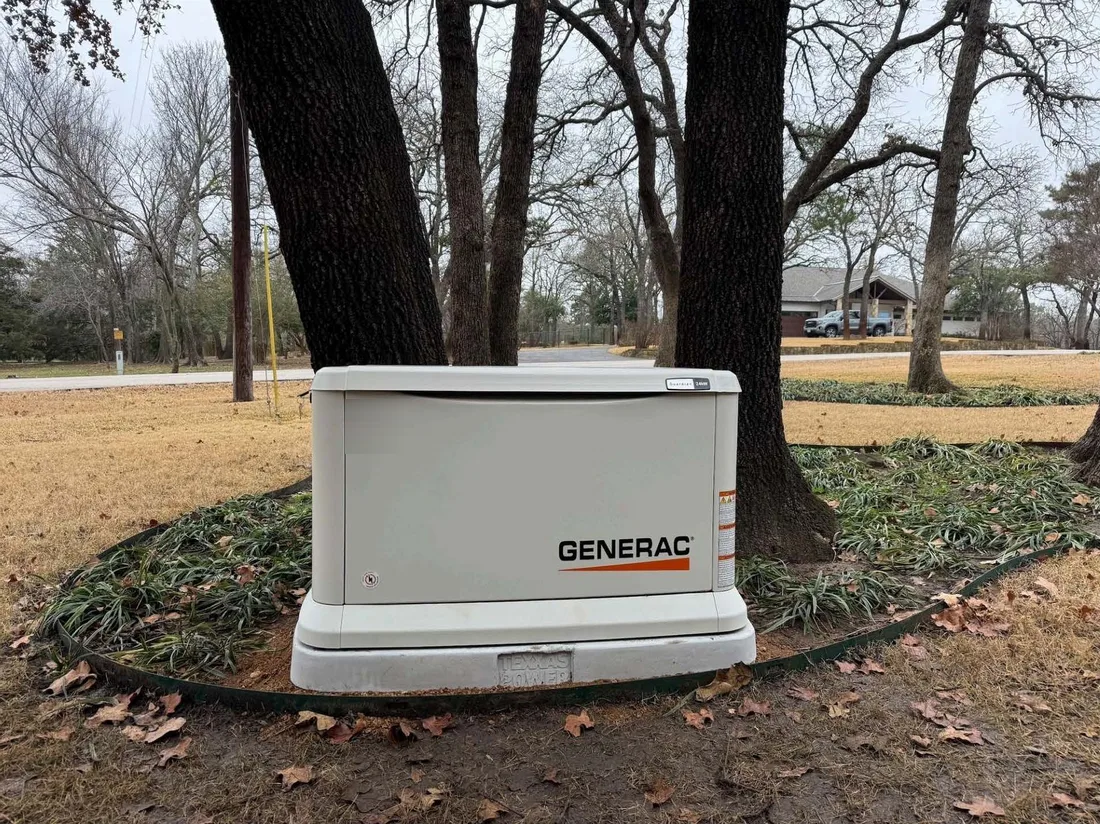
The siting questions are in where a standby generator can go on your lot.
6. What North Texas adds
The Dallas-Fort Worth climate tests a generator in two seasons. Summer first: DFW recorded 55 days at or above 100°F in 2023, the fourth most on record (National Weather Service Fort Worth, annual 100-degree days). Generac’s air-cooled schedule moves the oil change to every year or 100 hours when a unit runs continuously above 85°F or in cold below 40°F, so a long summer outage or an ice storm in Denton or Collin County uses up service intervals faster than the calendar suggests. Our guides to triple-digit days, winter ice events and the DFW weather calendar cover both seasons.
Then storms. The National Weather Service Fort Worth says large hail, damaging winds, flooding and tornadoes “occur nearly every year in the Dallas/Fort Worth Metroplex” (NWS Fort Worth, DFW climate narrative), though any single location is unlikely to see all of them in a given year. Hail and wind damage is excluded from Generac’s warranty, so a look at the enclosure after a storm is worth doing. If a storm leaves the unit faulting, generator service during a storm explains what happens when you call. HomeSafe’s emergency service is available 24/7, every day including holidays. After-hours and emergency rates apply depending on the circumstances, and you are told what they are before a technician is dispatched.
7. When age becomes a question
Age alone is not the test. By Generac’s statement, a unit with a good service record at 10 or 12 years is well inside the range the maker describes, and one that has been neglected may have problems sooner. What matters at any age is whether it starts, transfers and carries your home’s load, and whether the cost and frequency of repairs still make sense.
That is an easy thing to test. Every HomeSafe maintenance visit includes a power outage simulation, a real transfer test, and load output testing is standard, so a unit’s condition is checked by use and not guessed from its birth year. Load bank testing is available. The plans are Single Service, Annual (Q4), Bi-Annual (Q2 and Q4) and Quarterly (all four quarters). A unit with a service record is far easier to assess than one with none, which is the case if you have bought a home with a generator and no history. HomeSafe services Generac, Kohler, Champion, Briggs and Stratton and Cummins units, including units other companies installed. See generator service and repair.
To be fair, you may not need a plan at all. A newer unit with few run hours may be well served by an Annual visit, and a unit under warranty needs its required maintenance documented. If your home has changed, with a new air conditioner or an added load, a unit that is not old may still be the wrong size; the sizing planner covers that.
This guide covers home standby generators. It does not cover portable generators, and commercial units are handled under Texxas Power.
In this series: what generator maintenance includes · when a standby generator won’t start · Generac error codes · air-cooled vs liquid-cooled
Quick answers
How long does a whole-house generator last?
Generac states 20 years or more for a well-maintained home standby generator. That figure is Generac’s own statement for its home standby generators, it assumes the maker’s maintenance schedule is followed, and it is a statement about the product in general, not a guarantee for one unit.
How long do Generac generators last?
20 years or more when well maintained, according to Generac’s FAQ. Generac also says its home standby generators are built to last decades and that following the manufacturer’s recommended maintenance schedule can help maximize the lifespan.
How many hours does a standby generator last?
Generac states its lifespan in years, not hours: 20 years or more when well maintained. The figure of 5 years or 2,000 hours, whichever occurs first, is the coverage period of Generac’s limited warranty, and Kohler’s comprehensive warranty is five years or 2,000 hours. A warranty period is not an expected life.
Does a generator that rarely runs last longer?
Not by itself, because maintenance runs on years as well as hours. Generac’s schedule is every 2 years or 200 hours for Schedule A on air-cooled units, whichever comes first, and its break-in oil change is based on engine hours however they were accumulated.
What affects how long a standby generator lasts?
Upkeep first. Generac says following the manufacturer’s recommended maintenance schedule can help maximize the lifespan. The starting battery lasts about 3 to 5 years on average, and Generac’s manual asks for water to be directed away from the enclosure and for 3 feet of clearance around the louvers.
How do I check how many hours my generator has run?
Through the Mobile Link app on all supported models. On a Guardian Series panel press ESC, choose Sub Menus, then Maint and Run Hrs. On Next Generation Series units the panel does not show it, so use Mobile Link or Field Pro.
Does the warranty cover a generator at the end of its life?
No. Generac’s air-cooled warranty will not cover repair “when normal use has exhausted the life of a part(s) or engine,” and in years 4 and 5 it covers only the engine short block and the alternator rotor and stator.
Do air-cooled or liquid-cooled generators last longer?
Not according to Generac’s statement, which is not split by cooling type. What differs is the service schedule: its liquid-cooled manual calls for service every year or 125 hours, against every 2 years or 200 hours for air-cooled. See our guide to air-cooled and liquid-cooled generators.
When should a whole-house generator be replaced?
Not on age alone. The useful tests are whether it starts, transfers and carries the load at an outage simulation, and whether repairs are becoming frequent. A technician can check the first two at a maintenance visit.
To have a technician check your unit, contact HomeSafe or call (817) 439-9009. HomeSafe holds Texas Electrical Contractor License #41809 and has a 5.0 rating across 200+ Google reviews, which you can read on our reviews page.