
Last reviewed: November 2026
Shopping for a home standby generator, you will meet two engine types sooner than you expect: air-cooled and liquid-cooled. Sales pages treat them as a ranking, with one better than the other. For a home, it is closer to a size question than a quality one, and the answer changes what sits beside your house, how it is serviced and what the gas supply has to carry.
Here is the short answer. An air-cooled engine is cooled by fans that force air across the engine. A liquid-cooled engine circulates coolant through a radiator, the way a car does. Air-cooled units are the smaller group, and liquid-cooled units start where air-cooled ones stop: at HomeSafe, Generac air-cooled units run 18 to 28 kW and its liquid-cooled Protector series 32 to 80 kW, while Kohler is air-cooled at 20 and 26 kW and liquid-cooled at 30, 38 and 48 kW. Champion’s whole-house models are all air-cooled. If an air-cooled unit covers your load, it protects your home as well as a liquid-cooled one.
This guide is for homeowners in Fort Worth, Dallas, Plano, Frisco, Southlake, Flower Mound and across DFW and North Texas who are choosing between the two or want to know what they already own. It covers how each type cools, where the kW line falls, size and gas demand, published sound, the service schedule, warranty and heat. It does not rank brands, size your generator or discuss prices; the links below go to the guides that do.
1. How each type keeps the engine cool
Generac puts the difference in one line: air-cooled engines “use fans to force air across the engine for cooling, while liquid-cooled generators use enclosed radiator systems for cooling, similar to an automobile” (Generac, Home Standby FAQs). It adds that liquid-cooled engines are generally used on larger kW generators because the engines are larger.

The manufacturers’ own documents show the same split. Generac’s liquid-cooled Protector spec sheet lists a 50/50 ethylene glycol coolant mix, a belt-driven water pump and a pusher-type fan (Generac Protector 48, 60 and 80 kW spec sheet). Kohler’s 30RCLA lists a radiator system with a centrifugal water pump and three 16-inch fans whose speed is electronically controlled (Kohler 30RCLA spec sheet G4-304). Kohler’s power business now trades as Rehlko, so you may see either name on its documents.
An air-cooled unit has no coolant at all. What it needs instead is clear airflow: Generac’s air-cooled manual warns against obstructing “cooling and ventilating airflow around the generator” and asks that shrubs and tall grass within 3 feet of the intake and discharge louvers on the enclosure sides be removed (Generac owner’s manual, 60 Hz air-cooled generators).
2. Where the line falls: kW ranges by brand
There is no single kW number where air-cooled stops. Each brand draws the line in a different place, and the models HomeSafe installs show it.

| Brand | Air-cooled models | Liquid-cooled models |
|---|---|---|
| Generac | 18, 22, 24, 26 and 28 kW | Protector series: 32, 40, 48, 60 and 80 kW |
| Kohler | 20RCA and 26RCA (20 and 26 kW) | 30RCLA, 38RCLC and 48RCLC (30, 38 and 48 kW) |
| Champion | Whole-house models of 14, 22 and 26 kW, plus a smaller essential-circuits unit | None in the whole-house line |
Two things follow. First, a home that needs more than 28 kW from Generac, or more than 26 kW from Kohler, is a liquid-cooled home by default, because the air-cooled lines stop there. Second, below those numbers you usually have a choice of brand and cooling type that your load does not force. How many kW your home needs is a separate question from how the engine is cooled; our generator sizing planner walks through it, and the brand-by-brand model lists are on the Generac, Kohler and Champion pages.
3. What changes on your property
From the street the two types look alike. On the lot they do not, and this is where most owners notice the difference. Here is a Generac air-cooled unit beside a brick home, and below it a liquid-cooled Generac Protector between two stone walls.


Kohler’s spec sheets give a clean comparison inside one brand. The air-cooled 26RCA measures 47 by 26 by 32.3 inches (length, width, height), while the liquid-cooled 30RCLA measures 74 by 32.9 by 46.0 inches and ships at 1,320 pounds with its fluids (Kohler 26RCA spec sheet G4-315; Kohler 30RCLA spec sheet G4-304). Kohler notes that its drawings are for reference and should not be used for planning an installation. Our Kohler guide sets all five models side by side, and where a standby generator can go covers clearances, pad and HOA rules, which depend on your lot and your city rather than on the cooling type.
The bigger footprint matters most on tight lots. A narrow side yard in Highland Park or University Park leaves little room, while an acre in Aledo or Parker County leaves plenty. HomeSafe’s free in-home assessment looks at the electrical panel, the gas supply and meter, and the places a unit could realistically go, then recommends a size and a brand. If a smaller system covers your need, we say so.
Gas demand scales with engine size too. Kohler’s sheets list natural gas use at full load of 290 cubic feet per hour for the 26RCA and 424 for the 30RCLA, and propane use of 129 and 166 cubic feet per hour. These are different sizes, so the point is not that one type burns more fuel for the same power. A larger engine needs a larger gas supply, and the gas line and meter, which for most DFW homes means Atmos Energy, are looked at before a quote. How gas work shapes the quote is in our generator cost guide, and how the pieces connect is in how a standby generator works.
4. Sound
Neither type is quieter by nature. Each maker publishes a figure for its own models, measured at 23 feet, and the numbers depend on the model and the mode.
| Model | Type | Exercise mode | Normal operation |
|---|---|---|---|
| Generac 22 to 28 kW | Air-cooled | 55 dB(A) (Quiet-Test low-speed exercise) | 67 dB(A) |
| Generac Protector 48, 60 and 80 kW | Liquid-cooled | 68 dB(A) | Not listed |
| Kohler 26RCA | Air-cooled | 56 dB(A) | 67 dB(A) |
| Kohler 30RCLA | Liquid-cooled | 53 dB(A) | 61 dB(A) |
Sources: Generac 22 to 28 kW spec sheet, the Generac Protector spec sheet above, and the two Kohler spec sheets above. Both makers note that sound levels on other sides of a unit can differ. Kohler’s liquid-cooled sheet attributes part of its low figure to electronically controlled fan speeds, which is a feature of that model rather than of liquid cooling itself. For the brand-by-brand comparison of published sound, see Generac vs Kohler vs Champion.
5. The service schedule
This is the difference you live with after the install. Generac’s two manuals schedule the work differently, and the liquid-cooled one adds cooling-system tasks.
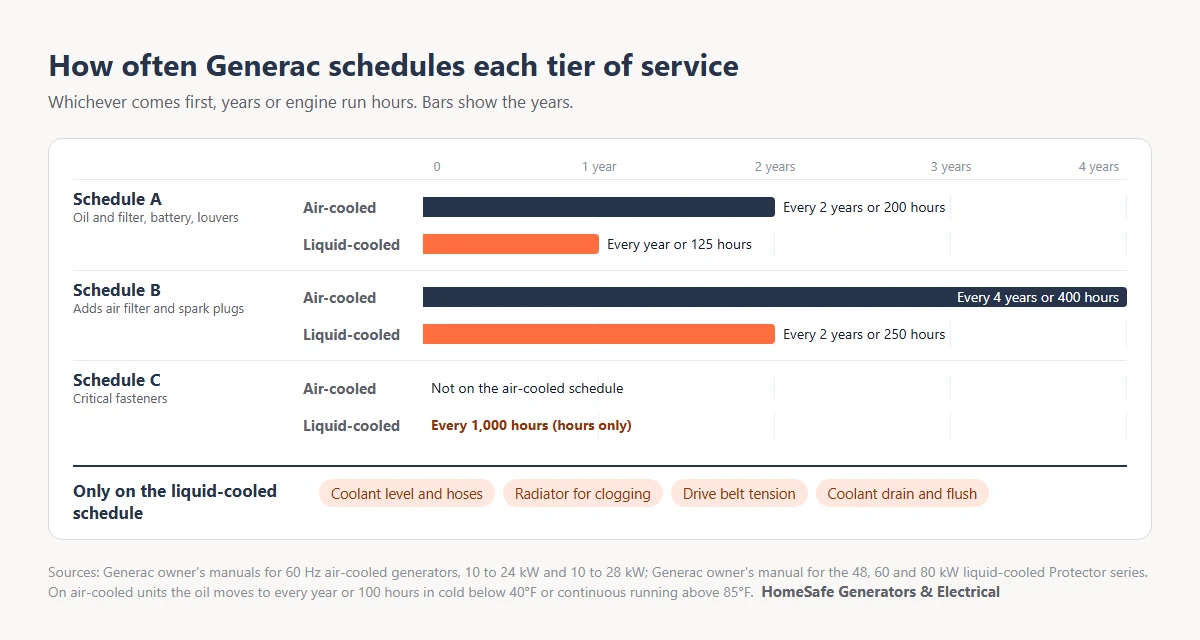
| Item | Air-cooled (10 to 28 kW manuals) | Liquid-cooled (48, 60 and 80 kW manual) |
|---|---|---|
| Routine service | Schedule A: every 2 years or 200 hours | Schedule A: every year or 125 hours |
| Larger service | Schedule B: every 4 years or 400 hours | Schedule B: every 2 years or 250 hours |
| Major service | None listed | Schedule C: every 1,000 hours |
| Engine oil and filter | With Schedule A; every year or 100 hours in cold below 40°F or continuous running above 85°F | 1 year or 200 hours per oil change, whichever comes first |
| Cooling system | No coolant | Coolant level and hoses, radiator for clogging, drive belt tension, coolant drain and flush |
Sources: Generac air-cooled owner’s manual and Generac Protector owner’s manual. In both cases the unit’s own manual for your model is the final word. Both manuals tie the first oil change to the first 25 hours of running, and both say to check the louvers and the fuel lines.
In plain terms, a liquid-cooled unit has more to inspect and comes due sooner by calendar. That is not a flaw. It is what a larger engine with a coolant loop needs. HomeSafe’s maintenance plans (Single Service, Annual, Bi-Annual and Quarterly) work the same way on either type, and every visit ends with a power outage simulation, a real transfer test rather than just a run test. What each visit covers is in our maintenance guide, and the service page is generator service and repair.
6. Warranty
Cooling type does not change the headline warranty period at either of the two makers. Generac offers “5-year limited warranties for most home standby generator models,” with 3 years for its PowerPact and EcoGen models (Generac Help Center, home standby warranty). Kohler’s 26RCA and 30RCLA spec sheets both list a five-year or 2,000-hour limited warranty, and Kohler’s premium version on the 26RCA covers parts, labor and travel (Kohler 26RCA spec sheet).
A warranty period is not a lifespan, and the two should not be mixed up. What decides how long a generator lasts is covered in our guide to how long a whole-house generator lasts. For each brand’s terms in full, see the three-brand comparison and the Champion guide. HomeSafe is warranty-authorized for Generac, Kohler and Champion, and warranty repairs follow each manufacturer’s own terms.
7. Heat in DFW
North Texas heat is the usual argument for liquid cooling, so it is worth checking what the documents say. DFW recorded 55 days at or above 100°F in 2023, the fourth most on record (National Weather Service Fort Worth, annual 100-degree days). Our guide to triple-digit days in DFW has the full record.
Generac’s air-cooled manual says its units are tested to UL 2200 at an operating temperature of -20°F to 122°F, and that above 77°F “there may be a decrease in engine power.” Kohler publishes derating rules for both of its types: its 26RCA sheet reduces output 2% per 10°F above 60°F, and its 30RCLA sheet 3.0% per 18°F above 77°F. The Generac Protector sheet lists a maximum ambient temperature of 140°F. The takeaway is that heat does not rule out air-cooled in DFW. It is one of the inputs to sizing, which is why a unit is sized with a margin and not to the exact load. And in a long summer outage, Generac’s air-cooled manual moves the oil change to every year or 100 hours when a unit runs continuously above 85°F, the case our maintenance guide explains.
8. Which fits which DFW home
| Your home | What usually fits |
|---|---|
| One or two air conditioners and a moderate load, such as many Plano, Frisco and Fort Worth homes | An air-cooled unit, in the size your load calls for |
| A tight lot, such as Highland Park or University Park | An air-cooled unit where the load allows, since it takes less room |
| A large home with several air conditioners, a pool, a well pump or outbuildings, as in Southlake or on acreage near Aledo | A load above 28 kW points to liquid-cooled |
| A home whose load sits near the top of the air-cooled range | A conversation worth having at the in-home assessment, with the load and the lot in front of us |
To be fair to the other side of the sale: a liquid-cooled unit on a home that an air-cooled unit would cover adds size, gas demand and expense without adding protection. If your load sits below the air-cooled ceiling, the bigger machine is not the safer choice. The reverse also holds. Where the load needs more than the air-cooled range offers, there is no air-cooled option to weigh. HomeSafe recommends only what it will stand behind and explains why.
9. Which type you already own
The easiest check is the owner’s manual. Generac titles its air-cooled manual “60 Hz Air-Cooled Generators,” and its liquid-cooled manual lists a coolant overflow reservoir, a coolant drain hose and a radiator inspection in the service section. A look inside the enclosure shows the same thing: a radiator and coolant reservoir mean liquid-cooled. If you are not sure, the model number on the data label tells us.
HomeSafe services Generac, Kohler, Champion, Briggs and Stratton and Cummins units, including units other companies installed, so the type you own does not limit who can maintain it. If it is a Generac, how to choose a Generac dealer in DFW explains the dealer tiers. This guide covers home standby generators; commercial and larger facility units are handled under Texxas Power. To compare backup options beyond generators, see standby generator, battery or portable.
In this series: Kohler generators in DFW · Champion whole-house generators · Generac vs Kohler vs Champion · how to choose a Generac dealer
Quick answers
What is the difference between an air-cooled and a liquid-cooled generator?
The cooling system. Air-cooled engines use fans to force air across the engine; liquid-cooled engines circulate coolant through an enclosed radiator system, similar to a car. Generac notes that liquid-cooled engines are generally used on larger kW generators because the engines are larger.
What is a liquid-cooled generator?
A generator whose engine is cooled by coolant pumped through the engine and a radiator. On Generac’s Protector series that is a 50/50 ethylene glycol mix with a belt-driven water pump and a pusher fan. On Kohler’s 30RCLA it is a radiator system with three electronically controlled fans.
Which sizes are air-cooled and which are liquid-cooled?
Across the models HomeSafe installs, air-cooled runs from about 14 to 28 kW and liquid-cooled from 30 to 80 kW, and each brand draws the line in a different place. Generac is air-cooled at 18 to 28 kW and liquid-cooled at 32 to 80 kW, Kohler is air-cooled at 20 and 26 kW and liquid-cooled at 30, 38 and 48 kW, and Champion’s whole-house models are all air-cooled.
Is a liquid-cooled generator better than an air-cooled one?
No, not in general. Size decides. An air-cooled unit that covers your load protects your home just as well, and a liquid-cooled unit exists for loads beyond the air-cooled range, such as a large home with several air conditioners.
How do I know if my generator is air-cooled or liquid-cooled?
Two quick checks settle it: the owner’s manual and the inside of the enclosure. Generac’s manuals name the type in the title, and a liquid-cooled unit has a radiator and a coolant reservoir that an air-cooled unit does not. The model number on the data label also settles it.
Do liquid-cooled generators last longer than air-cooled ones?
Not according to Generac’s own statement, which is not split by cooling type: a well-maintained home standby generator can last 20 years or more, depending on use, environment and upkeep. What differs between the two is the service schedule. See our guide on how long a whole-house generator lasts.
Which type is quieter?
Neither by nature. Kohler publishes 56 dB(A) in exercise and 67 dB(A) at full speed for the air-cooled 26RCA, and 53 and 61 dB(A) for the liquid-cooled 30RCLA, all at 23 feet. Generac’s air-cooled 22 to 28 kW units list 55 dB(A) in Quiet-Test exercise and 67 dB(A) in normal operation.
Does a liquid-cooled generator need more maintenance?
Yes, more items and sooner by calendar. Generac’s liquid-cooled manual schedules service every year or 125 hours and adds coolant, radiator and belt work, while its air-cooled manual schedules every 2 years or 200 hours with no coolant to service.
Does the warranty differ by cooling type?
No, not in the headline period. Generac gives 5-year limited warranties for most home standby models, and Kohler lists a five-year or 2,000-hour limited warranty on both its air-cooled 26RCA and liquid-cooled 30RCLA. Terms and exclusions come from each manufacturer’s own warranty.
To talk through which type your home needs, contact HomeSafe or call (817) 439-9009. HomeSafe holds Texas Electrical Contractor License #41809 and has a 5.0 rating across 200+ Google reviews, which you can read on our reviews page. Generator installation starts with a free in-home assessment.