
Last reviewed: November 2026
Every DFW summer starts the same way. Someone at the grocery store says this will be the year it hits 100 in May. A neighbor mentions the electric bill. By July the whole metroplex is planning its day around the thermostat. If you live in Fort Worth, Dallas, Plano, Frisco or Southlake, you have probably wondered how unusual a long run of triple-digit days really is.
The National Weather Service (NWS) Fort Worth office keeps the record. It publishes the normal number of 100-degree days and a ranked list of the years with the most 100-degree days at DFW. This guide says what those figures show and do not show. Then it turns to the practical question: what a hot stretch means for the air conditioning in your house, and why that matters if you are thinking about backup power.
The short answer: a normal year at DFW has about 20 days at or above 100 degrees, on the NWS 1991 to 2020 normals. The hottest years on record have produced between 44 and 71, and three of the top ten are recent. Air conditioning is usually the biggest single factor when a generator is sized for a DFW home. A generator is not the only way to handle a hot outage, and we say where it is not the answer.
1. The record: normal years and the hottest years
NWS Fort Worth’s 1991 to 2020 normals give DFW an average of 20 days a year at or above 100 degrees, 2 more than the 1981 to 2010 normals. The hottest year on its ranked list is 2011, with 71 days, and the tenth-hottest is 1952, with 44. When NWS last updated the list on September 22, 2026, 2026 stood at 52 days, tied for fifth. NWS marks that entry as subject to change through the end of the warm season, so check its page for the final count before quoting it.
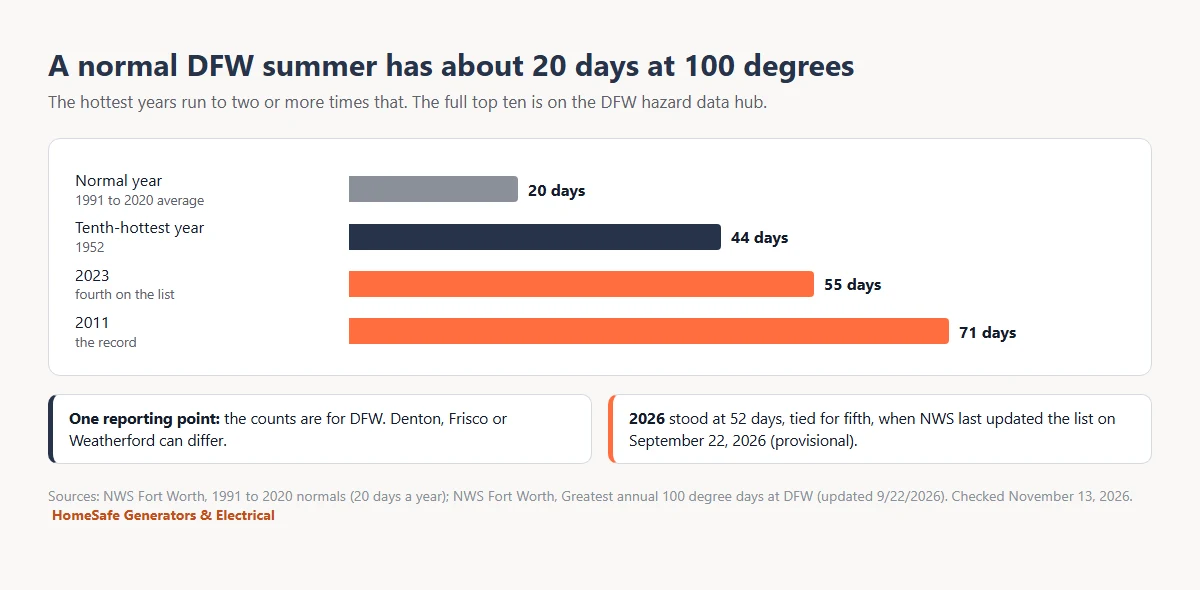
The full top ten, with every year and rank, is kept in one place on the DFW hazard data hub.
2. What the record does and does not show
It is tempting to read the list as a steady climb. The data does not say that. Three of the ten years are recent (2022, 2023 and the provisional 2026), but the other seven are spread between 1952 and 2011. The two hottest years on record, 2011 and 1980, are decades apart. What the list does show is that very hot summers have happened in every era of the record, and that recent summers rank among them.
It also tells you nothing about the rest of the year. A year can rank high on 100-degree days and still have a mild spring and fall. And it counts days at one reporting point, DFW, so conditions in Denton, Frisco or Weatherford can differ.
3. When the heat arrives
The NWS DFW 100-degree facts page puts the average first 100-degree day on July 1 and the average last on August 27. March, April and October have had 100-degree days, but NWS notes the average for those months is near zero.
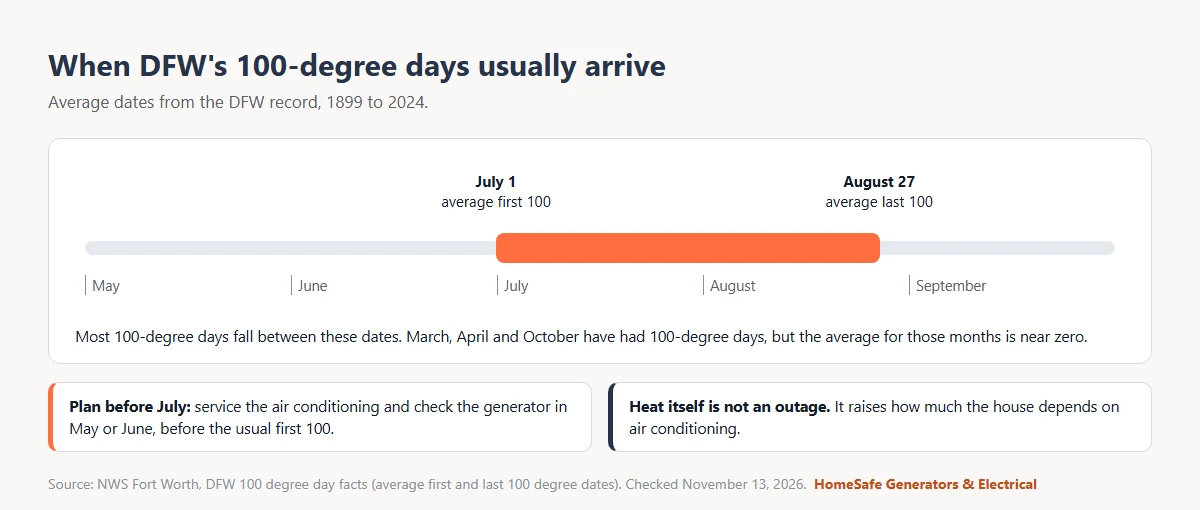
Heat works differently from storms. The month-by-month calendar of DFW weather risk shows severe storms, which are concentrated in spring. Storms are brief and local. A heat season is long and affects every home at once, and what you notice is the air conditioning running for hours a day.
That is why heat shows up in generator planning even though a heat wave is not an outage. Heat raises how much you rely on the air conditioning, and it raises the stakes of losing it.
4. Why air conditioning is the big load
In most DFW homes the air-conditioning system is the largest electrical load. A central system has a compressor and a blower motor. Electric motors draw extra power for a moment when they start. Generac’s own example is a refrigerator that runs at 700 watts but needs 2,200 watts to start, a surge that “typically lasts two to three seconds” (Generac Help Center). Generac lists air conditioners among the appliances that draw this starting surge. A system that cycles on and off all afternoon repeats that demand each time.
For a generator, that matters in two ways. First, whether you want the air conditioner running in an outage at all decides much of the size. Second, how many air-conditioning units you have, one or two, and how large they are, changes the answer as well. A two-story home in Plano with two systems asks for a different generator than a compact single-system home in Fort Worth.
The sizing planner explains how size is worked out, including how the air-conditioning load is handled. The right number comes from your home’s actual panel and equipment, not from a rule of thumb. That is also why a written recommendation follows a visit to the property.
5. The options for a hot outage
There is more than one way through a hot outage. The right one depends on how often power fails where you live and how long it lasts.
| Option | What it can run | Starts by itself | Trade-off |
|---|---|---|---|
| A prepared kit | Devices from a power bank, food in a cooler | Not applicable | No cooling; fine where outages are short and rare |
| Portable generator | A refrigerator, fans, a window unit, lights | No | Runs outdoors only, at least 20 feet from windows, doors and attached garages (Ready.gov); needs refueling |
| Battery backup | Chosen circuits, for as long as the stored energy lasts | Yes | Run time depends on stored energy and load |
| Standby generator | Air conditioning and the rest of the home, if sized for it | Yes | The most complete answer, and more than some homes need |
The guide to the best generator for a power outage sets out the portable and standby trade-offs, and the battery backup comparison covers batteries.
A fair point against our own interest: if you only want to keep the refrigerator and a few lights running, a standby system sized for whole-home air conditioning would be more than you need. A smaller system, or a portable unit, may cover you. When HomeSafe visits a home, it says so.
6. Heat and the grid
The summer heat does put demand on the electric system, but hot days and outages are not the same thing. Ready.gov notes that “heat waves may cause you to lose power”, while EIA figures show Texas outage time on ordinary days close to the U.S. average, with the large numbers coming from rare, large events. The figures are on the hazard data hub, and ERCOT conservation appeals explains the requests to save power on the hottest afternoons.
7. A practical plan for the summer
Whether or not you own a generator, the same short list helps before the first triple-digit week.
- Have the air-conditioning system serviced before June, and replace the filter.
- Know where your breaker panel is, and check that the labels are readable.
- Learn which circuits you would want during an outage: refrigerator, a few lights, the air conditioning, internet, any medical device. Backup for medical equipment is job specific and needs a job-specific review before any system is designed.
- If you own a standby generator, make sure its service is current. The maintenance guide explains what a visit includes, including a power outage simulation at every maintenance visit.
- Check on neighbors who are elderly or live alone. Ready.gov suggests finding a cooling center if your home has no air conditioning.
If you are thinking about a standby generator, location also matters in summer, since the unit sits outdoors beside the house and needs clearances. See the placement guide and, for permits, the generator permit guide. Insurance questions come up too, and the guide on home insurance and a whole-home generator answers them. Winter brings its own load questions, covered in DFW winter ice events.
8. Planning a home for DFW summers
If you want a straight recommendation for your own house, a free in-home assessment looks at the panel, the gas supply, the air-conditioning equipment and where a unit could go, and then recommends a size and brand. If a smaller system covers the need, HomeSafe says so. Most installs are finished 3 to 5 weeks after the equipment arrives, and the work at your home usually takes one day, so a spring decision leaves room before July. You can read how the process works and see financing options before you decide.
Still deciding whether a standby generator is worth it for your home? Read is a whole house generator worth it.
Sources
All checked November 13, 2026.
- NWS Fort Worth, 1991 to 2020 normals (20 days a year at or above 100 degrees at DFW): weather.gov/fwd/1991-2020_normals
- NWS Fort Worth, Greatest annual 100 degree days at DFW (updated 9/22/2026; 2026 ranking provisional): weather.gov/fwd/danncon10
- NWS Fort Worth, DFW 100 degree day facts (average first and last 100-degree dates): weather.gov/fwd/d100info
- Generac Help Center, What does surge or starting wattage mean: support.generac.com
- Ready.gov, Extreme heat: ready.gov/heat
- Ready.gov, Power outages (generator placement): ready.gov/power-outages
- U.S. EIA, Electric Power Annual, Table 11.3 (2025 and 2024), as summarized on the hub: eia.gov, Table 11.3
In this series: the DFW hazard data hub · seasons of risk in DFW · DFW winter ice events · storms and hurricane remnants · Texas grid reliability · ERCOT conservation appeals · the seasonal readiness timeline
Quick answers
How many 100-degree days does DFW get a year?
About 20, on the NWS Fort Worth 1991 to 2020 normals. The hottest years have run far higher: 71 days in 2011 and 55 in 2023.
When does DFW usually hit 100 degrees for the first time?
July 1, on average. NWS Fort Worth puts the average first 100-degree day at DFW on July 1 and the average last on August 27, though March, April and October have had them too.
Can a heat wave cause power outages?
Yes, sometimes. Ready.gov notes that heat waves may cause you to lose power. A hot day is not the same as an outage, though: EIA data for 2025 show Texas at 128.7 outage minutes per customer without major events, close to the U.S. figure of 120.8.
Is the 2026 count final?
No, not as of the last NWS update. NWS listed 2026 at 52 days, tied for fifth, on September 22, 2026, and says the ranking is subject to change through the end of the warm season.
Why does air conditioning matter when sizing a generator?
Air conditioning is usually the largest electrical load in a DFW home, and its motors draw extra power for a few seconds when they start. Whether you want it running during an outage, and how many systems you have, decides much of the generator size.
Can a portable generator run my central air conditioning?
Not always. A portable generator is often enough for a refrigerator, fans and lights. Whether it can start and run a central system depends on the generator’s starting watts and on your equipment, so ask a licensed electrician to review it before you rely on it.
For a free in-home assessment, contact HomeSafe or call (817) 439-9009. HomeSafe holds Texas Electrical Contractor License #41809 and has a 5.0 rating across 200+ Google reviews.