
Last reviewed: November 2026
Most people think about backup power twice a year: when a storm is on the radar and when the weather turns very hot. By then the useful preparation is already out of reach. A generator that has not been checked, a freezer with nothing to keep cold and a medication plan nobody has discussed are all easier to sort out on a quiet Saturday than during an outage.
This guide is a checklist built around the DFW calendar. It is for homeowners in Fort Worth, Dallas, Plano, Frisco, Denton and the surrounding communities, whether you already own a generator, you are thinking about one, or you have decided you do not need one. For the food, supplies and medication items we rely on guidance from Ready.gov and the U.S. Food and Drug Administration (FDA), linked below. For when each kind of weather tends to arrive, see the month-by-month calendar of DFW weather.
The short answer: do a small amount in each of four windows (February, March, May and October), and keep a short household plan on paper. Many homes need nothing more than that, and some need only a portable generator.
1. The four windows at a glance
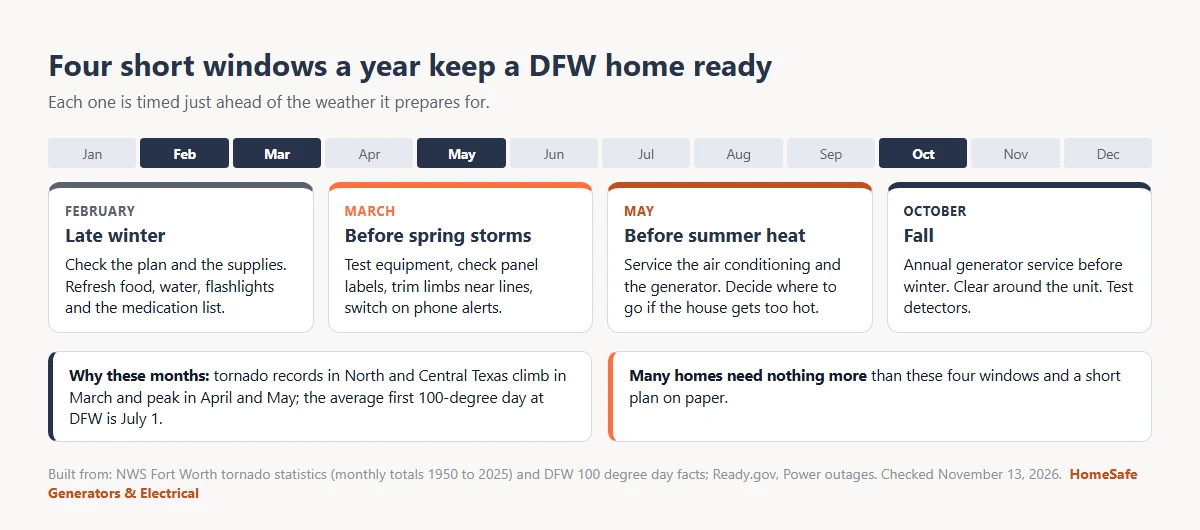
Each window sits just ahead of the weather it prepares for. Tornado records in North and Central Texas climb in March and peak in April and May, and DFW’s average first 100-degree day is July 1 (NWS Fort Worth, figures on the DFW hazard data hub).
| Window | Month | Main tasks | Ahead of |
|---|---|---|---|
| Late winter | February | Check the plan and the supplies; refresh food, water, flashlights and the medication list | Spring storms and any late winter ice |
| Before spring storms | March | Test equipment, check panel labels, have limbs near lines dealt with, switch on phone alerts | The April and May storm peak |
| Before summer heat | May | Air-conditioning service and a check on the generator; decide where you would go if the house got too hot | Triple-digit days |
| Fall | October | Annual generator service, clear around the unit, test detectors, winter kit | October storms and winter |
Take it with you: download the DFW seasonal readiness checklist (one-page PDF) and keep it with your outage kit.
HomeSafe’s maintenance plans follow the same rhythm. The annual plan covers a fourth-quarter visit, the bi-annual plan covers the second and fourth quarters, and the quarterly plan covers all four. Every maintenance visit includes a power outage simulation, a real transfer test and not just a run test. The details are in the maintenance guide.
2. If you own a standby generator
A standby generator is built to start by itself, which is also why it is easy to forget. A short checklist for each window:
- Confirm service is current. Skipping service can void a warranty and means you will not know about a problem until you need the unit. Warranty terms differ by manufacturer, so read yours.
- Look at the unit. Clear leaves, mulch and stored items from around it. Check the clearances still match what was planned. The placement guide covers the distances.
- Check the fuel supply. The unit runs on natural gas or propane. If it runs on propane, check the tank level. Know where the gas shutoff is.
- Check the controller and any alerts. Most units show a status light or a message. If you see a fault, call. Do not wait for the next storm.
- Watch the exercise cycle. A unit usually runs a short self-test on a schedule. If you have not heard it in weeks, mention it at the next service.
3. If you use a portable generator
A portable generator is a valid answer for many DFW homes. A few points from Ready.gov apply before each season.
- Run it outdoors only, at least 20 feet from windows, doors and attached garages.
- Keep it dry, and protected from rain and flooding.
- Let it cool before refueling. Spilled fuel on hot engine parts can ignite.
- Follow the manufacturer’s instructions.
- Install carbon monoxide detectors with battery backup on every level of the home. Ready.gov recommends placing them in central locations.
Every spring and fall, start it, run it under load for a few minutes and check that the cords and plugs are in good order. Store fuel as the manufacturer directs. To compare it with a standby unit, the guide to the best generator for a power outage is a fair place to start.
4. The panel and the circuits
Whether or not you have a generator, the electrical panel decides what you can power.
- Label the breakers. If you cannot read the labels, you will lose time in the dark.
- Write down what matters: refrigerator, freezer, a few lights, internet, any medical device and, in summer, the air conditioning. This is also the first step in sizing. See the sizing planner.
- Disconnect sensitive electronics during an outage. Ready.gov notes that power can return with surges that cause damage.
- Do not connect a generator to the house without a properly installed transfer switch. OSHA warns that a generator attached to a building’s wiring without one “can energize wiring systems for great distances” (OSHA, Using Portable Generators Safely). A licensed electrician should do this work, and permits apply. The generator permit guide explains how permitting differs across cities such as Dallas, Fort Worth, Plano and Frisco.
5. What to stockpile
Ready.gov’s list is short. Keep these together, and check them in the February window:
- Enough nonperishable food and water for your household.
- A flashlight for each household member, with spare batteries. Ready.gov asks you to plan batteries and other power sources for what you need.
- Charged power banks for phones.
- A cooler and ice packs, so the refrigerator door can stay shut.
- An appliance thermometer for the refrigerator and one for the freezer.
- A written list of medications and dosages, and the plan you made with your provider.
- Carbon monoxide detectors with battery backup on every level.
- Your utility’s outage contact. Oncor, which delivers power to much of DFW, runs an outage map; if you are served by a co-op or another utility, note its number instead.
6. What not to do during an outage
- Do not run a generator indoors or in an attached garage. Run it outdoors only, at least 20 feet from windows, doors and attached garages (Ready.gov).
- Do not use a gas stove or oven to heat your home (Ready.gov).
- Do not keep opening the refrigerator and freezer. Closed doors keep food cold longer.
- Do not judge food by how it looks or smells (FDA).
- Do not plug a generator into a wall outlet or the panel without a transfer switch (OSHA).
- Do not go near fallen lines. Report them to your utility.
7. Food planning
The FDA’s guidance on food safety in a power outage is specific, and worth reading once now so you do not have to look it up later.
- Keep the refrigerator at or below 40 degrees F and the freezer at or below 0 degrees F. An appliance thermometer in each helps.
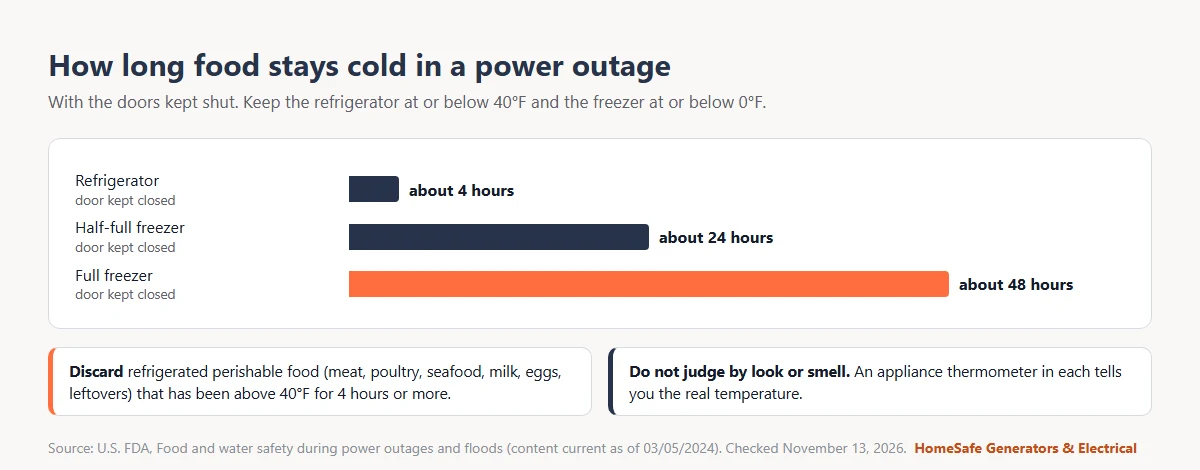
- Keep the doors closed. An unopened refrigerator keeps food cold for about 4 hours. A full freezer holds its temperature about 48 hours with the door closed, and a half-full freezer about 24 hours.
- Discard refrigerated perishable food, such as meat, poultry, seafood, milk, eggs and leftovers, that has been above 40 degrees F for 4 hours or more.
- Perishable food left at room temperature for 2 hours or more should be discarded, or 1 hour if the outdoor temperature is above 90 degrees F, which in DFW summers is common.
- Do not judge safety by appearance or odor.
Ready.gov’s power outage page uses a stricter rule, discarding food exposed to 40 degrees F or higher for two hours or more. When the two differ, the shorter time is the safer one: when in doubt, throw it out. A practical routine: keep an appliance thermometer in each, keep the doors shut, and keep a cooler and ice ready in case an outage runs long.
8. Medication and medical equipment
Ready.gov asks households to plan this ahead with a health provider.
- Ask your provider for a backup plan if you rely on powered medical equipment or refrigerated medication.
- Find out how long refrigerated medicine stays safe at higher temperatures, and ask for specific guidance on any life-critical medication.
- Ready.gov advises that if the power is out for more than a day, refrigerated medication should be discarded unless the label says otherwise, and that you should consult your doctor or pharmacist for a new supply.
- Keep a list of medications and dosages with your kit.
Backup for medical equipment is job specific and needs a job-specific review before any system is designed. If someone in your house depends on powered equipment, raise it at the first visit so it is considered from the start.
9. Heat season: May and June
Before the first run of triple-digit days, have the air-conditioning system serviced and the filter replaced. A normal year at DFW has about 20 days at or above 100 degrees, and the hottest years have had far more (NWS Fort Worth; the dated top ten is on the hazard data hub). The piece on triple-digit days in DFW explains the record and what it means for sizing.
Also decide where you would go if the house became uncomfortable in a long outage, and who you will check on in your street. On the hottest days you may also hear about ERCOT conservation appeals; the guide to Texas grid reliability explains how often outages actually happen.
10. Do you need a standby generator at all?
Sometimes the answer is no. If outages where you live are short and rare, a portable generator with a cooler, a power bank and the household plan above may be enough. Battery backup suits some loads, and the generator versus battery backup guide covers that. Some homes need no equipment beyond the kit.
A standby generator makes more sense when outages run long enough to spoil food or leave the home uncomfortable, when you work from home, or when you travel and want the house looked after. Where someone relies on powered medical equipment, the job-specific review comes first. If you already know you want one, the buyer’s guide is a good starting point, and financing is available. Insurance questions are covered in the guide on home insurance and a whole-home generator.
If you want a straight recommendation for your own home, including a smaller system if that covers it, the first step is a free, no-obligation visit. You can see how the process works and check where HomeSafe works across DFW and North Texas. For a fuller look at who a standby generator suits and who can skip one, read is a whole house generator worth it.
Sources
All checked November 13, 2026.
- Ready.gov, Power outages (supplies, medication, carbon monoxide, generator safety, food, gas stove warning): ready.gov/power-outages
- U.S. FDA, Food and water safety during power outages and floods (refrigerator and freezer times, discard rules; content current as of March 5, 2024): fda.gov
- OSHA, Using Portable Generators Safely (OSHA 3286, transfer switch): osha.gov
- NWS Fort Worth, 1991 to 2020 normals and DFW 100 degree day facts: weather.gov/fwd/1991-2020_normals, weather.gov/fwd/d100info
- NWS Fort Worth, North and Central Texas tornado statistics (monthly totals 1950 to 2025): weather.gov/fwd/fwdtornadoes
In this series: the DFW hazard data hub · seasons of risk in DFW · triple-digit days in DFW · DFW winter ice events · storms and hurricane remnants · Texas grid reliability · ERCOT conservation appeals
Quick answers
How do I prepare for a power outage?
Four short checks a year cover most homes: February for the plan and supplies, March for equipment and the panel, May for air conditioning and the generator, and October for the annual service and the winter kit. Add a written household plan and a medication plan made with your provider.
What should I stockpile for a power outage?
A flashlight for each person, spare batteries, nonperishable food and water, charged power banks, a cooler, appliance thermometers and a written medication list. Ready.gov also recommends carbon monoxide detectors with battery backup on every level of the home.
What should you not do during a power outage?
Never run a generator indoors or in an attached garage, and never use a gas stove or oven to heat your home. Keep the refrigerator and freezer shut, do not judge food by its look or smell, and do not connect a generator to the house without a transfer switch.
How long does food stay safe in a refrigerator during a power outage?
About 4 hours if the door stays shut, according to the FDA. Refrigerated perishable food that has been above 40 degrees F for 4 hours or more should be discarded.
How long does a full freezer keep food frozen?
About 48 hours with the door closed, according to the FDA. A half-full freezer lasts about 24 hours.
Where should I run a portable generator?
Outdoors only, at least 20 feet from windows, doors and attached garages, according to Ready.gov. Keep it dry and let it cool before refueling.
Can I connect a portable generator to my house myself?
No. OSHA says a generator should not be attached to a building’s wiring unless a qualified electrician has installed it with a transfer switch, because it can energize lines beyond your home. In Texas the work also needs a licensed electrician and, usually, a permit.
How often should a standby generator be serviced?
At least as often as your manufacturer’s schedule says. HomeSafe maintenance plans range from one visit a year in the fourth quarter to a visit every quarter, and each visit includes a power outage simulation.
What should I do about medication that needs refrigeration?
Plan it with your health provider before an outage. Ready.gov advises that refrigerated medication should be discarded if power is out for more than a day, unless the label says otherwise, and that you should consult your doctor or pharmacist for a new supply.
For a free in-home assessment, contact HomeSafe or call (817) 439-9009. HomeSafe holds Texas Electrical Contractor License #41809 and has a 5.0 rating across 200+ Google reviews.