
Last reviewed: November 2026
If you live in Fort Worth, Plano, Frisco, Denton, Keller, Arlington or anywhere else in DFW and North Texas, you already know the weather here does not stay still. A calm week in February can be followed by an ice morning. A clear April afternoon can turn into a storm warning by dinner. What most homeowners do not have is a simple picture of when each kind of weather tends to arrive, and which of it can affect the power at home.
This guide builds that picture from public records. The figures come from the National Weather Service (NWS) and NOAA, and each is shown with its source. The full data tables live on the DFW hazard data hub; this page turns them into a calendar you can plan around.
The short answer: severe storm activity in North and Central Texas peaks in April and May. Summer brings long stretches of triple-digit heat, usually from early July to late August. October has a smaller storm bump, and winter ice is less frequent but hard to predict. A standby generator suits some homes in that calendar and is more than others need. We cover both sides below.
1. The year at a glance
The table puts each month on one line. Tornado counts are the NWS Fort Worth monthly totals for 1950 to 2025, the same figures as the hub.
| Month | Tornadoes recorded, 1950 to 2025 | Main weather to plan for | Task window |
|---|---|---|---|
| January | 45 | Occasional ice, sleet, hard freezes | |
| February | 33 | Occasional ice, sleet, hard freezes | Late winter: plan and supplies |
| March | 215 | Spring storms begin: hail, wind, tornadoes | Before spring storms: test equipment |
| April | 555 | Peak storm season | |
| May | 525 | Peak storm season | Before summer heat: air conditioning service |
| June | 154 | Storms fade, heat builds | |
| July | 26 | Heat; average first 100-degree day July 1 | |
| August | 41 | Heat; average last 100-degree day August 27 | |
| September | 65 | Heat eases | |
| October | 145 | Second, smaller storm season | Fall: annual generator service |
| November | 58 | Quieter | |
| December | 91 | Freeze season begins |
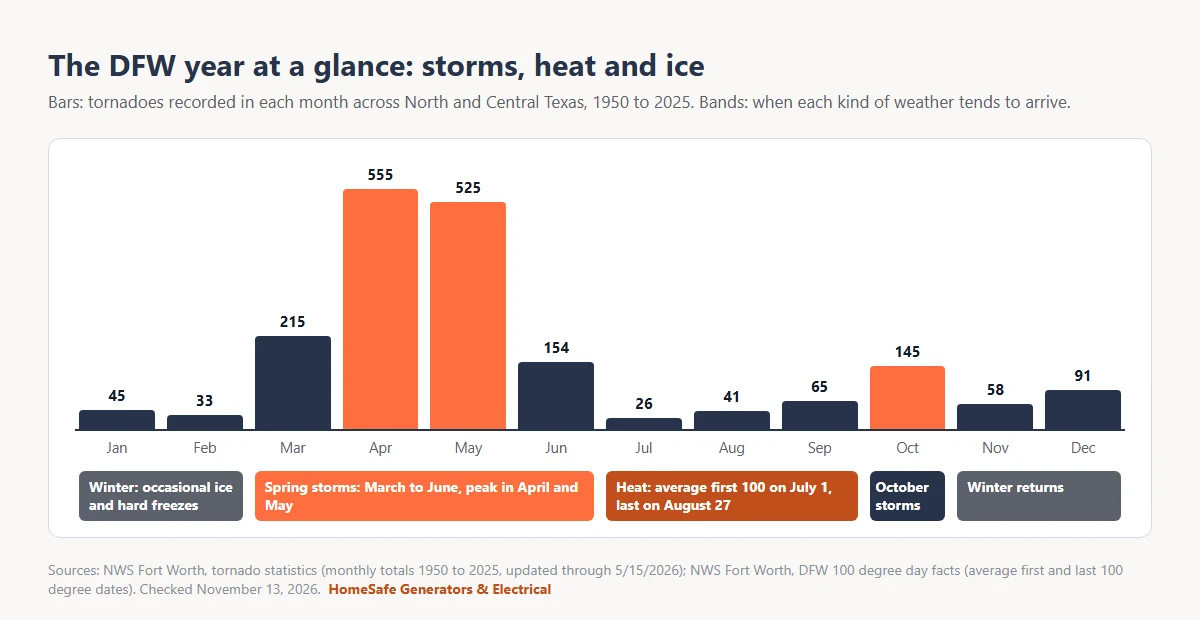
The task window column points to the seasonal readiness timeline, which has the full checklist for each window and a printable copy.
2. How to read this calendar
Two cautions before the months. First, the tornado counts come from the NWS Fort Worth office, whose area covers North and Central Texas. That is a larger region than the DFW metro, so the counts describe the region, not your street. Second, a count of events says how often something has been recorded. It does not say whether it will reach your home or your power line.
We also refer to statewide measures of utility reliability from the U.S. Energy Information Administration (EIA). They cover all of Texas, not DFW and not any single utility, so treat them as background.
3. January and February: winter ice and cold snaps
Winter in DFW is usually mild, with occasional freezing rain, sleet or a hard freeze. Ice is the winter condition most relevant to power, because ice on tree limbs and lines can bring them down locally. Storms are not only a spring subject either: the NWS table shows 45 tornadoes in January and 33 in February across North and Central Texas from 1950 to 2025.
The winter event most people remember is Winter Storm Uri in February 2021. The Texas Department of State Health Services’ final report gave an official toll of 246. It was an unusual event, and we mention it once, for context, not as a forecast for any given winter.
What to do in this season:
- Know where your main water shutoff is and how to protect exposed pipes.
- Have limbs that hang over your service line dealt with before winter, not during it. Limbs near power lines are a job for your utility (Oncor in much of DFW), not for you.
- Keep flashlights and a charged power bank where you can find them in the dark. Ready.gov recommends a flashlight for every household member.
- If you own a generator, confirm it starts and takes load. The maintenance guide explains what a service visit covers.
4. March: the season starts
March is when the NWS counts start to climb. From 1950 to 2025 the NWS Fort Worth area recorded 215 tornadoes in March, far above the 33 in February. Spring storms bring more than tornadoes, including hail and straight-line wind.
What to do in this season:
- Check that emergency alerts are switched on for your phone, and know your safe room.
- Look at your roof, gutters and trees. Loose limbs are a common cause of local line damage in wind.
- Book any generator service before April. A unit that has not run in months is better tested in a calm week than on the night of a storm.
- Walk your property and note where a generator could go. The placement guide covers clearances, slope and drainage.
5. April and May: the peak
This is the peak of the severe-weather year in North and Central Texas. The NWS Fort Worth monthly table for 1950 to 2025 shows 555 tornadoes in April and 525 in May. Together that is 1,080 of the table’s 1,953 total, about 55% (our arithmetic). June adds 154, then the count falls sharply.
The counts also vary a great deal by year. The NWS yearly totals on the same page show 76 tornadoes in 2015 and 12 in 2018, so a busy season in one year says little about the next.
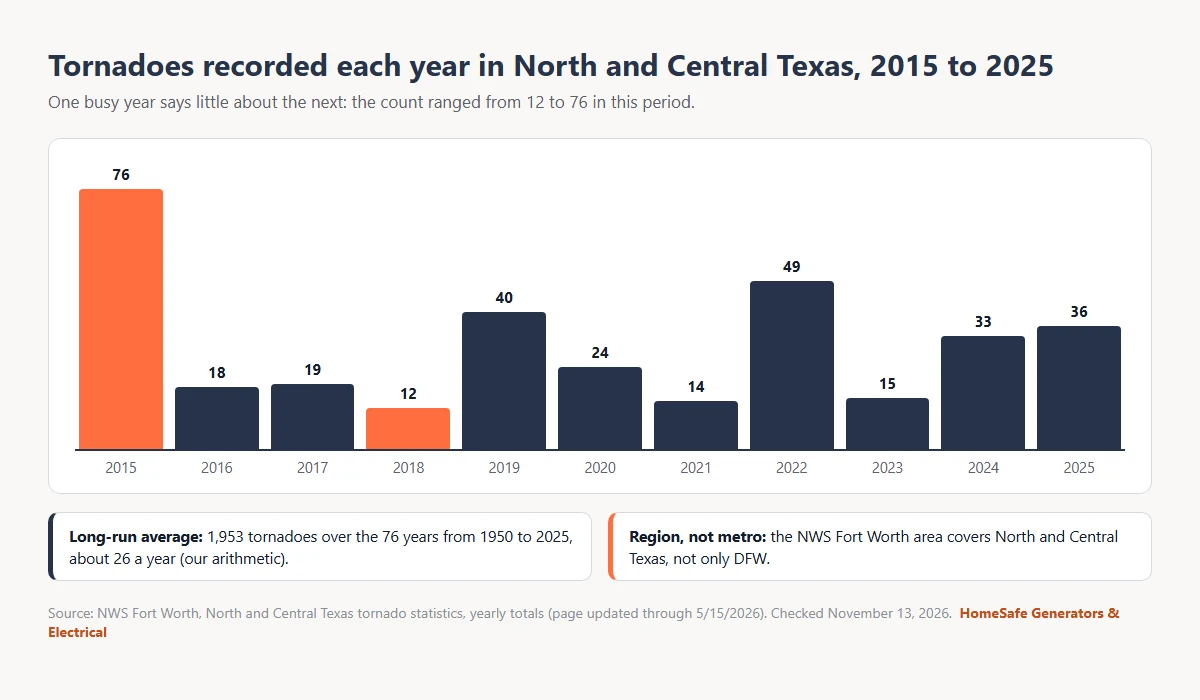
For power at home, spring storms matter mostly through wind, falling limbs and lightning on the lines. Whether a given storm reaches your power depends on where it tracks and how your local lines are exposed.
What to do in this season:
- Charge devices and fill the car’s fuel tank when a strong storm is forecast.
- Make sure everyone in the house knows where the breaker panel is.
- If you have a standby generator, it should already have been serviced. If you are still comparing options, the guide to the best generator for a power outage compares portable and standby units.
- Permits differ by city and every site is different, so it is better to decide before storm season than during it. The generator permit guide explains how permitting works across DFW cities such as Dallas, Fort Worth, Plano and Frisco.
6. June: late spring turns to summer
June still has 154 recorded tornadoes in the 1950 to 2025 table, then July drops to 26. That fall is the clearest seasonal edge in the data. By late June the conversation in DFW turns from storms to heat.
What to do in this season:
- Replace the air filter and have your air-conditioning system checked before the first run of triple-digit days.
- Review which circuits your household really needs in an outage. This is the same question generator sizing starts with, and the sizing planner walks through it.
7. July to September: heat
The summer story in DFW is heat more than storms. A normal year at DFW has about 20 days at or above 100 degrees, and the average first and last 100-degree days fall on July 1 and August 27 (NWS Fort Worth). The hottest years have run far beyond that; the full top ten, dated, is on the hazard data hub.
Heat matters for power because air conditioning is the largest load in most DFW homes. Losing it on a 105-degree afternoon is a different experience from losing power in April. The separate piece on triple-digit days covers the sizing side.
On the grid side, EIA figures show that on ordinary days Texas outage time is close to the U.S. average, and that rare, large events make the difference between years. Texas grid reliability explains the figures, and ERCOT conservation appeals covers the requests to save power you may hear about on the hottest days.
What to do in this season:
- Check on neighbors who are elderly or live alone during hot spells.
- Plan for the refrigerator and any medication that needs cooling. Our readiness timeline covers this.
- Decide in advance where you would go if the house became uncomfortable in a long outage, such as a relative’s home or a public cooling center.
8. October: the second, smaller storm season
October looks quiet but is a real secondary peak. The NWS table shows 145 tornadoes in October, well above September (65) and November (58). Homeowners who relax after summer are sometimes caught out by this.
What to do in this season:
- Service your generator, if you have one, before winter. HomeSafe’s maintenance plans place the annual visit in the fourth quarter.
- Clear leaves and debris from around the unit and from gutters.
- Test your flashlights and replace batteries in your smoke and carbon monoxide detectors.
9. November and December
November (58) and December (91) are quieter months for tornadoes, and December leads into the winter freeze season. The preparation is practical: refresh your outage kit, check your panel labels and, if you own a portable generator, make sure fuel is stored properly and the unit is ready to run outdoors.
10. The longer view: which weather does the most damage in Texas
NOAA’s National Centers for Environmental Information (NCEI) tracks the most damaging weather and climate events in each state, using its own loss threshold. For Texas from 1980 to 2024, severe storms are the largest category by a wide margin. They make up about two thirds of the events in each of the two tables on the NOAA page (our arithmetic; the page shows two totals and does not explain the difference, so we give no count). Drought is the next largest category. This is a statewide record that ends in 2024. It is a useful reminder that for Texas the dominant story is severe storms, but it does not describe DFW outages.
11. Where a standby generator fits, and where it does not
A standby generator is a good fit if outages in your area tend to last long enough to spoil food or leave the home uncomfortable, if you work from home, or if you want the house to carry on without any action from you. It starts automatically when the power fails. If someone in the home uses powered medical equipment, raise it early: backup for medical equipment is job specific and needs a job-specific review before any system is designed.
It is not the only answer. If outages where you live are short and rare, a portable generator, a power bank for devices and a cooler may be enough, and a larger investment would not buy you much. Some homes need nothing beyond a prepared kit. The guide to generators versus battery backup in DFW sets out the trade-offs. If you want a straight recommendation for your own home, including a smaller system if that covers it, book a free in-home assessment.
On timing: most installs are finished 3 to 5 weeks after the equipment arrives, and the work at your home usually takes one day. The permit office is the main variable, so a decision made in the fall or winter leaves room before the spring peak.
Sources
All checked November 13, 2026.
- NWS Fort Worth, North and Central Texas tornado statistics (monthly totals and yearly totals, 1950 to 2025; page updated through 5/15/2026): weather.gov/fwd/fwdtornadoes
- NWS Fort Worth, 1991 to 2020 normals (20 days a year at or above 100 degrees at DFW): weather.gov/fwd/1991-2020_normals
- NWS Fort Worth, DFW 100 degree day facts (average first and last 100-degree dates): weather.gov/fwd/d100info
- NOAA NCEI, Billion-dollar weather and climate disasters, Texas state summary (1980 to 2024): ncei.noaa.gov
- Texas DSHS, February 2021 winter storm mortality surveillance report, December 30, 2021: dshs.texas.gov
- Ready.gov, Power outages: ready.gov/power-outages
In this series: the DFW hazard data hub · triple-digit days in DFW · DFW winter ice events · storms and hurricane remnants · Texas grid reliability · ERCOT conservation appeals · the seasonal readiness timeline
Quick answers
What month has the most severe weather in Texas?
April and May, going by tornado records. NWS Fort Worth counts 555 tornadoes in April and 525 in May across North and Central Texas from 1950 to 2025. March and June are the next busiest months, and October is a smaller second peak with 145.
How many tornadoes does North Texas get in a year?
About 26 on the long-run average (our arithmetic from 1,953 tornadoes over 1950 to 2025), but single years vary widely. NWS Fort Worth’s yearly totals show 76 in 2015 and 12 in 2018. The counts cover North and Central Texas, not only the DFW metro.
When does DFW heat peak?
July and August. NWS Fort Worth puts the average first 100-degree day at DFW on July 1 and the average last on August 27, and a normal year has about 20 such days.
What is the best month to buy a generator?
Fall or winter, if you want it in place before the April and May storm peak. Most installs are finished 3 to 5 weeks after the equipment arrives, and the work at your home usually takes one day. The permit office is the main variable, so starting early leaves room.
Do I need a standby generator for DFW weather?
Not always. If outages where you live are short and rare, a portable generator and a prepared kit may be enough. A standby generator suits homes where longer outages, work from home or comfort make automatic power worth having, and homes with powered medical equipment after a job-specific review.
For a free in-home assessment, contact HomeSafe or call (817) 439-9009. HomeSafe holds Texas Electrical Contractor License #41809 and has a 5.0 rating across 200+ Google reviews.