
Last reviewed: November 2026
Every so often, a phone alert, a news banner or a text from a family member says that ERCOT is asking Texans to use less electricity. If you live in Fort Worth, Plano, Frisco, Colleyville, Keller or anywhere else in DFW and North Texas, the first reaction is often a quick question: is the power about to go out? The terms in these notices (Weather Watch, conservation appeal, Energy Emergency Alert) sound alike. They mean different things.
This guide explains them in plain English, using ERCOT’s own wording and thresholds. ERCOT is the Electric Reliability Council of Texas, which manages the flow of power on the Texas grid. In most of DFW, the poles and wires that reach your home belong to Oncor, so the guide also says which notices come from ERCOT and which come from your utility.
The short answer: a conservation appeal is a request to use less power, usually for a few evening hours, and it is not an outage notice. Every household can help during one without owning a generator. A standby generator suits some homes and is more than others need, and the end of the guide covers both sides.
1. What ERCOT is, and what it is not
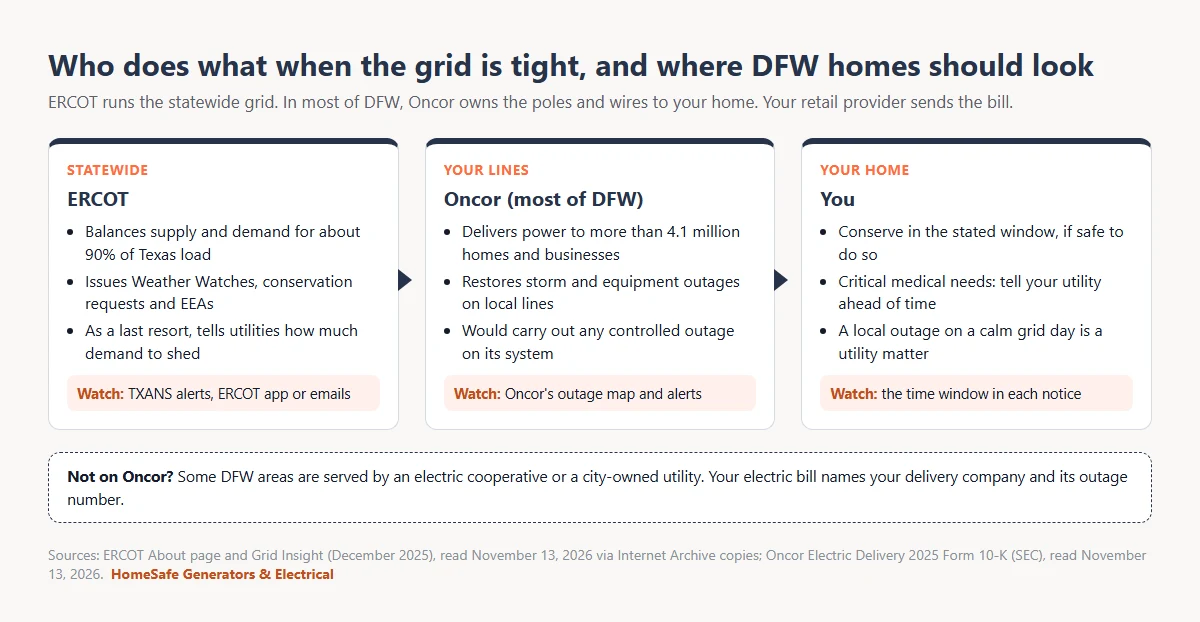
ERCOT manages the flow of electric power to more than 27 million Texas customers, about 90 percent of the state’s electric load (ERCOT, About ERCOT, read November 13, 2026). Its notices are about the grid as a whole. They talk about reserves, the grid’s margin of supply over demand. They are not reports on your street or your meter.
The wires are a separate job. Oncor operates the largest transmission and distribution system in Texas and delivers power to more than 4.1 million homes and businesses, in an area that includes Dallas, Fort Worth and the surrounding suburbs (Oncor 2025 Form 10-K, read November 13, 2026). Some parts of DFW are served by an electric cooperative or a city-owned utility instead. Your electric bill names your delivery company. Whoever it is, a fallen line or a local outage is theirs to fix, and their outage page is where you report it. For how often Texas homes lose power on an ordinary day, see the guide to Texas grid reliability.
ERCOT’s notices sit on a ladder. They begin with early information, move to requests for voluntary conservation, and only at the top become formal emergency alerts. ERCOT describes the levels on its Texas Advisory and Notification System (TXANS) page.
2. Weather Watch: the earliest notice
A Weather Watch is the first rung. ERCOT calls it an early notification, “approximately 3-5 days ahead”, of significant weather and higher demand. During a Weather Watch, ERCOT says, grid conditions are expected to be normal and there is enough supply to meet demand, though reserves may be lower (ERCOT Grid Insight, December 2025, read November 13, 2026).
In plain terms, a Weather Watch is a heads-up. A heat wave or a cold front is coming. Nothing is being asked of you yet. It is a good moment to check your own plans, and nothing more.
3. Voluntary Conservation Notice: the next step
ERCOT describes a Voluntary Conservation Notice as “a call for Texans to voluntarily reduce energy usage during peak demand”, if safe to do so. On the TXANS page it is linked to higher demand forecast with lower energy supply.
Reserves are the cushion of extra generation the grid keeps ready beyond what is in use. Lower reserves mean a thinner cushion. The request is voluntary. The words “if safe to do so” are part of ERCOT’s own wording.
4. Conservation Appeal: the one most people hear about
ERCOT describes a Conservation Appeal as “an elevated request for Texans to reduce their energy use” during peak demand periods. It moves to this level when there is a potential to enter emergency operations due to lower reserves.
Read that carefully. The appeal comes when there is a potential for emergency operations. It does not mean they have begun. It is an early request, so that enough people using a little less for a few hours can keep the grid from getting there. ERCOT also says TXANS notices “do not indicate emergency grid conditions are expected.” Each notice states its own time window, so read the window in the notice itself.
5. Energy Emergency Alerts: the formal levels
An Energy Emergency Alert (EEA) is a formal step in ERCOT’s operations. There are three levels. Each is tied to reserves or grid frequency falling below a set limit. The table puts the whole ladder in one place, with the triggers ERCOT publishes.
| Notice | ERCOT’s trigger | What ERCOT does | Is power cut? |
|---|---|---|---|
| Weather Watch | Significant weather and higher demand forecast, about 3 to 5 days ahead | Monitors and updates | No |
| Voluntary Conservation Notice | Higher demand forecast with lower energy supply | Asks Texans to conserve in a set window, if safe to do so | No |
| Conservation Appeal | Potential to enter emergency operations due to lower reserves | Elevated request to conserve; asks government offices to cut use | No |
| EEA Level 1 | Reserves below 2,500 MW, not expected to recover within 30 minutes | Brings on extra generation, including imports from neighboring grids (up to 1,220 MW) | No |
| EEA Level 2 | Reserves below 2,000 MW, not expected to recover within 30 minutes, or frequency below 59.91 Hz for 15 minutes | Requests conservation and deploys remaining demand response programs | No |
| EEA Level 3 | Reserves below 1,500 MW, or frequency below 59.8 Hz for any period | Can instruct transmission and distribution utilities to reduce demand through controlled outages | Possible |
Source: ERCOT Grid Insight, December 2025 and the TXANS page, read November 13, 2026. ERCOT updates these figures from time to time, so its own pages are the place to check.

Two points are worth knowing. EEA 1 is not an outage notice; ERCOT’s EEA 1 page asks anyone with critical medical needs to contact their local utility and have a backup plan in case controlled outages are needed later. And controlled outages belong to the top of the ladder. ERCOT decides how much demand must come off, and the utilities carry it out. In most of DFW that utility is Oncor, so its outage map is where you would see it.
6. What a tight-grid day looked like in DFW
Two recent summer days show how the ladder works in practice. On August 17, 2023, ERCOT issued a Voluntary Conservation Notice for 3 to 8 p.m., citing extreme temperatures, forecast high demand and lower reserves (ERCOT release, August 17, 2023, read November 13, 2026).
On September 6, 2023, ERCOT issued a conservation appeal for 6 to 9 p.m. Reserves kept falling, and it moved into emergency operations at EEA 2. Its release that evening said: “there are no power outages associated with the ERCOT power grid” (ERCOT release, September 6, 2023, read November 13, 2026). For a home in Tarrant, Dallas, Collin or Denton County, the grid notices on those days were requests, not outages. That is the usual pattern. The month-by-month picture of when heat peaks is in the guide to triple-digit days in DFW.
7. How an appeal differs from rotating outages
The table below puts the two side by side, using ERCOT’s descriptions.
| Conservation Appeal | Rotating (controlled) outages | |
|---|---|---|
| What it is | A request to use less power | A service interruption ordered by ERCOT and carried out by utilities |
| Who acts | Households and businesses, voluntarily | Transmission and distribution utilities, such as Oncor |
| Ladder position | Below the emergency alerts | EEA 3 only, as a last resort |
| Is it an outage? | No, it is a request | Yes, for the customers affected |
The first row is the key idea. An appeal asks for a little less demand for a limited time. It does not switch anything off.
8. What ERCOT asks households to do
ERCOT’s TXANS page and its releases suggest small, practical steps, always “if safe to do so”:
- Raise the thermostat a degree or two if you are comfortable.
- Postpone running large appliances such as dishwashers, washers and dryers. Run pool pumps early in the morning or overnight instead.
- Turn off lights and electronics you are not using.
You can do each of these with no equipment at all. The pattern is the same: shift what you can outside the window, and keep comfort and safety first. If someone at home relies on medical equipment, or would be put at risk by a warmer house, do not follow a conservation request where it is not safe. That is what ERCOT’s “if safe to do so” means. ERCOT also suggests telling your local electric utility about any critical medical needs ahead of time.
9. What an appeal does and does not mean for you
An appeal does mean the grid is tighter than ERCOT would like for a limited period, and your help is requested. It does not mean your power is off, that an outage is scheduled, or that one is certain to follow. It is also not a statement about the lines at your home. Local outages from storms, falling limbs or equipment faults come from your local utility, not from a grid-wide alert.
For how DFW weather and the grid fit together, see the guide to DFW seasons of risk, the record of winter ice events and the look at storms and hurricane remnants. The shared figures for the whole series sit in one dated place, the DFW hazard data hub.
10. A simple household plan for an appeal
You can prepare for the notice itself in about ten minutes, long before one arrives.
- Decide which appliances you can run earlier in the day, such as laundry and the dishwasher.
- Know your thermostat plan: a degree or two is the kind of change ERCOT mentions.
- Keep a phone charger and a flashlight where you can find them. The readiness timeline lists what to check each season.
- Check on neighbors who may need help if the house gets warm.
- Bookmark your utility’s outage page, such as Oncor’s outage map, in case a local outage happens for an unrelated reason.
11. Where a standby generator fits, and where it does not
A conservation appeal alone is not a reason to buy a generator. You can take part with a thermostat and a few habits. If outages where you live are short and rare, a portable generator, a battery power bank for devices and a cooler may cover you. Some homes need nothing beyond a prepared kit.
A standby generator makes more sense if outages in your area tend to last long enough to spoil food or leave the home uncomfortable, if you work from home, or if you want the house to carry on without any action from you. It starts on its own when the power fails. If someone at home relies on powered medical equipment, backup for it needs a job-specific review before any plan is made. The sizing planner shows how the size is worked out, and the guide on whether a whole-house generator is worth it covers the trade-offs.
If you want a straight recommendation for your own home, HomeSafe offers a free in-home assessment. It looks at your panel, your gas supply and where a unit could go, and if a smaller system covers the need, we say so. How it works sets out each step. This guide covers ERCOT’s grid notices for homes; it does not cover business demand-response programs or electricity plans and pricing.
In this series: the DFW hazard data hub · seasons of risk in DFW · triple-digit days in DFW · DFW winter ice events · storms and hurricane remnants · Texas grid reliability · the seasonal readiness timeline
Quick answers
What is an ERCOT conservation appeal?
A request to use less power. ERCOT calls it an elevated request for Texans to reduce energy use during peak demand, if safe to do so. It is issued when there is a potential to enter emergency operations due to lower reserves, and each appeal names its own time window.
Does a conservation appeal mean my power will go out?
No. An appeal is a request, not an outage notice and not a forecast of one. ERCOT says its TXANS notices do not indicate that emergency conditions are expected. Controlled outages are possible only at Energy Emergency Alert Level 3, the top of the ladder.
Does ERCOT cover all of Texas?
No. ERCOT manages power for more than 27 million Texas customers, about 90 percent of the state’s electric load. Some parts of the state are on neighboring grids. Most of DFW, including Oncor’s service area, is on the ERCOT grid.
Are there rolling blackouts in Dallas?
No, not as a routine. Controlled outages are ERCOT’s last resort, used only at Energy Emergency Alert Level 3, when reserves fall below 1,500 MW. Even on September 6, 2023, when ERCOT reached EEA 2, it reported no outages tied to the grid. Local outages from storms or equipment are a separate matter for your utility.
Do I need a generator to take part in an appeal?
No. Raising the thermostat a degree or two, delaying large appliances and switching off unused lights are things any household can do. A standby generator suits some homes, and a portable unit, a battery kit or simple preparation may be enough for others.
For a free in-home assessment, contact HomeSafe or call (817) 439-9009. HomeSafe holds Texas Electrical Contractor License #41809 and has a 5.0 rating across 200+ Google reviews.
Sources
- ERCOT, About ERCOT: https://www.ercot.com/about
- ERCOT, Texas Advisory and Notification System (TXANS): https://www.ercot.com/txans
- ERCOT, Grid Insight: Grid Conditions Notifications (December 2025): https://www.ercot.com/files/docs/2025/12/17/ERCOT-Grid-Insight-Grid-Conditions-Notifications.pdf
- ERCOT, Conservation Appeal: https://www.ercot.com/conservation
- ERCOT, Voluntary Conservation Notice: https://www.ercot.com/vcn
- ERCOT, Energy Emergency Alert 1: https://www.ercot.com/energyemergone
- ERCOT news release, Voluntary Conservation Notice (August 17, 2023): https://www.ercot.com/news/release/2023-08-17-ercot-issues-voluntary
- ERCOT news release, EEA Level 2 (September 6, 2023): https://www.ercot.com/news/release/2023-09-06-ercot-has-initiated
- Oncor Electric Delivery Company LLC, Form 10-K for 2025 (SEC): https://www.sec.gov/Archives/edgar/data/1193311/000119331126000007/c311-20251231x10k.htm
- Oncor outage map: https://stormcenter.oncor.com/