
Last reviewed: November 2026
If you live in Fort Worth, Plano, Frisco, Colleyville or Keller, you probably remember a winter morning when the roads were glazed and school was canceled. Those memories are hard to compare. Each of us remembers the worst day we lived through.
This guide puts nine winter events side by side, each with a date and the effects the National Weather Service (NWS) Fort Worth office itself reports. It uses only what is written on the NWS pages, plus the Texas Department of State Health Services and one federal report on the February 2021 outages.
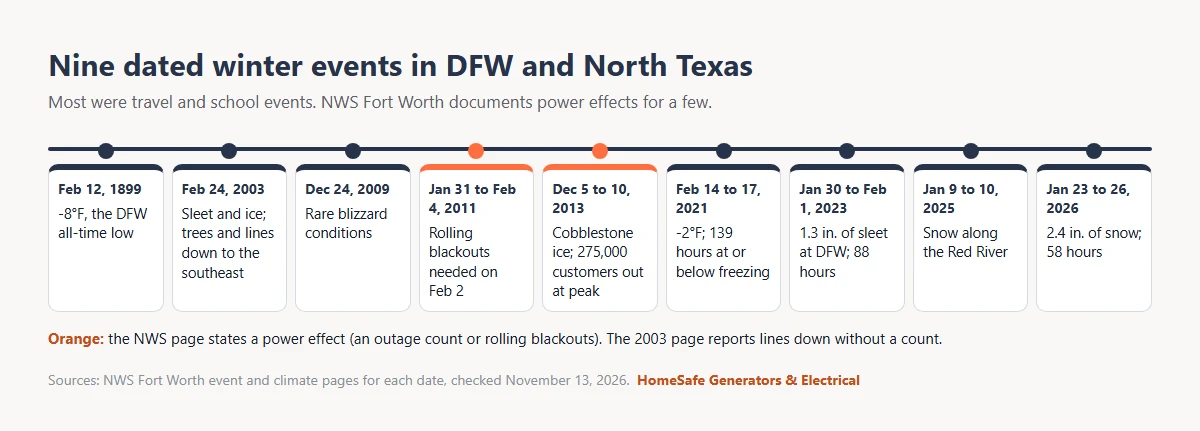
The short answer: the nine events differ a lot. Several were mostly a travel problem. A few are documented with power effects: rolling blackouts in February 2011, and 275,000 North Texas customers without power at the peak of the December 2013 ice storm. Whether a standby generator fits your home depends on how your own lines have fared, and the end of the guide covers where one does and does not fit at the end.
1. How to read this list
The list is not complete. NWS Fort Worth’s Significant North Texas Snow and Ice Events page and its Past Event Summaries index list many more dates. The events chosen are those with a dedicated NWS page or a written entry with an impact. Counts, such as inches of sleet, are for the airport or place named, not for your street. The NWS area covers North and Central Texas, so some entries come from counties outside the DFW metro, and that is noted.
NWS Fort Worth makes one general point worth having first. On its winter weather page it says freezing rain and sleet “can and often do impact North Texas more frequently and more severely” than snow. It calls heavy snow “a somewhat rare event.” That is a statement, not a count.
| Date | Type | DFW-area figure the NWS gives | Power effect stated |
|---|---|---|---|
| February 12, 1899 | Arctic cold | -8°F at DFW, the all-time low | None stated |
| February 24, 2003 | Sleet and ice | 1 to 1.5 inches of mainly sleet in central North Texas | Trees and power lines down in the southeast, no count |
| December 24, 2009 | Blizzard conditions | DFW’s first measurable Christmas Eve snow | None stated |
| January 31 to February 4, 2011 | Ice, sleet, snow | Up to 3/4 inch of ice in some counties | Rolling blackouts needed on February 2 |
| December 5 to 10, 2013 | Cobblestone ice | 1.25 inches of liquid at DFW Airport | 275,000 customers without power at the peak |
| February 14 to 17, 2021 | Arctic outbreak and snow | -2°F; 139 hours at or below freezing | Statewide controlled outages (section 7) |
| January 30 to February 1, 2023 | Sleet and ice | 1.3 inches of sleet; 88 hours at or below freezing | Ice on lines pictured, no figure |
| January 9 to 10, 2025 | Snow | 9 to 11 inches in Cooke and Grayson counties | None stated |
| January 23 to 26, 2026 | Mixed precipitation | 2.4 inches of snow; 58 hours at or below freezing | None stated |
2. February 1899: the coldest day on the DFW record
NWS Fort Worth lists the all-time low at DFW as -8 degrees Fahrenheit on February 12, 1899. The February 2021 outbreak reached -2 degrees on February 16, 2021, which the same page ranks second, tied with January 31, 1949. 1899 is included for scale, not as a prediction. It is the benchmark later cold outbreaks are measured against.
3. February 24, 2003: sleet and ice
The NWS page for this sleet and ice storm reports “3 to 4 inches of sleet and snow” at several northern locations. Central North Texas had 1 to 1.5 inches of mainly sleet. In the south and southeast, ice built up between 1/4 and 3/4 inch. The ice “caused numerous trees and power lines to fall, especially in Leon and Roberston [sic] Counties,” with no outage count. The page also records numerous traffic accidents, delays at D/FW Airport, and schools that sent students home early or canceled the next day’s classes.
4. December 24, 2009: rare blizzard conditions
The NWS climatology page for December 24 says that in 2009 “rare blizzard conditions” affected parts of North Texas. As much as 9 inches of snow fell in Jacksboro and Bowie, and winds over 50 mph made 3 to 5 foot drifts. It was DFW’s first measurable Christmas Eve snowfall on record.
5. January 31 to February 4, 2011: two storms in one week
NWS Fort Worth describes the first week of February 2011 as “plagued with two winter weather events and persistent cold temperatures” (North Texas Snowfall Events). The first storm began late on January 31 and ended the morning of February 1. Before the snow, rain, freezing rain and sleet “provided a sheet of ice underneath the snow.” Snow of 5 to 8 inches fell in the northwestern counties. Elsewhere, up to 3/4 inch of ice and 2 inches of sleet were reported.
Schools and businesses were shut for days, and “rolling blackouts were needed on the 2nd.” A second storm on February 3 and 4 brought 6 to 9 inches of snow to the far northeast. The page says its impacts were minimal, because the area was already in the cold spell.
6. December 5 to 10, 2013: the cobblestone ice storm
NWS Fort Worth’s page for this storm titles it December 5 to 7, while its text says it ran from “December 5th through the 10th.” Freezing rain, sleet and a little snow began on the afternoon of December 5. Temperatures stayed below freezing for most of the next five days. Sleet and ice measured as deep as 5 inches in some areas, and DFW Airport observed 1.25 inches of liquid. The hardened “cobblestone ice” reached up to 4 inches deep where traffic left peaks and valleys in the slush.
The page reports that “at the peak of the storm, 275,000 customers were without power in the North Texas region.” Hundreds of cars and trucks were stranded on main highways. Airlines at DFW and Dallas Love Field canceled hundreds of flights. Most schools in the hardest-hit areas closed for several days. This is the clearest documented ice-and-power event of the nine.
7. February 14 to 17, 2021: the arctic outbreak and Winter Storm Uri
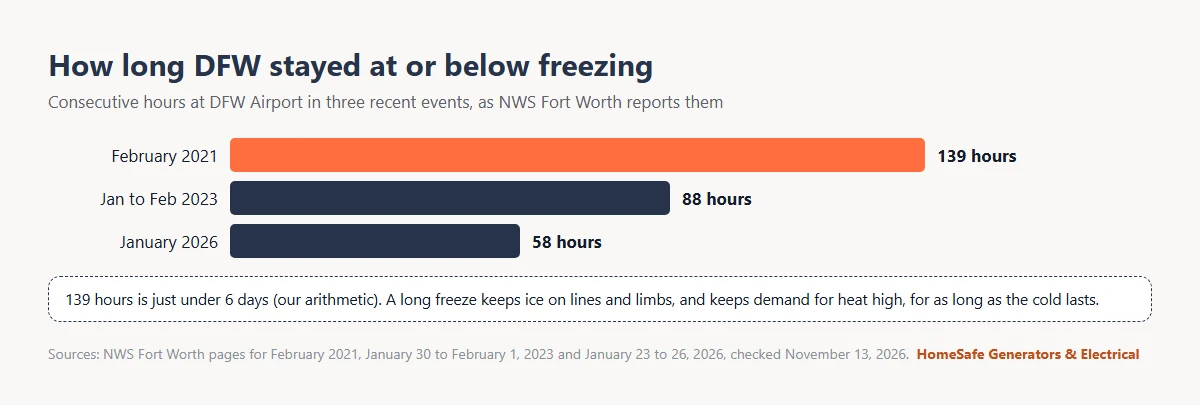
NWS Fort Worth reports official snowfall of 5.0 inches at DFW Airport, “the highest event total in more than a decade” (NWS, February 2021). DFW fell to -2 degrees on February 16. It stayed at or below freezing for 139 hours, from 5 p.m. on February 13 to noon on February 19. On February 15, DFW’s high “was lower than the record low for the date.” Winter Storm Warnings covered the entire state on February 14.
The power side was statewide. A federal staff report found that more than 4.5 million people in Texas lost power, some for as long as four days. Three-quarters of the generating unit outages, derates and failures to start came from freezing issues (44.2 percent) or fuel issues (31.4 percent), mainly natural gas supply (FERC, NERC and Regional Entity staff report, November 2021). What has changed since is in the guide to Texas grid reliability.
The Texas Department of State Health Services reports that, as of October 27, 2021, it had confirmed 246 deaths as winter storm-related. That is the official figure, from the state’s report dated December 31, 2021.
8. January 30 to February 1, 2023: sleet and ice
NWS Fort Worth reports that this event ran across much of North and Central Texas from Monday, January 30 through Wednesday, February 1. The heaviest precipitation came from January 31 into the morning of February 1. DFW Airport recorded 1.3 inches of sleet, and the NWS received “several reports of ice accumulations of 0.5″” (half an inch). DFW stayed at or below freezing for 88 hours.
The page reports “several hundreds traffic accidents across the region.” From January 30 to February 3, there were 3,544 flight cancellations at DFW and 982 at Dallas Love Field. It shows photographs of ice on power lines but gives no outage figure.
9. January 9 to 10, 2025: snow along the Red River
The NWS entry says “multiple rounds of measurable snow fell within a 24-hour period, mainly along and north of the I-20 corridor.” Totals “exceeded 6 inches along the Red River,” including isolated amounts of 9 to 11 inches in Cooke and Grayson counties. The entry states no impacts, so none is added.
10. January 23 to 26, 2026: the most recent event
The NWS page describes “widespread mixed precipitation” across North and Central Texas. DFW Airport’s official snowfall was 2.4 inches over January 24 and 25. DFW stayed at or below freezing for 58 consecutive hours from 1 a.m. on January 24, and set a record low maximum of 21 degrees on January 25. The page reports widespread hazardous travel, school and business closures, and an FAA-sourced estimate of about 5,859 flight cancellations from January 23 to 28.
11. What the list shows, and what it does not
Read together, the effects the NWS states are mostly travel, flights and schools. The documented power effects are in 2003 (trees and lines in the southeast), 2011 (rolling blackouts), 2013 (275,000 customers) and the statewide outages of 2021. That is a reading of nine events, not a rate. A printable copy of the timeline below is available to download.
12. Ice, cold and your power in DFW
Ice is the winter condition most tied to power on these pages: it brought down trees and lines in 2003 and left 275,000 customers without power in 2013. A long freeze keeps that ice in place, so hours below freezing are worth watching. Heat demand also stays high for as long as the cold lasts, which is when ERCOT issues its grid notices; the guide to ERCOT conservation appeals explains each one.
If the lights go out on your street, the repair is your delivery utility’s job. In most of DFW that is Oncor, whose outage map shows current outages and is the place to report one. Winter is short in DFW, and summer brings its own demand; see triple-digit days in DFW and the seasons of risk calendar for the year as a whole.
13. Where a standby generator fits, and where it does not
The list shows power effects in some events and none described in others. If outages where you live have been short, a portable generator used safely outdoors, warm layers, a power bank and some stored water and food may be enough. Some homes need nothing beyond a prepared kit. The guide on whether a whole-house generator is worth it walks through the trade-offs.
A standby generator suits homes where long outages would be hard to manage, or where you want heat and the refrigerator to keep running without any action from you. It runs on natural gas or propane and starts automatically. If someone relies on powered medical equipment, that backup needs a job-specific review before any plan is made. HomeSafe offers a free in-home assessment that looks at your panel, your gas supply and where a unit could go, and if a smaller system covers your needs, we say so. To size your own loads first, use the sizing planner.
Before the next cold snap, the readiness timeline lists what to check, and the DFW hazard data hub holds the shared figures for the series. This guide covers winter weather and power; it does not cover frozen pipes, roads or travel advice.
In this series: the DFW hazard data hub · seasons of risk in DFW · triple-digit days in DFW · storms and hurricane remnants · Texas grid reliability · ERCOT conservation appeals · the seasonal readiness timeline
Quick answers
Why did Texas lose power during the winter storm?
Mostly frozen equipment and fuel shortages at power plants. In February 2021, freezing issues caused 44.2 percent and fuel issues 31.4 percent of generating unit outages, derates and failures to start, according to the FERC and NERC staff report. With too little supply, ERCOT ordered controlled outages.
How long did Texas go without power?
Up to four days for some homes in February 2021. The FERC and NERC staff report found that more than 4.5 million people in Texas lost power, some for as long as four days, while temperatures stayed below freezing for more than six days.
Is Dallas having power outages?
Oncor’s outage map shows it live. Oncor delivers power to most of Dallas and DFW, and its map lists current outages and lets you report one. If you are served by a cooperative or a city-owned utility, use that utility’s outage page.
What was the worst ice storm in DFW history?
December 2013 is the best documented. NWS Fort Worth reports 275,000 customers in the North Texas region without power at the peak, with sleet and ice up to 5 inches deep in places.
How cold has DFW ever been?
-8 degrees Fahrenheit, on February 12, 1899, per NWS Fort Worth. February 2021 reached -2 degrees on February 16, and DFW stayed at or below freezing for 139 hours that week.
Do I need a standby generator for winter weather?
No, not always. If outages where you live have been short, a portable generator, a power bank and a prepared kit may be enough. A standby generator suits homes where longer outages, a home office or the need for automatic heat and refrigeration make it worthwhile.
For a free in-home assessment, contact HomeSafe or call (817) 439-9009. HomeSafe holds Texas Electrical Contractor License #41809 and has a 5.0 rating across 200+ Google reviews.
Sources
All pages checked November 13, 2026.
- NWS Fort Worth, Winter weather (records and general statement): https://www.weather.gov/fwd/winterwx
- NWS Fort Worth, Past Event Summaries (index): https://www.weather.gov/fwd/events
- NWS Fort Worth, Significant North Texas Snow and Ice Events: https://www.weather.gov/fwd/dsnows
- NWS Fort Worth, North Texas Snowfall Events, including January 31 to February 4, 2011: https://www.weather.gov/fwd/snowevents
- NWS Fort Worth, Major Sleet/Ice Storm, February 24, 2003: https://www.weather.gov/fwd/sleetice2003
- NWS Fort Worth, Climatology for December 24: https://www.weather.gov/fwd/ddec24
- NWS Fort Worth, Cobblestone Ice, December 2013: https://www.weather.gov/fwd/december72013
- NWS Fort Worth, Historic Winter Storm and Arctic Outbreak, February 2021: https://www.weather.gov/fwd/Feb-2021-WinterEvent
- NWS Fort Worth, Sleet and Ice Event, January 30 to February 1, 2023: https://www.weather.gov/fwd/jan-feb2023
- NWS Fort Worth, Winter Storm, January 23 to 26, 2026: https://www.weather.gov/fwd/january2026
- Texas DSHS, February 2021 Winter Storm-Related Deaths report (dated December 31, 2021; data as of October 27, 2021): https://www.dshs.texas.gov/sites/default/files/news/updates/SMOC_FebWinterStorm_MortalitySurvReport_12-30-21.pdf
- FERC, NERC and Regional Entity Staff Report, The February 2021 Cold Weather Outages in Texas and the South Central United States (November 2021): https://nerc.com/pa/rrm/ea/Documents/February_2021_Cold_Weather_Report.pdf
- Oncor outage map: https://stormcenter.oncor.com/