
Last reviewed: November 2026
Almost every homeowner who decides to install a standby generator asks the same thing within the first few minutes: where does it go? It sounds like a detail. In practice it is one of the first and most consequential decisions in a DFW installation, because the spot you choose sets the length of the gas line and the electrical run, whether the unit clears your windows and your neighbor’s, how your HOA reacts, and whether rain can reach it.
DFW lots make the question harder than it looks. Many are small. Side yards can be a few feet wide. The gas meter is often on one side of the house, the electric meter on another and the main panel in the garage. Drainage, mature trees, pools, patios and a neighbor’s bedroom window all have a say. The question comes first at almost every visit, and a homeowner who understands the trade-offs makes better decisions at the kitchen table than one who finds out at the permit counter.
This guide is for homeowners in Fort Worth, Southlake, Argyle, Highland Park and across DFW who are planning an installation, or deciding whether their lot can take one. The short answer: a standby generator can go on most lots, but where it can go is set by three things at once, the manufacturer’s clearances (typically 5 feet from windows and doors and 18 inches from the wall for models rated for it), your city’s rules, and the layout of your house and utilities. If you live under an HOA, Texas law limits what the association can ban, though it can still have a say on screening and location.
The guide covers what to measure, what to ask your city and HOA, and what to expect when the property is walked. It does not cover where to run a portable generator, which has its own safety distance, and it is not legal advice: for that, read the law and your HOA documents, or ask a lawyer. The guide to generator permits in DFW covers the permit side.
1. What a good generator spot has to do
- Sit far enough from windows, doors and vents that exhaust cannot find its way inside.
- Sit close enough to your gas meter, electric meter and main panel that the pipe and wire runs stay short.
- Stay level and dry, with water directed away from it.
- Stay out of the neighbors’ sightlines and your HOA’s view corridors.
- Leave room for a technician to open the enclosure and service the unit for years.
These goals pull against each other. A gas meter under a bedroom window is a common example, which is why the lot is walked before any spot is recommended.
2. Clearances from your house, windows and doors
Manufacturers publish minimum distances, and they are the first filter. Generac’s guidance lists the minimums below and attributes them to NFPA 37, the National Fire Protection Association’s standard for stationary engines (Generac, clearance requirements, updated March 16, 2026). Champion’s published guidance matches the two numbers it covers (Champion, HSB clearance). Kohler’s installation drawing for its 24kW liquid-cooled model adds its own figures (Kohler installation manual TP-7202, drawing ADV-9758). All three were checked November 13, 2026.
| Distance | What it applies to | Who publishes it |
|---|---|---|
| 5 feet | From openings in walls: windows, doors, vents and window wells | Generac; Champion; Kohler (from the exhaust end) |
| 18 inches | From the back of the generator to the wall, for models tested for close clearance | Generac (models with the SwRI mark); Champion; Kohler, “per NFPA 37” |
| 5 feet | Clear space above the generator | Generac |
| 3 feet | Clear space at the front and both ends, including trees and shrubs | Generac |
| 4 feet | No plants, shrubs or other combustibles beyond the exhaust end | Kohler 24RCLA |
| 10 feet | Furnace and similar air intakes, from the exhaust end | Kohler 24RCLA |
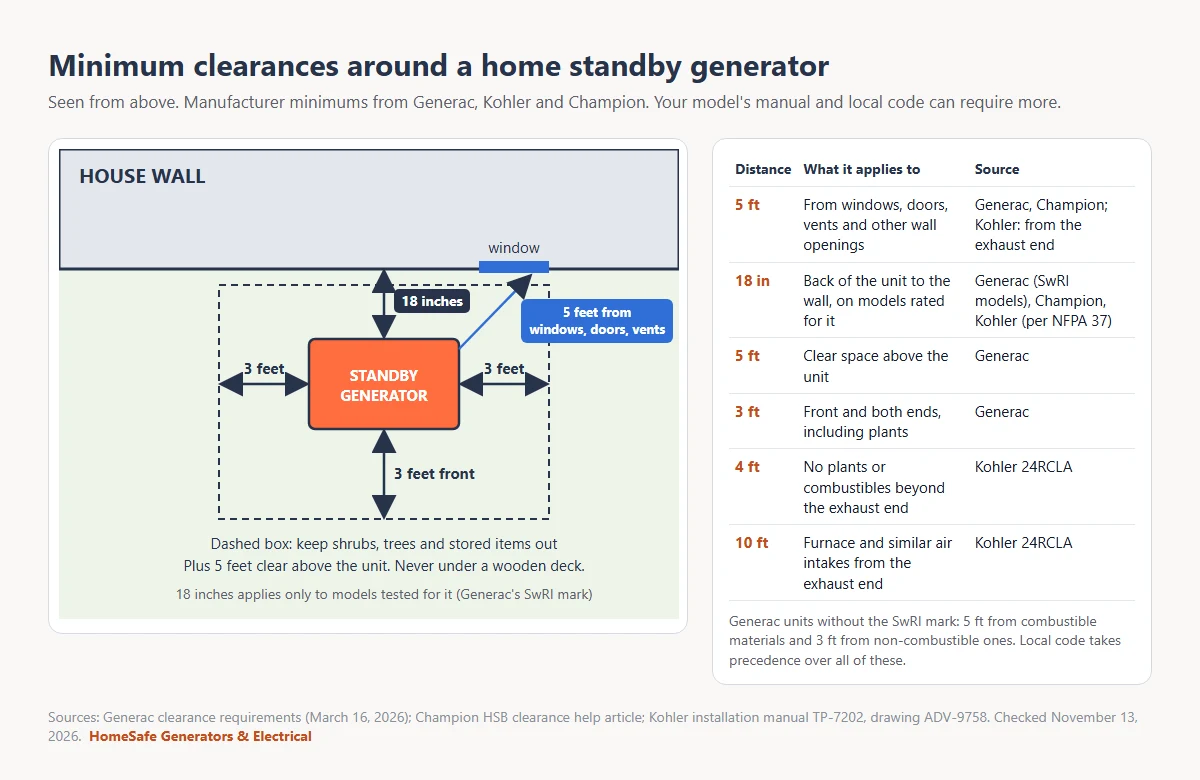
Treat these as minimums, not targets. Three details matter:
- The 18-inch figure applies only to models tested for reduced clearance. Generac units without the SwRI mark must sit 5 feet from combustible materials and 3 feet from non-combustible ones.
- Generac also notes a unit may need to sit farther from the house than the minimum, because carbon monoxide can still enter through small gaps around windows, soffits and pipes. Kohler asks for carbon monoxide detectors on each level of an adjacent building.
- Generac says not to install a standby generator under a wooden deck or platform, and Kohler says not to place one near patios, decks or play areas.
Local code takes precedence over all of it. Every brand’s installation manual has its own clearance table, so the work follows the manual for the exact model on your quote, whether it is a Generac, a Kohler or a Champion. If you are still choosing a brand, Generac vs Kohler vs Champion compares them.
A spot that passes on paper is not always the spot to choose. A few extra feet between the unit and a bedroom window are worth more than an argument about inches with an inspector.
3. Why distance to your meters and panel matters
Every foot between the generator and your gas meter is more pipe. Every foot between the generator and your panel is more wire and conduit, and often more trenching. Champion’s guidance makes the same point: keep the unit near the fuel meter, the electric meter or the main panel to hold installation cost down, because longer runs mean trenching. Kohler’s manual says to install the unit near the incoming gas service.
That is one reason neighbors can get different quotes for the same generator; what drives home generator cost explains the other drivers. The shortest run is not always the best spot. If it puts the unit under a window, the better plan is to move it and accept the longer run.
Two practical notes. First, the pad, the gas line and the conduit all need to reach the same spot, so a location that is easy for the gas can be hard for the electric. Second, anything buried needs to be located before anyone digs. In Texas that means requesting a utility locate, a free call to 811, before a trench is opened, and HomeSafe also runs a dig test before any electrical or gas trenching begins, so what is underground is known before anything is cut.
4. Slope, drainage and low corners
A standby generator sits on a level pad and needs to stay dry. Generac’s guidance is to direct sprinklers, roof runoff, downspouts and sump pump discharge away from the enclosure, and Kohler’s manual says the location must not be subject to flooding. On many DFW lots, that means walking the property after a rain and looking at where water goes, not just where it should go.
Heavy clay soil, common in parts of Tarrant County, holds water. A low corner that looks fine on a dry day can pond in a storm, so mention it if your lot has a swale or a history of standing water.
After the 2016 Iowa floods, FEMA’s mitigation team found that backup power systems raised above flood level after earlier floods generally performed very well. FEMA’s advisory also notes that current codes referencing the ASCE 24 flood standard require equipment and utilities in buildings in identified flood-risk areas to be elevated or floodproofed. If your home sits in a mapped flood zone, ask your city what it requires before choosing a spot. Source: FEMA Recovery Advisory RA5, Flood Protection for Backup and Emergency Power Fuel Systems (April 2017), checked November 13, 2026.
5. Setbacks from the property line
There is no single setback rule for DFW, and no manufacturer publishes a property-line distance. The clearances above come from the manufacturer; the setbacks come from your city and your lot.
Your city may require a minimum distance from the property line, and utility easements usually cannot be built on. Those numbers change from city to city and often from neighborhood to neighborhood, so ask your city for the figure that applies to your lot. A lot in Collin County can follow different rules than one in Tarrant, Denton or Dallas County.
Some cities run their own review. Highland Park and University Park are independent municipalities with their own building departments, and University Park has detailed standards for generator placement and enclosure appearance. The Town of Westlake runs its own permit and inspection process, and its larger lots change the placement question (see the Westlake page). Dallas and Fort Worth are usually the quickest to issue a residential generator permit; Highland Park, University Park, Flower Mound, Frisco, Plano and Southlake take longer. The permit guide explains what is being permitted and how review differs city by city.
6. HOA rules in Texas
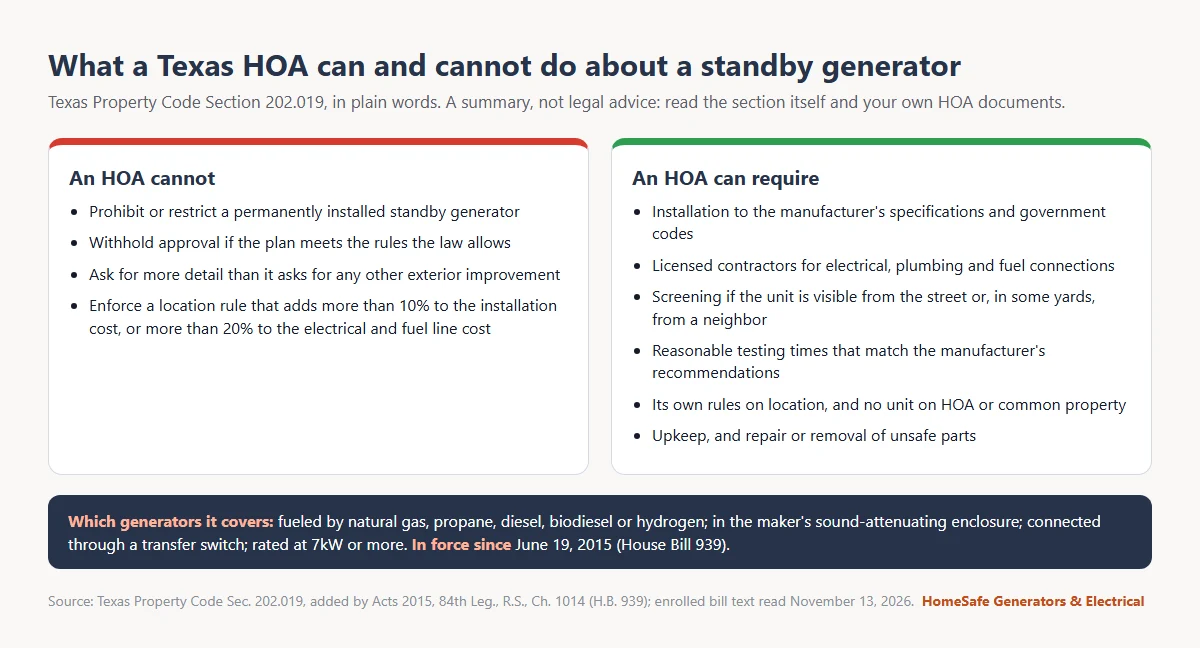
An HOA approves a generator separately from your city permit. In Texas, what it can decide is set by Texas Property Code Section 202.019, added by House Bill 939 and in force since June 19, 2015 (enrolled text read November 13, 2026; the current code is on the Texas Legislature’s statutes site). In plain words:
- An association may not prohibit or restrict an owner from owning, installing, operating or maintaining a permanently installed standby generator. The law covers units fueled by natural gas, propane, diesel, biodiesel or hydrogen, in the maker’s sound-attenuating enclosure, connected through a transfer switch and rated at 7kW or more.
- It may require installation to the manufacturer’s specifications and government codes, licensed contractors for electrical, plumbing and fuel connections, upkeep, screening when the unit is visible from the street or, in some side and rear yards, from a neighbor, and reasonable testing times that match the manufacturer’s recommendations.
- It may regulate location and keep units off association or common property. A location rule cannot be enforced if it adds more than 10% to the cost of installing the generator, or more than 20% to the cost of the electrical and fuel lines.
- If approval is required, it may not be withheld when the plan meets the rules the law allows, and the application may not ask for more detail than for any other exterior improvement.
In practice, an architectural review committee often asks for a site plan showing where the unit will sit, the model and its published sound information, a screening plan (a fence, planting or an enclosure) and proof that the contractor is licensed and insured. For published sound figures, the Kohler guide carries the makers’ numbers with sources. Plan the HOA submission before the permit, because a changed location after approval can mean going back through both.
To be fair about the trade-off: the law limits what an HOA can ban, but a location rule can still push the unit away from the easiest spot. A longer gas or electrical run costs more, within the limits above. The sales visit looks at the places a unit could realistically go, including what your HOA will allow, before anything is filed. Southlake, Colleyville, Westlake and many neighborhoods in Frisco and Plano have active associations, so ask for your HOA’s guidelines early.
7. Natural gas, propane and where the fuel comes from
Most suburban DFW homes in Plano, Frisco and Southlake are on a natural gas main, so the fuel question is mainly about the meter and the line. The meter’s capacity and the pipe size also feed into whether the generator you want can be supported, which is one reason sizing and placement are decided together. The guide to sizing a generator covers the sizing side.
Where there is no gas main, the generator runs on propane, and the tank becomes part of the placement puzzle. It needs its own clearances, a way for a delivery truck to reach it and a spot that does not spoil the view. That is common on acreage, covered below.
8. Noise and neighbors
Sound is a placement question too. Every standby generator runs a short scheduled self-test, so think about which neighbor’s bedroom window faces your preferred spot, and where your own bedrooms are. Facing the unit toward a fence, a garage wall or a side yard with no windows usually helps more than any adjustment after the fact. At startup, ask to hear the unit run from the places you care about. The guide to how a standby generator works explains the scheduled test cycle.
9. Acreage lots: Argyle and beyond
On acreage, the best spot is often not next to the house. Argyle properties may carry a well pump, a barn or a shop, and the generator has to serve those loads without a long run to each one. Some Argyle properties are not on a natural gas main, which makes propane and tank placement part of the plan, and the electric utility can be Oncor or CoServ. See the Argyle page.
10. Retrofits on finished homes
Many homes were finished long before anyone planned for a generator. Narrow side yards, patios, pools, hardscape and mature landscaping all limit where the pad, gas line and conduit can go. Older neighborhoods such as Highland Park and established streets in Colleyville can bring these constraints, along with mature trees that affect the clearances above and beside the unit.
The usual solutions are moving the unit to the other side of the house, running conduit around a patio instead of through it, or trenching through a planting bed and restoring it. You are told what each choice involves before the work is done, and work outside the quoted scope is approved in writing before it begins. On a few lots, the honest answer is that placement limits what will fit, and a smaller unit is the better plan. See the Highland Park and Colleyville pages.
11. Mistakes to avoid when choosing a spot
- Picking the spot for the shortest pipe run without checking the distance to the nearest window.
- Choosing a low corner that looks dry today.
- Placing the unit beneath a wooden deck or against a fence the neighbor may need to repair.
- Forgetting the HOA, and finding out after the permit is filed.
- Planting shrubs back against the enclosure afterward, which cuts into the clear space around it.
12. What happens at a free in-home assessment
Do not pick the spot before the visit. The free estimate takes 30 to 60 minutes, and the property is walked with you to look at:
- Where your gas meter, electric meter and main panel are.
- The distance from each candidate spot to windows, doors, vents and the property line.
- How water moves across the lot.
- Your panel and the loads you want covered, which also decides the generator size and the transfer switch.
- What your city and your HOA will need to see.
You then get a written quote that lists everything included, at one total price, with no obligation. Installations are permitted under Texas Electrical Contractor License #41809. Take it with you: download the one-page lot checklist to walk your own property first.
13. How an installation works
Placement is decided at the sales visit and confirmed during internal review, before the permit is filed. From there the job moves through permitting, installation, startup, and a generator school and outage simulation. Most installs are finished 3 to 5 weeks after the equipment arrives, and the work at your home usually takes one day. The permit office is the main variable, and your point of contact tells you each date as it is booked. One company stays accountable from the first call to the final walkthrough. The full sequence is on the how an installation works page, and the generator installation page covers what is installed.
If you are placing a portable generator for an outage instead, its rules are different; see using a generator during a power outage.
In this series: generator permits in DFW · what a safe installation looks like · how a standby generator works
Quick answers
How far does a generator need to be from the property line?
No manufacturer sets a property-line distance; your city does. Setbacks and easements vary by city and often by neighborhood across DFW, so ask your city’s building department for the figure that applies to your lot before you choose a spot. The manufacturer’s clearances from your own house still apply on top of it.
How far should a standby generator be from the house?
18 inches from the wall at the back for models tested for it, and 5 feet from windows, doors and vents. Generac and Champion publish both figures, and Kohler gives 18 inches per NFPA 37. Generac also asks for 3 feet at the front and ends and 5 feet above, and your city’s code can require more.
Where is the best place to put a generator?
Close to the gas meter and the electrical panel, on level ground that stays dry, and clear of windows, doors and vents by at least 5 feet. Face it toward a fence or a wall with no windows where you can, leave room to service it, and settle the spot with your HOA before the permit is filed.
Why does a generator need to be 20 feet away?
20 feet is the distance for portable generators, not standby units. The U.S. Consumer Product Safety Commission says to run a portable generator outdoors only, at least 20 feet from the home, with the exhaust pointed away (January 23, 2026). A permanently installed standby generator follows its manufacturer’s clearances and local code instead.
Can an HOA ban a standby generator in Texas?
No. Texas Property Code Section 202.019 bars a property owners’ association from prohibiting or restricting a permanently installed standby generator. It can still require screening, licensed contractors, installation to code and reasonable testing times, regulate location and keep units off common property. This is a summary, not legal advice.
What are the Texas HOA rules for standby generators?
Section 202.019 of the Texas Property Code, in force since June 19, 2015. An HOA may set reasonable rules on screening, location, testing times and licensed installation, but a location rule cannot be enforced if it adds more than 10% to the installation cost, and approval cannot be withheld when the plan meets the allowed rules.
If you are planning a standby generator in Fort Worth, Southlake, Argyle, Highland Park, Flower Mound or anywhere else across DFW, the property walk tells you where the unit can go and what that means for your installation. Call (817) 439-9009 or request your free in-home assessment. HomeSafe has a 5.0 rating across 200+ Google reviews, all on the reviews page.