
Last reviewed: November 2026
When people in Fort Worth, Plano, Frisco, Keller or Southlake think about North Texas weather, tornadoes usually come first. They are not the whole picture. Thunderstorm wind, large hail and heavy rain cause most of the storm trouble that homeowners talk about afterward. The remains of tropical systems have reached the region too.
This guide takes those hazards one at a time and uses only what the National Weather Service (NWS) Fort Worth office, the National Hurricane Center (NHC) and the U.S. Energy Information Administration (EIA) have published. Where a source gives a date and a documented impact, the guide quotes it. Where the sources give no number, for example how often hail or damaging wind occurs, the guide says so and supplies none. A record of past events is not a forecast. When storms do take down lines, the repair is your delivery utility’s job, which in most of DFW means Oncor.
The short answer: DFW and North Texas have well-documented examples of damaging wind, very large hail and flooding rain. NWS Fort Worth lists 36 tropical storms and hurricane remnants that affected the region from 1874 to 2024. Its entries mostly describe rain, with some wind, and Hurricane Ike in 2008 is documented with power outages in counties east of the metro. Whether any of this calls for a standby generator depends on how your home and your local lines have fared, and the end of the guide covers that.
1. How to read these records
Two cautions. First, NWS Fort Worth’s forecast area covers North and Central Texas, which is larger than the DFW metro. Several events below happened in counties well outside Tarrant, Dallas, Denton and Collin. Second, a storm documented in one county says little about the next street. These events are used to show what kinds of hazard exist, not to rank neighborhoods.
2. Damaging thunderstorm wind
Straight-line wind from a thunderstorm can bring down limbs and lines without any tornado. NWS Fort Worth’s page on the severe storms of April 24 to 29, 2026 gives a recent example. For Saturday, April 25, it reports severe straight-line wind damage, especially in the Agnes and Springtown areas of Parker County. For Friday, April 24, it reports “considerable wind damage in and around Paris” in Lamar County. The page marks its information “PRELIMINARY and subject to change.”
Wind damage is a recurring, documented part of North Texas storm days, including in the counties that border the metro. Spring is the busiest time; the seasons of risk calendar shows the months.
3. Large hail
NWS Fort Worth documents two kinds of hail record. The first is a single storm. Its page for April 11, 2016 says that storm set the record for the largest hailstone in the NWS Fort Worth forecast area, at 5.25 inches. The strongest hail fell on Wylie in Collin County. The page states that “80% of homes were affected” in Wylie and that “only a few minor injuries were reported.”
The second is a multi-day pattern. On the April 2026 page, Saturday, April 25 lists many reports of hail up to softball size. Tuesday, April 28 lists dozens more, with the largest near Godley in Johnson County and Itasca in Hill County. Monday, April 27 lists numerous reports, with the largest in northeast Dallas, Rockwall and Hunt counties. The page gives no total count.
What a hail record cannot tell you is whether a home needs anything beyond a roof inspection. These pages describe hail damage to homes, not power loss.
4. Flooding rain
Flooding is the hazard most often tied to the tropical systems in the next section, but it also comes from stalled storms. NWS Fort Worth’s Past Event Summaries index lists flood events such as June 18, 2007 in Haltom City and Cooke County. The best-documented recent case is September 7 to 8, 2010, in section 6.
A standby generator does nothing for a flooded house. If flooding is your main concern, your local officials and utility are the place to start.
5. Tropical systems and their remnants
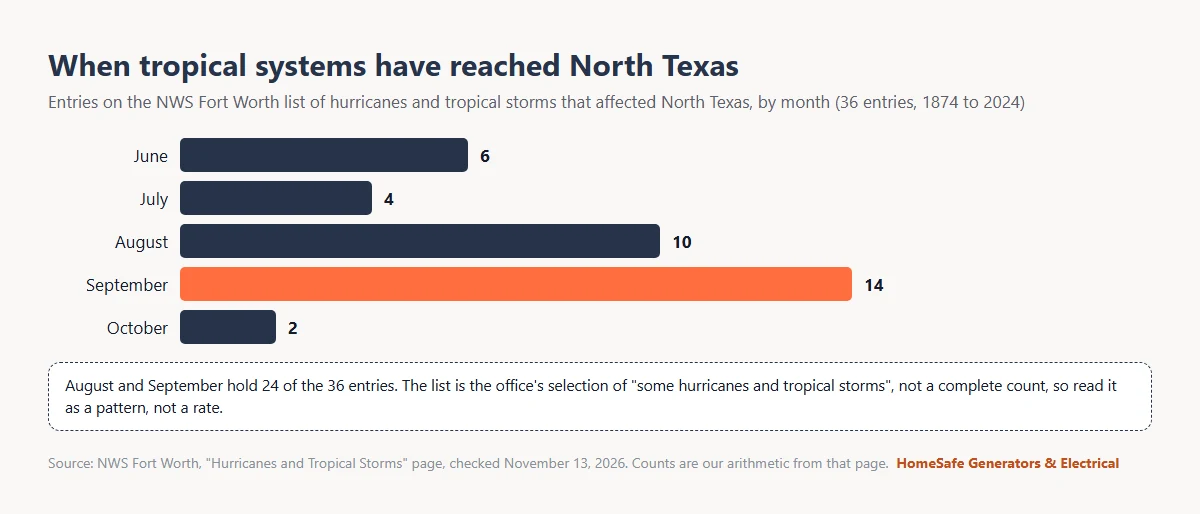
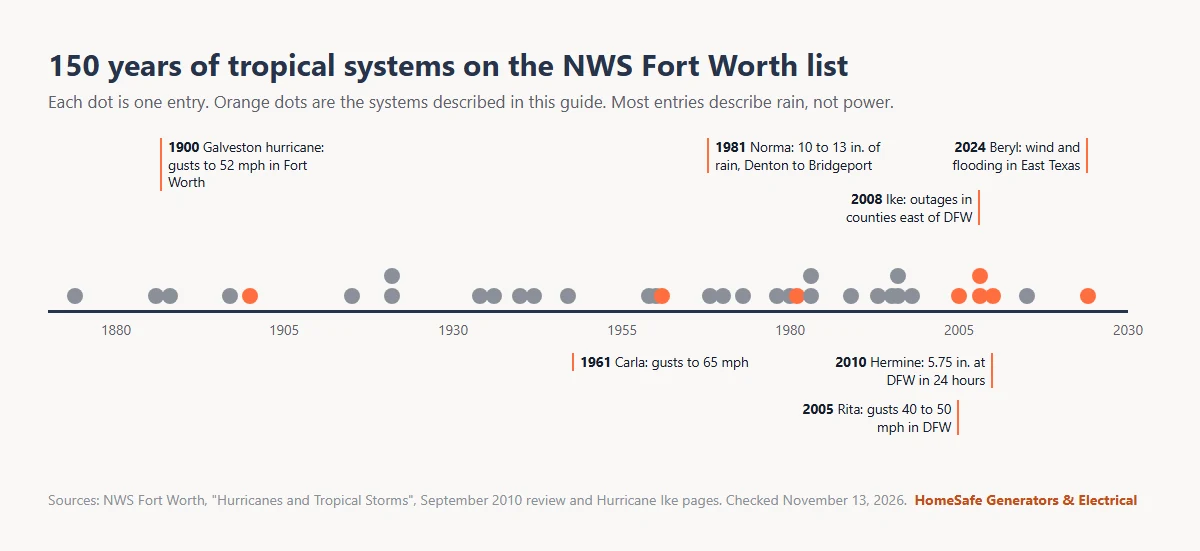
The NWS Fort Worth page “Hurricanes and Tropical Storms” describes its list as “some hurricanes and tropical storms that have affected North Texas since 1871.” It holds 36 entries, from September 1874 to July 8, 2024 (our count). August and September account for 24 of them. A few entries, in the page’s own words, show the range:
| Date | System | Rain | Wind | Effect noted by NWS |
|---|---|---|---|---|
| September 11 to 13, 1961 | Remnants of Hurricane Carla | 3 to 5 inches | East winds 30 to 40 mph, gusts to 65 mph | New low-pressure record at Carter Field |
| October 12 to 13, 1981 | Remnants of Pacific Hurricane Norma | 10 to 13 inches between Denton and Bridgeport | Not stated | Torrential rain, a few weak tornadoes |
| August 18 to 19, 1983 | Remnants of Hurricane Alicia | 2 to 3.5 inches | Not stated | Localized flooding |
| September 23 to 24, 2005 | Hurricane Rita | Scant | Gusts 40 to 50 mph in the DFW Metroplex | Wind |
| June 18, 2015 | Tropical Storm Bill | Over a foot in parts of Montague County | Not stated | Flooding in Wise, Montague and northern Parker counties |
| July 8, 2024 | Hurricane Beryl | Flooding rains in East Texas | Peak 47 mph at Palestine | Damaging winds in East Texas |
The page records quieter cases too. For July 26, 1959, remnants of Hurricane Debra, it says “little impact on the DFW area.” For October 18 to 20, 1983, remnants of Pacific Hurricane Tico, it says less than an inch fell over most of the local area. A tropical remnant can mean almost nothing here, or a very wet day, depending on its track.
6. A closer look: Hermine, September 2010
The NHC’s Tropical Cyclone Report on Tropical Storm Hermine covers September 5 to 9, 2010. Hermine made landfall on the northeastern coast of Mexico. As it moved across Texas, it “spawned tornadic activity,” including a tornado near downtown Dallas on September 8. That tornado heavily damaged one building and damaged warehouses near Dallas Love Field.
NWS Fort Worth’s September 2010 review adds the local rainfall. Hermine “brought a deluge to the I-35 corridor,” with widespread totals above 5 inches. The 5.75 inches on September 7 to 8 ranked eighth all-time for a 24-hour period at Dallas/Fort Worth. September 2010 ranked fourth wettest on record there, at 9.09 inches. The strongest tornado, rated EF-2, was in west Dallas. The tropical-systems page counts eight tornadoes; the review describes them differently, so that number is given as the page’s own statement only. Neither source gives a DFW power outage figure for Hermine.
7. A closer look: Hurricane Ike, September 2008
Ike is a counter-example, because it reached counties east of the metro as a still-strong system. NWS Fort Worth’s Ike page says it made landfall near Galveston at 2:00 a.m. on September 13, 2008. Winds “were sustained at hurricane force until it reached southeast Anderson County.” In Freestone County, gusts peaked near 70 mph, and “approximately 40 percent of Freestone County was affected by power outages.” In Leon County, “approximately 75 percent of the county was without power late in the day on September 13.” These counties are in the NWS Fort Worth area, not the DFW metro.
8. How long power stays out after a big storm
The NWS pages describe storms, not restoration times. For those, EIA’s national figures help. In 2024, U.S. customers averaged 11 hours without power, and major events such as Hurricanes Beryl, Helene and Milton accounted for 80 percent of those hours. Customers in South Carolina averaged nearly 53 hours after Helene (EIA, Today in Energy, December 1, 2025, checked November 13, 2026). Those are averages across every customer in a state.
In DFW, a storm outage on your street is restored by your delivery utility. For most of the metro that is Oncor, whose outage map shows active outages. Oncor reports its ordinary-year reliability separately from significant storms, which the guide to Texas grid reliability sets out. Storm outages are also different from grid-wide shortages, which come with ERCOT notices first; see ERCOT conservation appeals.
9. Reading these records for your own home
Tree cover, the age of your local lines and whether your lines run overhead or underground all affect how a storm plays out at your address. No regional record captures them. Use the events above to see what North Texas storms bring, then look at your own home. Summer heat is a different kind of season, covered in triple-digit days in DFW.
10. Where a standby generator fits, and where it does not
The records above describe storms, not how long any one home was without power. If outages where you live have been short, a portable generator used safely outdoors, a charged power bank for phones and a cooler for the refrigerator may be all you need. Some homes need only a plan. The guide on whether a whole-house generator is worth it sets out how to weigh that.
A standby generator suits homes where outages have run long enough to spoil food or leave the house uncomfortable, or where you want the house to carry on without any action from you. It runs on natural gas or propane and starts automatically when the power fails. If someone relies on powered medical equipment, that backup needs a job-specific review before any plan is made. HomeSafe offers a free in-home assessment for a straight recommendation, and if a smaller system covers the need, we say so. You can work out a rough load first with the sizing planner.
If you already have a generator and it stops during a storm, generator service during a storm explains what happens when you call. Before each season, the readiness timeline lists what to check. This guide covers storm hazards and power; it does not cover roof, hail or flood insurance claims.
In this series: the DFW hazard data hub · seasons of risk in DFW · triple-digit days in DFW · DFW winter ice events · Texas grid reliability · ERCOT conservation appeals · the seasonal readiness timeline
Quick answers
How long does power stay out after a hurricane?
From hours to days, depending on the track. In 2024, EIA reported that South Carolina customers averaged nearly 53 hours without power after Hurricane Helene, while the U.S. average for the year was 11 hours. In North Texas, remnants usually arrive as rain, and outage figures appear only for strong systems such as Ike in 2008.
Do hurricanes cause power outages in North Texas?
Sometimes, near the track. NWS Fort Worth reports that about 40 percent of Freestone County and about 75 percent of Leon County were affected by outages from Hurricane Ike in September 2008. Those counties are east of the DFW metro.
How often do hurricane remnants reach North Texas?
36 times on the NWS Fort Worth list, from 1874 to 2024 (our count), with 24 of those in August or September. The list is a selection of notable systems, not a complete count. Entries range from “little impact” to more than 10 inches of rain.
What storm hazards does DFW face besides tornadoes?
Wind, hail, flooding rain and tropical remnants. NWS Fort Worth documents straight-line wind damage, hail up to softball size in April 2026, a record 5.25-inch hailstone at Wylie in April 2016, and flooding rain such as 5.75 inches in 24 hours at DFW during Hermine in 2010.
Do I need a standby generator for storm season?
No, not always. If outages where you live are short, a portable generator, a power bank and a prepared kit may be enough. A standby generator suits homes where long outages, a home office or the need for automatic power make it worthwhile.
For a free in-home assessment, contact HomeSafe or call (817) 439-9009. HomeSafe holds Texas Electrical Contractor License #41809 and has a 5.0 rating across 200+ Google reviews.
Sources
All pages checked November 13, 2026. Counts marked “our count” are our arithmetic from the NWS list.
- NWS Fort Worth, Hurricanes and Tropical Storms (latest entry July 8, 2024): https://www.weather.gov/fwd/texashurricane
- NWS Fort Worth, September 2010 review: https://www.weather.gov/fwd/sep2010
- NHC, Tropical Cyclone Report, Tropical Storm Hermine (AL102010), November 22, 2010: https://www.nhc.noaa.gov/data/tcr/AL102010_Hermine.pdf
- NWS Fort Worth, Hurricane Ike’s effect on North Texas (created August 26, 2009): https://www.weather.gov/fwd/ikenorthtexas2008
- NWS Fort Worth, April 11, 2016 hail event: https://www.weather.gov/fwd/20160411
- NWS Fort Worth, Severe storms and tornadoes, April 24 to 29, 2026 (preliminary): https://www.weather.gov/fwd/april2026svrwx
- NWS Fort Worth, Past Event Summaries (index): https://www.weather.gov/fwd/events
- U.S. EIA, Today in Energy, “Hurricanes in 2024 led to the most hours without power in the United States in 10 years” (December 1, 2025): https://www.eia.gov/todayinenergy/detail.php?id=66744
- Oncor outage map: https://stormcenter.oncor.com/