
Last reviewed: November 2026
An electrical service upgrade involves more people than most home projects. You, a licensed electrician, the city and the utility each own a piece of it, and the job only moves when each piece is done in order. Most homeowners only find that out on the day the power goes off.
Here is the short answer. In Oncor’s area, you own the meter base and the wiring up to the weatherhead, and Oncor owns the pole, the transformer and the line to your house. A licensed electrician replaces your side, pulls the permit and tells Oncor before the meter comes out. The city inspects, and Oncor reseals the meter. In Fort Worth, homeowners may not work on the service themselves.
This guide is for homeowners in Fort Worth, Dallas, Arlington, Plano, Keller, Southlake and across DFW and North Texas who are planning a 100 to 200 amp upgrade or have been told the meter base needs work. If you are ready to book, our electrical panel upgrade service page has the details. For what moves the price, see what drives the cost of a panel upgrade.
1. Service upgrade or panel swap: what changes
A panel replacement swaps the breaker box inside or on the house. A service upgrade raises how much power the house can take from the utility, usually from 100 to 200 amps. That reaches past the panel to the meter base, the heavy service conductors and, on overhead service, the mast and weatherhead.
Oncor’s own equipment tables show why. The meter sockets it approves for homes are rated by amps, from smaller sockets such as 0 to 150 amps up to 0 to 200 and 200 to 320 amps (Oncor Electric Service Guidelines, February 2025, Table 5-C). An older socket sized for a smaller service is usually replaced when the service grows, which is why a 100 to 200 amp service upgrade usually includes a new meter base.
Not every panel problem needs this. A single failing breaker in a sound panel is a breaker job, and a load calculation can show that your existing service already has room. The electrical services team says so when that is the honest answer.
2. The parts of your service and who owns them
Oncor puts it plainly: for typical overhead residential service, the customer owns and is responsible for the meter base and the wiring in it, plus the conduit and wiring that connect to the weatherhead at the top of the house. Oncor owns the pole, the transformer and the service line that connects to the weatherhead and meter (Oncor meter FAQ).
| Part | What it is | Who owns it | Who works on it |
|---|---|---|---|
| Pole, transformer, service line | The utility’s equipment up to the point where its wires land on your house | Oncor | Oncor |
| Weatherhead and mast | The hooded fitting and the pipe that carry the service wires down from the roofline (overhead service only) | You | Licensed electrician |
| Meter base | The weatherproof socket the meter plugs into | You | Licensed electrician |
| Meter | The device that measures your use | Oncor | The electrician pulls it only after notifying Oncor; Oncor inspects and reseals it |
| Service conductors and panel | The heavy cable from the meter base and the breaker panel it feeds | You | Licensed electrician |
Oncor’s guidelines add detail most homeowners never see. The meter socket is provided, installed and maintained by the customer, its center must sit 4 to 6 feet above finished grade, and it must come from Oncor’s approved list. Where the service drop attaches more than 5 feet above the roofline, the mast needs extra support, such as guying, to carry the line’s tension (Oncor Electric Service Guidelines, February 2025). On underground service there is no mast, but the same split applies at the meter.
3. Who does what, step by step
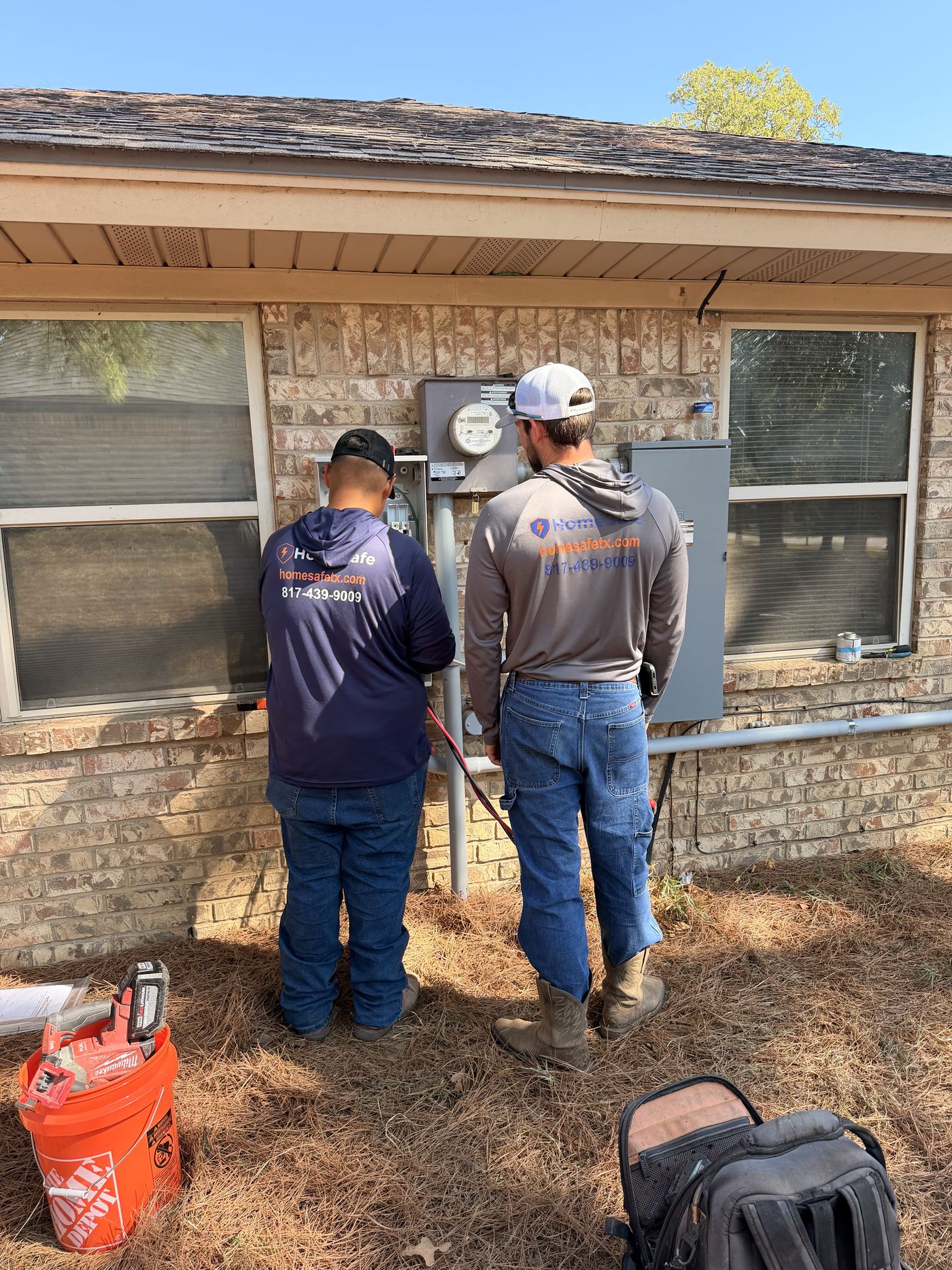
The matrix below is the whole job on one page. The rules behind each row come from Oncor and the City of Fort Worth.

- You book the visit, approve the written quote and plan for the power to be off for part of the day.
- The licensed electrician runs the load calculation, pulls the electrical permit, replaces the meter base, conductors and panel, and schedules the inspection. Texas counts service entrance conductors as electrical work under the licensing law (TDLR electrician compliance guide).
- The city issues the permit and inspects the new equipment.
- Oncor owns the line and the meter, and it comes out after the work to inspect and reseal the meter.
4. The call to Oncor before the meter comes out
This is the rule that catches people out. Oncor’s tariff, approved by the Public Utility Commission of Texas, treats any work that needs the meter seal cut and the meter removed as an unauthorized removal unless Oncor has been told first, and the customer is charged for it. Extra charges can apply if tampering is found, or if the meter or the customer’s meter base is damaged (Oncor Electric Service Guidelines, February 2025, notice on meter removal).
To avoid that, the electrical contractor calls Oncor before removing a self-contained meter and gives:
- the contractor’s company name, contact person and phone number
- the address and city, and the work to be done
- whether the work needs an electrical inspection
- the date the meter will be pulled and the date it will go back in
Oncor then schedules a trip after the meter is back in place, to inspect and reseal it. If the work slips past the planned date, the customer or electrician must tell Oncor to avoid a charge. Where a meter has a lock or locking bar, only Oncor may remove it, with one business day’s notice.
For you, this means two things. Never let anyone pull your meter without that call being made. And when you hear the outage date, it was set around that notice, the permit and the inspection, not picked at random.
5. Permits, inspection and the 2026 NEC
The service is not homeowner territory in Fort Worth. The city’s homestead electrical affidavit, the form a homeowner signs to do their own permitted work, states that homeowners may not work on the service, and that service work must be permitted and performed by a master electrician (City of Fort Worth, homestead affidavits).
The inspection is part of the utility side too. Oncor says many cities, towns and counties in its area require inspections before it can complete requested services, and that the requirements vary by city (Oncor, city inspection requirements). Dallas and suburbs such as Plano, Keller and Southlake each run their own permit office and inspection list. Our generator permit guide explains how permits move across DFW cities.
The code changed this year. Texas adopted the 2026 National Electrical Code as the state electrical code from September 1, 2026 (TDLR, Commission adopts rules, September 1, 2026). One change matters on a service upgrade: for one- and two-family homes, the 2026 NEC requires the service disconnect to be outdoors, either on the house or within sight of it and not more than 50 feet away (Section 230.70(A)), and the separate emergency disconnect section, 230.85, was deleted (EC&M, Top 25 changes to the 2026 NEC, November 18, 2025). Cities can add their own amendments, so your electrician checks the local rules before drawing the job.

6. On the day: what happens and how long the power is off
The outage is a planned window on the day, tied to the disconnect, not the whole job. Before it, the permit is in hand and Oncor has the dates. During it, the meter comes out, and the meter base, conductors and panel are replaced. Your existing circuits are reconnected to the new panel.
After the work, the city inspects. Oncor’s guidelines say it will not connect its lines to a customer’s electrical installation until it receives notice that the inspection authority has approved it, and Oncor returns to inspect and reseal the meter (Oncor Electric Service Guidelines, February 2025, 100.02.03). In its storm-repair steps, Oncor says the city sends it confirmation once the inspection has passed (Oncor meter FAQ). Your point of contact tells you each date and window as it is booked. Plan your day around the window, and mention anything at home that needs power at the first visit.
7. Storm damage, meter bases and weatherheads
North Texas storms are hard on overhead service. A falling limb can pull a mast over or tear a meter base off the wall, and ice adds weight to the line. Oncor’s outage advice is worth knowing: if your neighbor has power back and you do not, check your breaker, then look at the meter base and weatherhead. If either is damaged or pulled off, an electrician must repair it before Oncor can restore power (Oncor meter and outage FAQ).
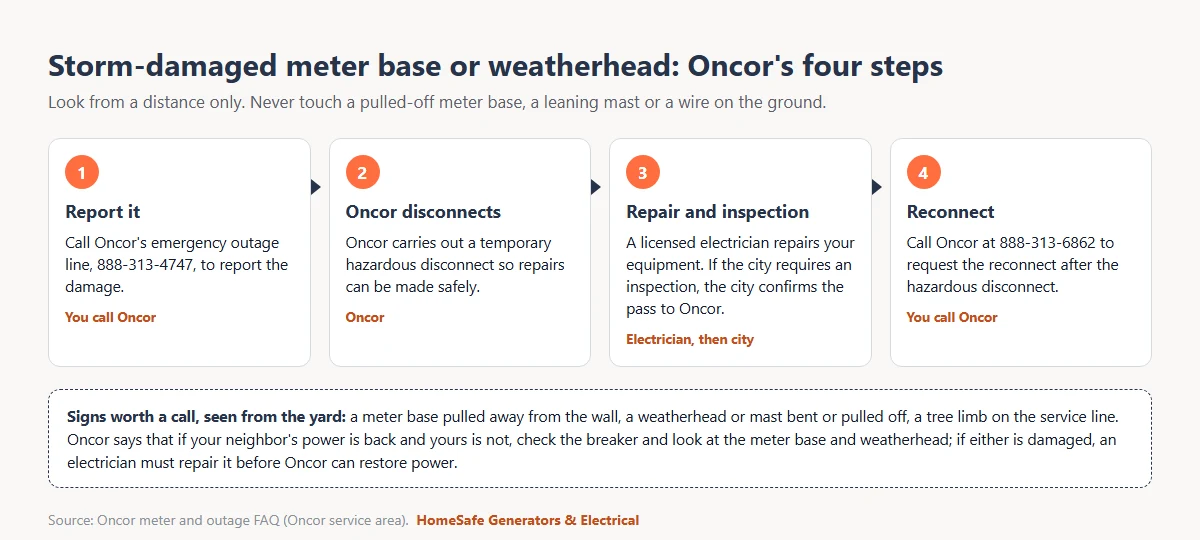
Look from a distance only. Signs worth a call are a meter base pulled away from the wall, a bent or leaning mast, a weatherhead pulled loose, or a limb resting on the service line. Never touch any of it, and treat any wire on the ground as live. For outage planning beyond the meter, see storms in DFW and winter ice events in DFW.
8. Generators, EV chargers and surge protection
A service upgrade is the natural moment to plan the other work that lives at the panel. Oncor’s guidelines say a generator transfer switch is installed on the load side of the meter base, and under no circumstances integrated or placed in series with the meter and the base (Oncor Electric Service Guidelines, February 2025). Our transfer switch installation page covers that part, and the generator sizing planner starts the generator installation conversation.
The same goes for a Level 2 charger. Our EV charger installation page and EV charger guide explain how the load calculation decides whether the panel needs work first. While the panel is open, it is also an efficient time to add whole-home surge protection.
9. Not on Oncor?
Oncor delivers to most DFW homes, but CoServ and Tri County Electric Cooperative serve parts of the metroplex. If a co-op delivers your power, your point of contact tells you how its disconnect and reconnect are arranged. In CoServ territory, HomeSafe pulls the meter and calls for a reseal afterwards. On Tri County lines, that step follows the co-op’s own schedule. Check your bill for the name of your delivery company, and see our service area for the cities we cover.
10. How HomeSafe handles a service upgrade
It starts with a free visit. We look at the panel, the meter base and the service entrance, and run the load calculation, so the recommendation fits what you run now and what you plan to add. You get one written quote that covers the permit, the panel work and the inspection. A 100 to 200 amp service upgrade usually includes a new meter base, and a mast is assessed job by job.
We pull the permit, coordinate with your utility and see the inspection through, then power is back on. The electrical work is led by Ty Shaver, a licensed master electrician, under Texas Electrical Contractor License #41809, and one company stays accountable from the first call to the final walkthrough. You can read more about HomeSafe, or see the cities we serve, including Dallas, Plano, Keller and Southlake.
Older homes may carry more than a small service. A fuse box, a Federal Pacific or a Zinsco panel is a replacement, not a repair. If you are unsure what you have, a home electrical safety inspection identifies it first, and our safety inspection guide explains what it covers.
In this series: what drives the cost of a panel upgrade · home electrical safety inspections · EV charger installation · 100 amp vs 200 amp service · signs you need a new panel · whether whole-home surge protection is worth it · transfer switch vs interlock kit · older home electrical risks by decade · permits for a panel upgrade
Quick answers
What is an electrical service upgrade?
A service upgrade raises how much power your home can take from the utility, usually from 100 to 200 amps. That means a new panel, usually a new meter base and heavier service conductors, with a planned disconnect at the meter. A panel swap alone replaces the breaker box without adding capacity.
Who is responsible for the meter base, me or Oncor?
You are. Oncor says that for typical overhead residential service, the customer owns the meter base and its wiring, plus the conduit and wiring to the weatherhead. Oncor owns the pole, the transformer, the service line and the meter. A licensed electrician repairs or replaces your side.
What are the signs your meter base needs replacement?
4 signs are the usual ones: a meter base pulling away from the wall, storm or tree damage to the mast or weatherhead, a service that is being upgraded beyond what the socket is rated for, and no power when your neighbors have it back. Look from a distance only and call a licensed electrician.
What is a weatherhead and a service mast?
They are the two parts of an overhead service that sit on your roofline. The mast is the pipe that rises above the roofline to hold the utility’s wires, and the weatherhead is the hooded fitting on top where those wires enter. Both are the homeowner’s, and Oncor’s guidelines call for extra mast support when the line attaches more than 5 feet above the roof.
How long is the power off during a service upgrade?
One planned window on the day of the work, not the whole job. The meter comes out, the equipment is replaced and the circuits are reconnected. After the city inspection passes, Oncor reseals the meter. Your point of contact tells you each date and window as it is booked.
Can I upgrade from 100 to 200 amps?
Yes, it is the usual service upgrade. A load calculation shows whether you need it, it usually includes a new meter base, and the quote covers the permit and inspection.
Do I need a permit and inspection for a service upgrade in Fort Worth?
Yes. Fort Worth’s homestead electrical affidavit says service work must be permitted and performed by a master electrician, and Oncor says many cities require an inspection before it can complete requested services such as the reconnect. HomeSafe pulls the permit and handles the inspection.
Can a panel upgrade be done together with the meter change-out?
Yes. A 100 to 200 amp service upgrade usually includes a new meter base, and it is replaced as part of the same job, during the same planned outage, under one permit and one written quote.
Can a homeowner do their own service upgrade in Fort Worth?
No. The city’s homestead electrical affidavit says homeowners may not work on the service, and Oncor charges for a meter removed without notice. Texas also counts service entrance conductors as electrical work under the state licensing law.
To talk through a service upgrade, book a free estimate on our electrical panel upgrade page, contact HomeSafe or call (817) 439-9009. HomeSafe holds Texas Electrical Contractor License #41809 and has a 5.0 rating across 200+ Google reviews, which you can read on our reviews page.