Last reviewed: November 2026
Your electrical panel works quietly for years, so most people only think about it when something changes. A breaker starts tripping. The lights dip when the air conditioning kicks on. An insurer asks what brand it is. Some of those signs need action today, some need a visit, and some only mean the panel will not carry what you plan to add.
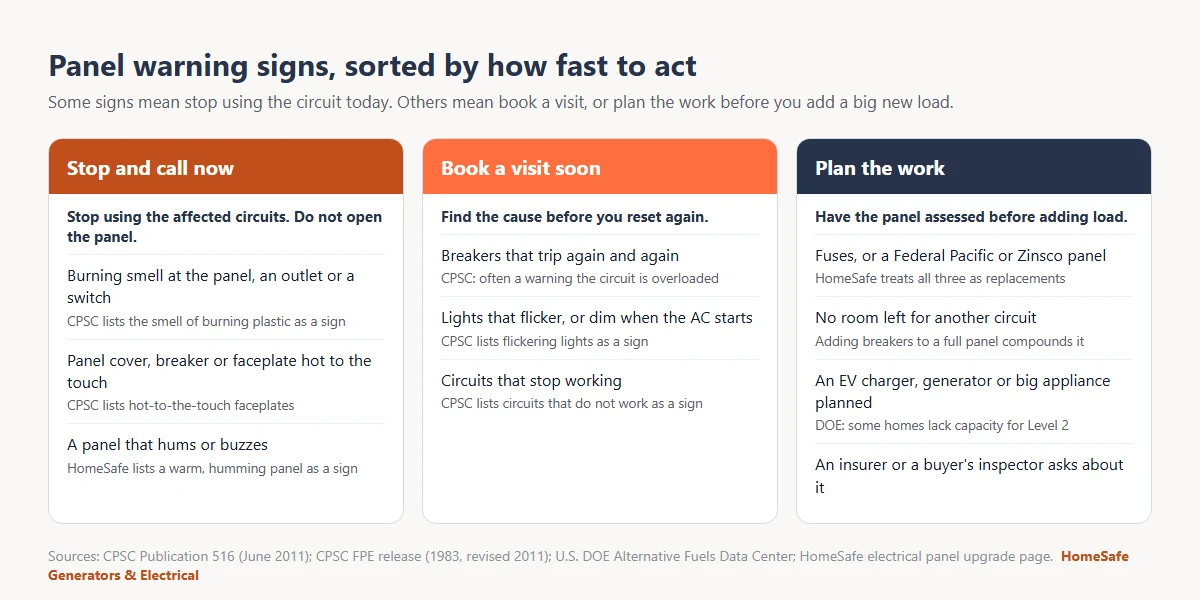
Here is the short answer. Stop using the circuit and call a licensed electrician if the panel is hot, smells of burning or buzzes. Book a visit if breakers trip again and again, lights flicker or circuits go dead. Plan a replacement if you have fuses, a Federal Pacific or Zinsco panel, or no room for another circuit. None of these signs on its own proves you need a new panel. A look at the panel and a load calculation decide that.
This guide is for homeowners in Fort Worth, Dallas, Arlington, Keller, Southlake, Plano, Frisco and across DFW and North Texas. It explains what each sign usually points to and which job fixes it. When you are ready for a straight answer on your own panel, our electrical panel upgrade and replacement page is where to book a free estimate.
1. Signs that mean act today
Three signs point to heat where there should be none. Heat in a panel or at a connection is how electrical fires start, so these come first.
- A burning smell. The U.S. Consumer Product Safety Commission lists “the smell of burning plastic at outlets or switches” among the signs of electrical system problems (CPSC Publication 516, June 2011). The same applies at the panel.
- Heat you can feel. CPSC lists “hot-to-the touch face plates on receptacles or switches”. A panel cover or breaker that is warm to the touch belongs in the same group.
- Humming or buzzing. Our panel page lists a panel that is “warm, humming or smells of burning” as one of the signs that bring us out, and our safety inspection guide flags “anything that buzzes”.
What to do: stop using the affected circuits and call a licensed electrician. Never take the panel cover off yourself. If you see smoke or flames, leave the house and call 911.
CPSC’s advice for these signs is direct: “have a qualified electrician determine the cause. DO NOT TRY TO DO IT YOURSELF.” Warm or scorched outlets and switches are also worth reporting, because they can be a wiring problem rather than a panel problem. A home electrical safety inspection checks both.
2. Signs of an overloaded or tired panel
These signs usually mean the panel, or one circuit on it, is carrying more than it was built for.
Breakers that keep tripping
A breaker trips to protect the wire behind it. CPSC’s advice is “Do not simply replace the fuse or reset the breaker,” because a trip “is often a warning that the circuit is overloaded” (CPSC release, 1983, revised February 18, 2011).
Where the trip happens matters. A breaker that trips whenever one appliance runs usually means that appliance needs its own dedicated circuit, not a new panel. Breakers that trip across the house, or a panel with no room left for the circuit you need, are a panel question.
Lights that flicker or dim
CPSC lists flickering lights as a sign of an electrical system problem. Lights that dim every time a large motor starts, such as the AC compressor, or flicker with nothing starting, are worth a visit. Our panel page lists “lights dim when the AC or a large appliance starts” as a sign we check.
Circuits that stop working
Circuits that do not work are also on CPSC’s list. A circuit that goes dead with no tripped breaker can be a loose connection at the panel or somewhere along the circuit. Either way, it needs an electrician to find it, not another reset.
3. Panels that are replaced, not repaired
Some panels are a replacement job no matter how well they seem to work. HomeSafe treats three as replacements, not repairs:
- Fuse boxes. A fuse box is always a replacement rather than a repair.
- Federal Pacific Stab-Lok panels. Found in many homes built from the 1950s to the early 1980s.
- Zinsco panels. From the same era, and treated the same way.
It helps to know the official record on Federal Pacific, because a lot of what is written online is not from it. CPSC investigated Federal Pacific Stab-Lok breakers and closed the matter in 1983 “without making a determination as to the safety of FPE circuit breakers”. It found the data “does not establish that the circuit breakers pose a serious risk of injury to consumers” (CPSC, 1983, revised 2011). Insurers and buyers’ inspectors in North Texas still ask about these brands by name, which is often how a homeowner first hears about them.
If you do not know what you have, a safety inspection identifies the brand and its condition in writing.
4. Signs you have outgrown the panel
A panel can be sound and still too small. The question is always whether the existing service can carry the new load alongside everything already on it.
- No room for another circuit. When every space is used, adding breakers makes the underlying problem worse, not better.
- An EV charger. The U.S. Department of Energy says “Some homes might have insufficient electric capacity for Level 2 equipment”, and that “Electricians can inform homeowners whether their home has adequate electrical capacity for vehicle charging” (DOE Alternative Fuels Data Center). Our EV charger installation page and EV charger guide cover the charger side.
- A standby generator. A generator connects through a transfer switch at or near the panel, so an older or full panel is often the first thing to deal with. That is why we assess the panel with every generator installation. Start with the generator sizing planner.
- A workshop, pool or new appliance. A new garage or workshop circuit, an electric range or a second AC unit all add load the panel has to carry.
A load calculation looks at what already draws power, then shows whether the panel stays, or whether a 100 to 200 amp service upgrade comes first. If it does, you hear that before any work starts, with both parts quoted together.
5. Age and the DFW housing stock
Age on its own is not a reason to replace a panel. What age does is make the signs above more likely, and it tells you what equipment to expect. DFW’s housing stock splits sharply by city.
| City | Homes built before 1980 | Median year built |
|---|---|---|
| Dallas | 45.9% (276,850 of 603,788 homes) | 1983 |
| Fort Worth | 32.7% (131,725 of 402,216 homes) | 2000 |
| Frisco | 1.1% (965 of 90,661 homes) | 2012 |
Housing units by year built. Source: U.S. Census Bureau, American Community Survey 2025 1-year, table B25034; median year built from table B25035. Percentages computed from the published counts.
In older neighborhoods of Dallas and Fort Worth you are more likely to find fuse boxes, Federal Pacific or Zinsco panels and 100 amp service. In Frisco and newer Collin and Denton County builds, the question is usually capacity for what you are adding rather than replacement.
Wiring age matters too. CPSC says homes built before 1965 are unlikely to have aluminum branch circuit wiring, while cables installed “between 1965 and the mid 1970s” may contain it (CPSC Publication 516, June 2011). CPSC also warns that failing aluminum connections “seldom provide easily detected warning signs”. If your home is from that era, have the wiring looked at as part of any panel work. Our older-home safety inspection covers it.
6. Repair, replace or upgrade: matching the sign to the job
A sign does not tell you which job fixes it. There are three, and the smallest is often the honest answer.
| What you are seeing | What it usually points to | Likely job |
|---|---|---|
| One breaker trips when one appliance runs | That appliance needs its own circuit | A dedicated circuit, panel stays |
| One breaker fails or will not reset, panel otherwise sound | A failing breaker | A single breaker replacement |
| Fuses, Federal Pacific or Zinsco | Equipment HomeSafe treats as a replacement | Full panel replacement |
| Heat, burning smell, buzzing at the panel | Overheating connections or parts | Assessment first; often a replacement |
| No room for a needed circuit | A full panel | Replacement, sometimes with a service upgrade |
| Not enough capacity for an EV charger, generator or new AC | Undersized service | Service upgrade, usually 100 to 200 amps |
A service upgrade changes more than the panel. It usually includes a new meter base, and power is cut at the meter before the work and restored after it, arranged with your utility. Our panel upgrade cost guide explains what each job adds and why.
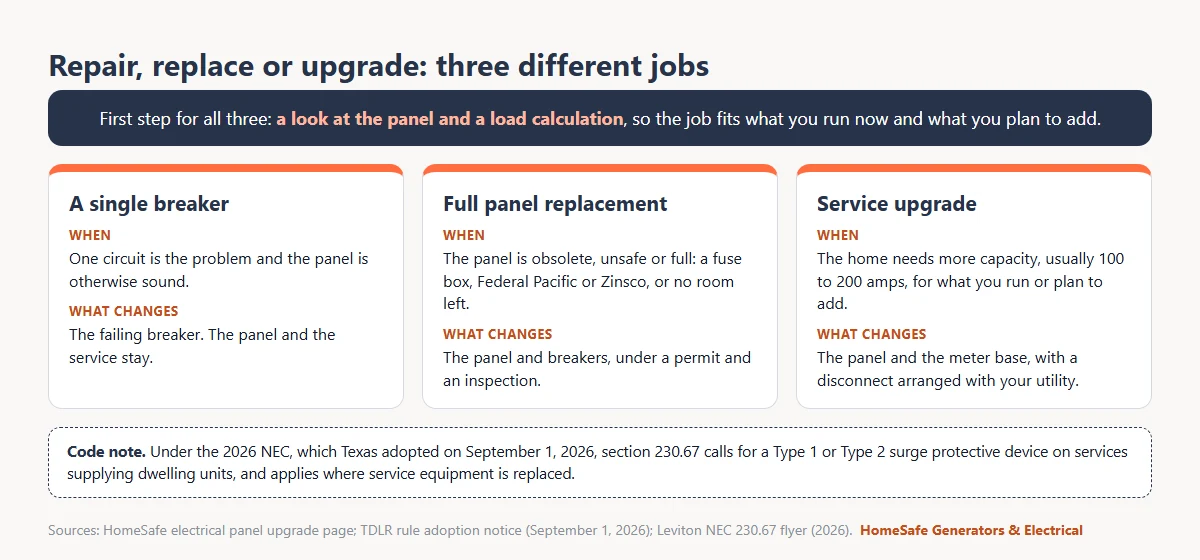
One code change is worth knowing. Texas adopted the 2026 National Electrical Code as the state electrical code from September 1, 2026 (TDLR, September 1, 2026). Section 230.67 of that code says all services supplying dwelling units “shall be provided with a surge-protective device”, and “Where service equipment is replaced, all of the requirements of this section shall apply” (Leviton, NEC 230.67 flyer, 2026). So if your service equipment is being replaced, plan on whole-home surge protection as part of the job. Cities can add local amendments, and we work to the code in force where you live.
Not sure which of the three you need? Our panel upgrade page explains how the free visit works.
7. What you can safely check yourself
Everything below is look-only. None of it needs the panel cover off or a tool in your hand.
- Read the label. Open the panel door, not the cover, and note the maker’s name and the main breaker size, often marked 100 or 200.
- Count the spaces. Note whether any breaker slots are empty.
- Keep a trip log. Write down which breaker trips, when, and what was running at the time.
- Feel from a distance. Note any warmth from the panel door or faceplates and any smell. Do not keep touching a hot surface.
- Look for rust or water. Note any staining around or below the panel.
Anything past this is electrician’s work. In Fort Worth, the city’s homestead affidavit says “Homeowner’s may not work on the service”, which “must be permitted and performed by a Master Electrician” (City of Fort Worth, Homestead Electrical Affidavit). Other DFW cities run their own permit offices, and a panel change needs a permit and an inspection. Our permit guide shows how city permitting works across DFW.
8. How HomeSafe handles a panel visit
The free visit starts with the panel itself and a load calculation, so any recommendation fits what you run now and what you plan to add. You then get a written quote with the permit, the panel work and the inspection in one total. We pull the permit, coordinate with your utility and see the inspection through.
To be fair to your budget, plenty of visits end without a new panel. One failing breaker in a sound panel is a breaker replacement. An appliance that trips its breaker may only need a dedicated circuit. A load calculation may show your 100 amp service has room for the charger you are adding. We will tell you when the smaller job is the right one.
Estimates are free. Electrical work is billed at $200 per hour plus materials, and a whole-home safety inspection is $295, with a written report. Ty Shaver, a licensed master electrician, leads our electrical work, all done under Texas Electrical Contractor License #41809. You can read more about the team, or see all our electrical services. We work across Tarrant, Denton, Collin and Dallas counties, from Dallas and Plano to Keller and Southlake.
This guide covers homes. For commercial buildings, our Texxas Power commercial team handles the work.
In this series: what drives the cost of a panel upgrade · home electrical safety inspections · EV charger installation · electrical service upgrades and Oncor · 100 amp vs 200 amp service · whether whole-home surge protection is worth it · transfer switch vs interlock kit · older home electrical risks by decade · fuse box vs breaker box · what happens at a free estimate
Quick answers
How long do electrical panels last?
Age alone does not decide it. A panel is judged on its condition, its brand and whether it can carry your load, not its age alone. A look at the panel and a load calculation decide whether it stays.
Should a 50 year old electrical panel be replaced?
No, not on age alone. A 50 year old panel is more likely to be a fuse box, a Federal Pacific or a Zinsco, or to be too small for today’s loads, and any of those points to a replacement or an upgrade. If it is none of those, shows no warning signs and has room for what you run, it can stay.
Do Federal Pacific and Zinsco panels need to be replaced?
Yes. HomeSafe treats Federal Pacific and Zinsco panels as replacements, not repairs. CPSC closed its Federal Pacific investigation in 1983 without making a safety determination, but insurers and buyers’ inspectors in North Texas still ask about both brands. If you are not sure what you have, a safety inspection identifies it.
Why is my electrical panel buzzing, warm or smelling of burning?
These are signs of heat where there should be none, often from a failing connection or breaker. Stop using the affected circuits, do not open the panel, and call a licensed electrician. If you see smoke or flames, leave the house and call 911.
Do I need to upgrade my electrical panel, or just replace it?
A load calculation answers that. Replace the panel when it is obsolete, unsafe or full. Upgrade the service, usually from 100 to 200 amps, when your home needs more capacity for an EV charger, a generator or new appliances. A service upgrade usually includes a new meter base.
Can you upgrade an electrical panel without rewiring the house?
Yes, in most homes. The existing branch circuits are reconnected to the new panel. Older homes can need extra work once the panel is open, such as grounding and bonding brought up to the code in force, or attention to aluminum wiring from the 1965 to mid 1970s era.
Do I need a permit to replace my electrical panel?
Yes. A panel or service change is permitted work, followed by an inspection. In Fort Worth, service work must be permitted and performed by a master electrician. HomeSafe pulls the permit and sees the inspection through.
Can I replace my electrical panel myself?
No. In Fort Worth, the city’s homestead affidavit says homeowners may not work on the service. CPSC’s warning on electrical repairs applies here too: you could be electrocuted, or you could make the problem worse. Keep to look-only checks and call a licensed electrician.
Get a straight answer on your panel
Tell us what your panel is doing, and you get a clear answer on whether it needs a breaker, a replacement or a full service upgrade. Book a free estimate on our electrical panel upgrade page, contact HomeSafe or call (817) 439-9009. HomeSafe has a 5.0 rating across 200+ Google reviews, which you can read on our reviews page.