
Last reviewed: November 2026
Your electrical panel and the service that feeds it carry every circuit in the house, so cities treat work on them as permitted work. A permit is how a city checks that a new panel was installed safely before anyone relies on it. The rules on who may pull that permit differ from city to city, and the answers online are often from another state, which is why we wrote this guide.
Here is the short answer. Yes, upgrading, replacing or moving an electrical panel needs an electrical permit and an inspection in Fort Worth and Dallas, including a like-for-like swap. A licensed electrical contractor normally pulls it. Both cities have a narrow homeowner route on a homestead, but Fort Worth does not let homeowners work on the service, and Dallas requires a city exam first. Elsewhere in DFW, your city’s building inspections office sets the rules, and Oncor says many cities require an inspection before it completes requested services.
This guide is for homeowners in Fort Worth, Dallas, Plano, Arlington, Frisco, Keller, Southlake and across DFW and North Texas who are planning a panel replacement or a 100 to 200 amp service upgrade. It covers which jobs need a permit, who may pull it, how the inspection ties in with getting power back, and what to do about a panel changed without one. It explains the rules as the official pages state them; it is not legal advice. On a HomeSafe job, we pull the permit: our electrical panel upgrade and replacement page shows how the work runs.
1. Which panel jobs need a permit
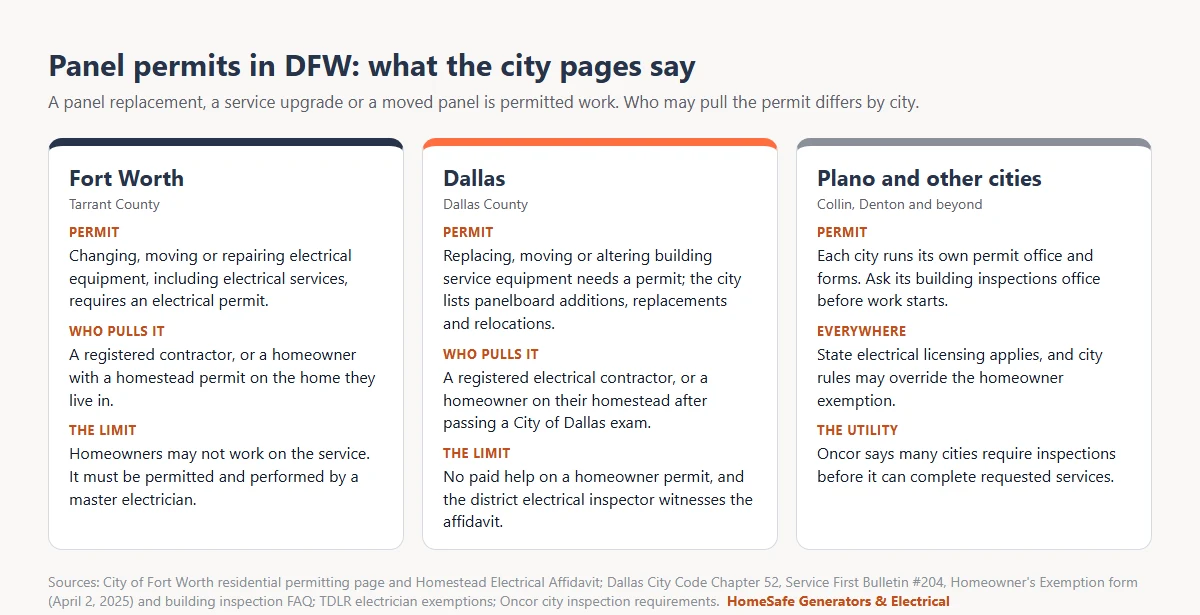
Fort Worth’s residential permitting page puts it in one line: “Changing, moving, or repairing electrical equipment, including electrical services requires an electrical permit” (City of Fort Worth, residential permitting). Dallas’s building code says no one may “alter, repair, replace, move” or install building service equipment “without first obtaining a permit from the building official”, and it counts electrical equipment and wiring as building service equipment (Dallas City Code, Chapter 52, section 301.1, city booklet current through March 27, 2024). The city’s 2025 bulletin on backup power systems spells out the wiring changes that need “a separate stand-alone electrical permit”, including “Panelboard additions, replacements, or relocations”, “Service rebuilds” and “Service entrance conductor additions or relocations” (City of Dallas, Service First Bulletin #204).
| Panel job | Fort Worth | Dallas |
|---|---|---|
| Full panel replacement, including a fuse box | Permit: “changing” electrical equipment | Permit: panelboard “replacements” |
| Like-for-like swap, same size | Permit: still a change of equipment | Permit: still a replacement |
| Service upgrade, 100 to 200 amps | Permit: “including electrical services” | Permit: “Service rebuilds” and service conductors |
| Adding a subpanel | Permit: “changing” electrical equipment | Permit: panelboard “additions” |
| Moving the panel | Permit: “moving” electrical equipment | Permit: panelboard “relocations” |
| Surge device, grounding or bonding work | Permit: “changing” electrical equipment | Permit: listed by name |
Sources: City of Fort Worth residential permitting page (the Fort Worth column applies its one-line rule to each job); Dallas City Code Chapter 52 and Service First Bulletin #204. Each city can change its forms; your contractor works to the version in force.
If your home has fuses, the swap is a full panel replacement. The guide to signs you need a new electrical panel explains which job fits which problem.
2. Who may do panel work in Texas
Electrical work in Texas is licensed by the Texas Department of Licensing and Regulation (TDLR). Its compliance guide says electrical work “includes service entrance conductors as defined by the National Electrical Code” (TDLR, electrician compliance guide). Texas adopted the 2026 National Electrical Code as the state electrical code from September 1, 2026 (TDLR, September 1, 2026).
There is one state exemption, and in fairness it cuts against our own business. TDLR says a person who performs electrical work “on a dwelling that they own and reside in” is “not required by the state to be licensed”. The same page adds: “Municipal or regional regulations may override these exemptions” (TDLR, exemptions to electrician licensing). The exemption is about who holds a licence. It is not a permit exemption, and Fort Worth and Dallas both narrow it for panel work.
3. Fort Worth: the permit and the service limit
Fort Worth’s Development Services Department issues electrical permits. Its residential permitting page says an applicant must be “a registered building contractor” or meet the requirements for a homestead permit, which applies to a home the owner lives in as a primary residence, shown by “a homestead exemption granted by the appraisal district”.
The homestead route has a hard limit for panel work. The city’s Homestead Electrical Affidavit asks the owner to certify that they “will personally perform all work covered by permit”, and then says: “Homeowner’s may not work on the service”. That work “must be permitted and performed by a Master Electrician” (City of Fort Worth, Homestead Electrical Affidavit). A service upgrade is service work. For what the service includes, from the weatherhead to the meter base, see the guide to electrical service upgrades in Fort Worth.
4. Dallas: the permit, the exam and the field office
Dallas’s building inspection FAQ says “Electrical work must be performed by a licensed electrician unless the homeowner can prove to the Chief Electrical Inspector that they have the knowledge and expertise to perform the electrical work on their own home.” Permits, “unless exempted by Chapter 52 of the Dallas Building Code, are required for electrical work” (City of Dallas, building inspection FAQ).
The homeowner route is set out on the city’s exemption form. A homeowner may act as the contractor on their homestead for “electrical repairs after passing an approved City of Dallas oral or written exam”, and must attest the work “will not be assisted by any other person performing any part of the work for remuneration”. For an electrical permit, the homeowner’s affidavit is witnessed by the district electrical inspector, and the permit is issued at the field office (City of Dallas, Homeowner’s Exemption from Registration as a Contractor, April 2, 2025). The form does not list panel or service work separately, so ask the field office before assuming the exam route covers a main panel.
Dallas is also clear on the other side: “Failure to obtain the required electrical permit constitutes a violation of Dallas City Code, Chapter 52” (Service First Bulletin #204), and the owner “has the duty to ensure that permits are obtained by properly qualified persons before work is started” (Chapter 52, section 301.1.3).
5. Plano, Arlington, Frisco and the rest of DFW
Every city in DFW runs its own permit office, forms and inspection list. If you live in Plano, Arlington, Frisco, Keller, Southlake, McKinney or another city, its building inspections office is the place to ask, before any work starts. Three things hold wherever you are:
- State licensing applies everywhere, and city rules may override the homeowner exemption.
- The utility is involved. Oncor, which serves most DFW homes, says “Many cities, towns and counties in our service area require inspections before we can complete requested services”, and that the requirements “vary by city, town or county” (Oncor, city inspection requirements).
- Outside city limits, rules still apply. The generator permit guide explains how unincorporated areas and a nearby city’s extraterritorial jurisdiction work, and covers the extra permits a generator brings.
6. The inspection, Oncor and getting power back
The inspection sits between the panel work and the power coming back on. On Oncor lines, the electrician notifies Oncor before removing the meter, and Oncor returns after the meter has been replaced to inspect and reseal it (Oncor Electric Service Guidelines, February 2025). Where the city requires an inspection first, that comes before Oncor completes the work.
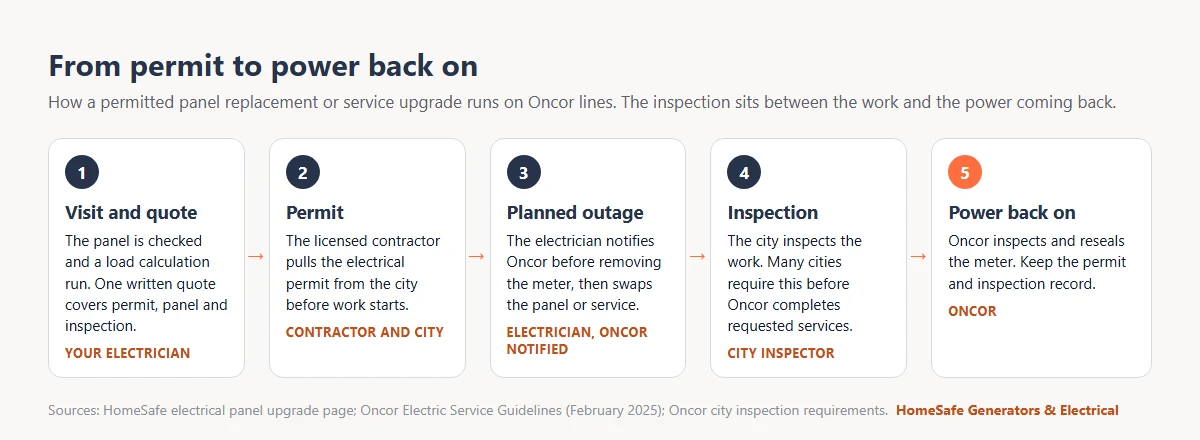
HomeSafe’s panel upgrade page sets out the same five steps from the homeowner’s side: free visit, written quote, permit, a planned outage window while the panel is swapped, then the inspection and power back on. If the job is a 100 to 200 amp upgrade, the guide to 100 amp vs 200 amp service explains how the size is chosen.

7. Moving a panel, adding a subpanel and related work
If you move your panel, you need a permit in both cities: Fort Worth names “moving” electrical equipment and Dallas names panelboard “relocations”. A subpanel is a panelboard addition. Work done while the panel is open often needs to be on the same permit or its own:
- Surge protection. Dallas lists surge protection devices among changes that need an electrical permit. The guide to whole-home surge protection covers when it is worth adding.
- A generator connection. Dallas lists transfer switches under service rebuilds. The guide to transfer switches and interlocks explains the options, and the transfer switch installation page covers the work.
- An EV charger circuit. Ask the city whether a new circuit goes on the panel permit or its own. See the EV charger installation page.
8. If your panel was changed without a permit
An unpermitted panel is not cause for panic, but it is worth sorting out. A buyer’s inspector may ask about it when you sell. A Texas home inspector reports panel deficiencies such as “the compatibility of overcurrent devices and conductors”, though the rule does not ask the inspector to judge service capacity (22 Tex. Admin. Code 535.229). Insurers may ask too: the Texas Department of Insurance lists reasons related to “the condition of the property” among reasons a home policy can be declined, canceled or not renewed (Texas Department of Insurance).
Start with your city’s building inspections office and ask how it handles a permit for work already in place. A home electrical safety inspection gives you a written report on the panel’s condition first, so you know what you are dealing with. The safety inspection guide explains what it covers. Keep the permit and inspection record with your house papers once it is done.
9. What HomeSafe handles for you
On a HomeSafe panel job, we pull the permit and see the inspection through for you. The free visit looks at the panel and runs a load calculation. Your written quote covers the permit, the panel work and the inspection in one total. We coordinate with your utility, and the work happens in a planned outage window.
To be fair about it, the city sets the pace. Permit offices differ across DFW, and nobody can promise an inspection date before the city does. Your point of contact tells you each date as it is booked.
Estimates are free. Electrical work is billed at $200 per hour plus materials, and a whole-home safety inspection is $295. Ty Shaver, a licensed master electrician, leads our electrical work, all done under Texas Electrical Contractor License #41809. See all HomeSafe electrical services, read more about the team, or find your city: Dallas, Plano, Keller and Southlake. This guide covers homes; for commercial buildings, our Texxas Power commercial team handles the work.
In this series: electrical service upgrades and Oncor · signs you need a new electrical panel · 100 amp vs 200 amp service · what drives the cost of a panel upgrade · fuse box vs breaker box · how to choose an electrician · what happens at a free estimate
Quick answers
Do I need a permit to upgrade or replace my electrical panel in Texas?
Yes, in Fort Worth and Dallas. Fort Worth requires an electrical permit to change, move or repair electrical equipment, including services, and Dallas requires a permit to replace or move building service equipment, panelboards included. Other DFW cities set their own rules, so check with your city’s building inspections office before work starts.
Do I need a permit for a like-for-like panel swap?
Yes, in Fort Worth and Dallas. A same-size swap is still a panel replacement. Dallas names panelboard replacements, and Fort Worth covers any change of electrical equipment. An inspection follows the work.
Can a homeowner pull an electrical permit in Fort Worth or Dallas?
Yes, but only narrowly. Both cities allow a homeowner permit on a homestead the owner lives in. Fort Worth’s affidavit says homeowners may not work on the service, which must be permitted and performed by a master electrician. Dallas requires the homeowner to pass a city exam and allows no paid help.
Who pulls the permit, me or the electrician?
Usually the electrician. A licensed, registered electrical contractor pulls the permit and schedules the inspection. On a HomeSafe panel job, we pull the permit and see the inspection through.
Can a homeowner upgrade their own electrical panel in Texas?
No, not the service in Fort Worth, where the city’s affidavit bars homeowners from service work. Texas exempts owners working on a home they own and live in from state licensing, but TDLR says city rules may override that, and Dallas requires a city exam first.
What electrical work can be done without a permit?
Very little, and not a panel replacement or service change. Dallas requires permits for electrical work unless Chapter 52 of its building code exempts it; the exemptions include replacing a breaker or fuse rated 30 amps or less, and small device replacements only where no change in electrical service or service disconnection is involved. Fort Worth exempts cosmetic remodels but not electrical changes. Ask your city’s building inspections office before starting anything.
Do I need a permit to move an electrical panel?
Yes. Fort Worth’s permit rule covers moving electrical equipment, and Dallas requires a permit to move building service equipment and lists panelboard relocations among the changes that need a separate electrical permit.
Does Oncor need a city inspection before turning the power back on?
Yes, in many cities. Oncor says many cities, towns and counties in its area require inspections before it can complete requested services, and the rules vary by city. On a meter pull, the electrician notifies Oncor first, and Oncor inspects and reseals the meter after.
What happens if my panel was upgraded without a permit?
It is worth sorting out. In Dallas, failing to obtain a required electrical permit is a violation of the city code, and buyers’ inspectors and insurers may ask about the panel. Ask your city’s building inspections office how it handles a permit for work already in place.
Plan a permitted panel upgrade
Tell us what you are planning, and you get a written quote with the permit, the panel work and the inspection in one total. Book a free estimate on our electrical panel upgrade page, contact HomeSafe or call (817) 439-9009. HomeSafe has a 5.0 rating across 200+ Google reviews, which you can read on our reviews page.