
Last reviewed: November 2026
A standby generator is there for the night the lights go out, so it is stressful to look outside, see the neighbors’ lights off and find that yours is not working either. If that is where you are right now, take a breath. Most generator problems are common, well understood and fixable, and what you do in the first few minutes makes the rest easier.
Here is the short answer. When you call (817) 439-9009, the phone is answered at any hour, and outside office hours your call goes to the on-call team. They help you read the status light and any code, tell you the rate before anyone is sent, and give you a time for a technician if one is needed. Emergency service is available 24/7, every day including holidays. After-hours and emergency rates apply depending on the circumstances, and you are told what they are before a technician is dispatched.
This guide is for owners of standby generators in Fort Worth, Southlake, Plano, Frisco, Argyle and across DFW, whoever installed the unit. It covers what to check before you call, what happens on the call, what maintenance does to keep this from happening, and how to vet any company that fixes generators. It does not replace your owner’s manual, and it does not cover portable generator repair.
1. First, check three things before you call
These take two minutes and make the call shorter. None of them involve opening the unit.
- Look at the status light. On a Generac Guardian unit, green means ready and flashes while it runs during an outage, yellow means maintenance is due or a warning is present, and red means the unit is OFF or has a shutdown alarm. Next Generation units add a blue light for service mode (Generac, status indicator lights, updated July 30, 2026, checked November 13, 2026). The Generac error codes guide explains each code.
- Read the control panel. If it shows a fault code, write it down. That one detail often points to the problem before anyone leaves the shop.
- Note what happened. Did it try to start and fail, start and then shut down, or never try at all? The guide to a standby generator that won’t start walks through the safe checks for each symptom.
Stop there. If you see smoke or sparks, get everyone outside and call 911. If you smell gas near the unit, move away and follow your gas utility’s leak instructions.
If you are running a portable generator in the meantime
A portable unit can bridge the gap safely if it is set up correctly. The U.S. Consumer Product Safety Commission advises running one outdoors only, at least 20 feet from the home, with the exhaust pointed away, never in a garage, basement or shed, and keeping battery-operated carbon monoxide alarms on every level of the home (CPSC, January 23, 2026). See using a generator during a power outage. If you are weighing a portable unit against a permanent one, the best generator for a power outage compares them.
2. Common reasons a generator does not work in an outage
Knowing the usual suspects helps you describe the problem clearly, and it shows why most of them are caught early by maintenance.
- A weak or dead battery. It can look fine and still fail to crank. Generac gives a typical battery life of 3 to 5 years (Generac).
- A fault flagged by the controller. The panel shows a code, the unit shuts down to protect itself and nobody sees the warning.
- A transfer switch that does not transfer. The generator runs, but the house stays dark. This is the one that surprises people, and it is treated as an emergency. The transfer switch page explains the part.
- A fuel supply problem. A closed valve, a low propane tank or an interruption in the gas supply.
- Something blocking the unit. After a storm, leaves, debris or standing water around the enclosure can cause trouble. Clearances matter here too; see where a standby generator can go.
3. What happens when you call HomeSafe
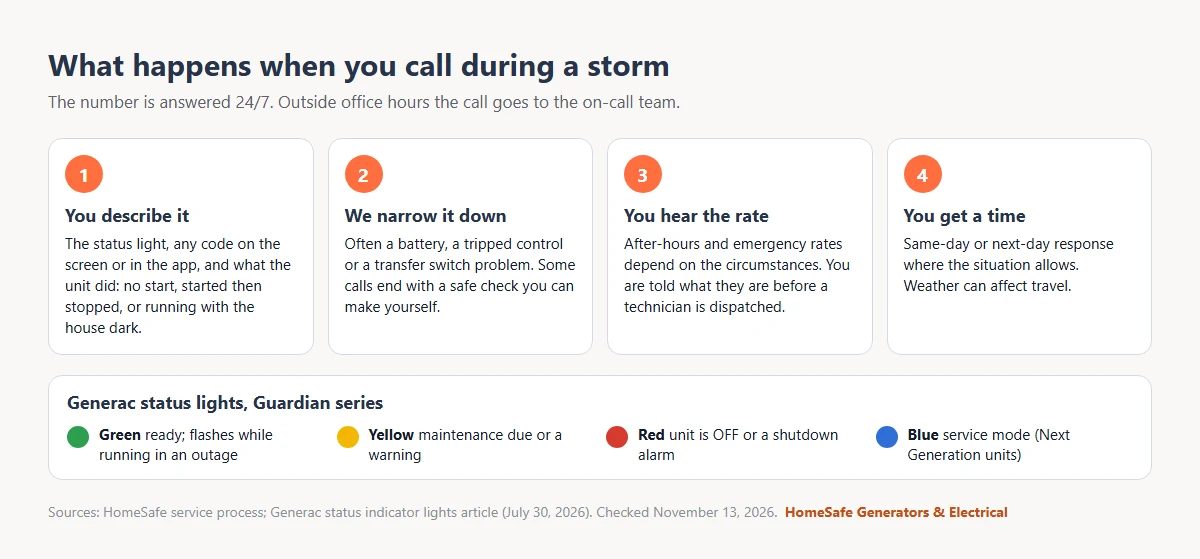
The number is answered 24/7. Outside office hours your call goes to the on-call team. Here is what to expect:
- You describe what you see. The status light, the code on the panel, and what the unit did.
- The likely cause is narrowed down. Often it is the battery, a tripped control or a transfer switch problem. Some calls end with a safe check you can make yourself, such as the fuel valve or the unit’s mode, with a fault cleared once in line with Generac’s own advice.
- You hear the rate before anyone is sent. After-hours and emergency rates apply depending on the circumstances, and you are told what they are before a technician is dispatched. Then you decide.
- You get a time. Same-day or next-day response where the situation allows, and weather can affect travel.
The full list of what is diagnosed and fixed is on the generator service and repair page. HomeSafe services Generac, Kohler, Champion, Briggs and Stratton, and Cummins units, including units installed by other companies. HomeSafe is a Generac PowerPro Premier dealer, a dealer and installer for Kohler and Champion, and warranty-authorized for Generac, Kohler and Champion, so warranty work on those brands is handled directly.
4. How maintenance reduces storm-time failures
Most outage failures are not surprises. They are batteries that were weak, controls that flagged a fault no one saw, or transfer switches that never got tested. That is why every HomeSafe maintenance visit includes a real power outage simulation: a transfer test, not just a run test. The utility power is interrupted, the unit starts, and the house transfers to generator power and back. Load output testing is standard, and what a generator maintenance visit includes lists every task.
| Plan | Visits | When |
|---|---|---|
| Single Service | One visit, whenever you book it | Your choice |
| Annual | 1 per year | Fourth quarter, before winter storm season |
| Bi-Annual | 2 per year | Second and fourth quarters, either side of summer heat and winter ice |
| Quarterly | 4 per year | Every quarter |
Contact HomeSafe to find out which plan fits your unit.
5. Monitoring and the VIP tier
HomeSafe’s monitoring program uses Generac Mobile Link, over Wi-Fi or cellular. It reports faults, so you do not have to be home to find out about one. The program has a VIP tier: priority service within 48 hours of a monitoring-flagged fault, weather permitting. It is a way to catch a problem before the next storm arrives.
6. Before the next storm: a short checklist
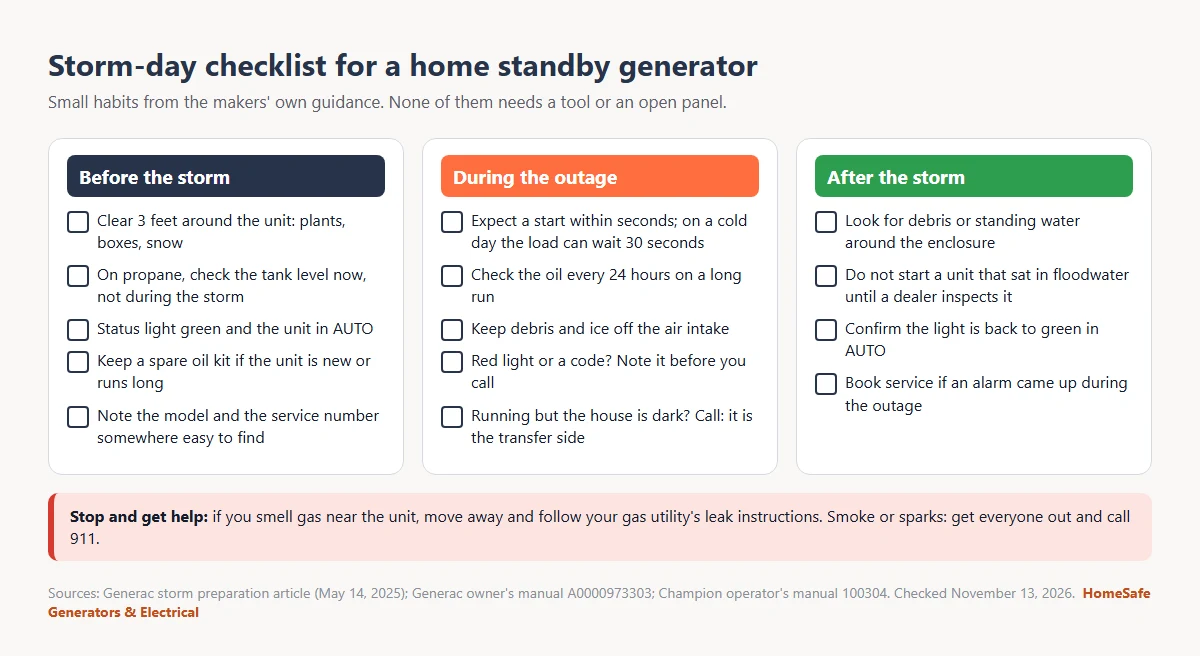
These are small habits that help a generator do its job. Generac’s own storm advice asks for at least 3 feet of clearance around the unit and an oil check every 24 hours during a long run (Generac, preparing a standby generator before a storm, May 14, 2025, checked November 13, 2026).
- Keep 3 feet around the unit clear of leaves, boxes and stored items, and trim plants back from the enclosure.
- If you run on propane, check the tank level before a forecast storm and not during it.
- Check the status light now and then. A yellow light is a maintenance reminder or a warning, not an emergency.
- Keep the control panel code and the service number somewhere easy to find.
- After a storm, look at the unit for debris or standing water before you assume anything is wrong. If it sat in floodwater, do not start it until a dealer has inspected it, as Champion’s manual advises.
Take it with you: download the storm-ready checklist (one-page PDF) to keep with the generator’s manual.
7. How to vet any generator repair company
Whoever you call, ask the same questions, and run them on HomeSafe too.
| Ask | A good answer |
|---|---|
| Do you service my brand, including a unit you did not install? | A clear yes for your brand, with no pressure to buy a new unit |
| Is the company a licensed electrical contractor? | Yes, with a license number you can check on the TDLR license search. HomeSafe’s is Texas Electrical Contractor License #41809. |
| Will you tell me the cost before you dispatch? | Yes, including any after-hours rate |
| Do you answer the phone at night and on holidays? | A real person or an on-call team, not only a voicemail |
| Will you test the transfer switch, or only run the engine? | A transfer test, not just a run test |
| Who is accountable if the problem comes back? | One company, from the first call to the final walkthrough |
8. Storm season across DFW
North Texas outages come in two kinds. Summer storms and heat can knock out power in Fort Worth and across Tarrant County. Winter ice does the same in Southlake, Collin County towns like Plano and Frisco, and Denton County. In Argyle, a power outage also stops well pumps, gates and barn equipment, and some properties run on propane instead of natural gas. Those details decide what a service visit needs to check. For the grid background, see how reliable the Texas grid is for DFW.
9. If you do not have a generator yet
If you are reading this because you wish you had a generator tonight, the process begins with a free estimate visit of 30 to 60 minutes and runs through internal review, permitting, installation, startup, and a generator school and outage simulation. Most installs are finished 3 to 5 weeks after the equipment arrives, and the work at your home usually takes one day. The how an installation works page explains each step, generator permits in DFW covers the permit side, and the generator installation page lists what is installed. To pick the right size, start with what size generator you need, and read whether a generator can affect your home insurance.
In this series: what generator maintenance includes · Generac error codes · when a generator will not start
Quick answers
Is it safe to run a generator during a storm?
Yes, for a home standby generator installed to its maker’s manual: it is built to run outdoors in its enclosure and start on its own. Keep 3 feet around it clear and check the oil every 24 hours on a long run. Do not start one that sat in floodwater until a dealer has inspected it. A portable generator must stay outdoors, at least 20 feet from the home.
How long can I run a generator in an emergency?
As long as the fuel lasts. Generac publishes no maximum run time for its standby units; it asks you to check the oil every 24 hours during multi-day runs. On natural gas, that means as long as the supply holds. On propane, a Generac 26kW unit uses 2.05 gallons an hour at half load, so tank size sets the limit.
Where should a generator go during a storm?
A standby generator stays where it was installed, outdoors on its pad with its clearances kept clear of debris. A portable generator goes outdoors only, at least 20 feet from the home, with the exhaust pointed away from windows and doors, never in a garage, porch or shed, and on a dry surface.
If your generator is down right now, call (817) 439-9009. Emergency service is available 24/7, every day including holidays. After-hours and emergency rates apply depending on the circumstances, and you are told what they are before a technician is dispatched. To talk about a maintenance plan before the next storm, contact HomeSafe. HomeSafe has a 5.0 rating across 200+ Google reviews, all on the reviews page.