
Last reviewed: November 2026
Most homeowners hire an electrician a handful of times in all the years they own a house. A breaker that keeps tripping, a panel an insurer has asked about, an EV charger, an older home that needs bringing up to date. Each time, you are letting someone work on the system that powers everything else, and most of what they do ends up behind a wall or a panel cover where you will never see it. Knowing how to find a good electrician matters more than the size of the job suggests.
Here is the short answer. Check eight things: that the company holds an active Texas electrical contractor license on TDLR’s license search; that a licensed master electrician stands behind the work; that the company is insured; that it is registered with your city and pulls the permit; that it has done your kind of job; that it looks at your panel before giving a firm price; that the price and scope are in writing with its license number on them; and what happens after hours. The first and fourth you can check yourself in minutes. The rest are questions with plain answers.
This guide is for homeowners in Fort Worth, Dallas, Arlington, Plano, Keller, Southlake and across DFW and North Texas. Each check explains why it matters, what a good answer sounds like and how to verify it, and ends with where HomeSafe stands, so you can run the same checks on us first. For the services themselves, see our residential electrical services.
1. Which checklist fits your job
This checklist is for electrical work on its own: panels, service upgrades, circuits, EV chargers, surge protection, inspections and repairs. If you are buying a standby generator, the questions change. Brand dealer status, the outage test and who services the unit afterward matter as much as the license, and our questions to ask a generator installer covers those.
One fair point before the list. Size is not a check. A one-truck company with an active license, a master electrician, a city registration and clear paperwork passes every item here. The checks are about the license and the paperwork, not the logo on the truck.
2. The checks
Check 1: The company’s electrical contractor license
TDLR says anyone who performs or offers to perform non-exempt electrical work in Texas must be licensed and must do that work through a licensed electrical contractor (TDLR, Electricians program). The individual electrician holds one license; the business you hire holds another. To check it, use TDLR’s license search and search by company name or license number, as TDLR’s own FAQ suggests (TDLR, Electricians FAQ). A good answer is an electrical contractor license that is active and in the same name as the quote.
You can also check the paperwork. TDLR requires the contractor’s name, address, phone number and license number on all proposals, invoices and written contracts, and its name and license number on both sides of each vehicle, in lettering at least two inches high (TDLR, Electricians Compliance Guide, sections 5.1.1 and 5.2.2).
Where HomeSafe stands: HomeSafe works under Texas Electrical Contractor License #41809, listed on TDLR’s public license search.

Check 2: Who does the work, and who supervises it
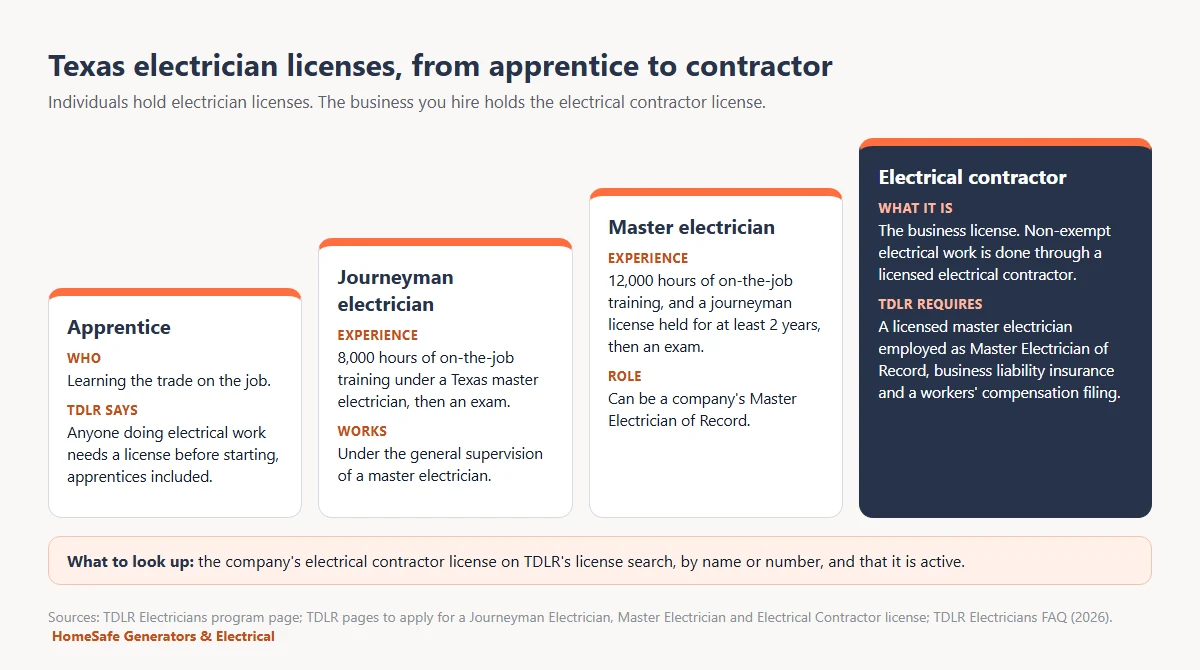
Texas licenses individual electricians by level. The ones you are most likely to meet on a home job are these.
| License | What TDLR requires | What it means for you |
|---|---|---|
| Apprentice electrician | A license before starting any electrical work; there is no grace period | Learning on the job, under supervision |
| Journeyman electrician | 8,000 hours of on-the-job training under a Texas master electrician, and an exam | Works under the general supervision of a master electrician |
| Master electrician | 12,000 hours of on-the-job training, a journeyman license held for at least 2 years, and an exam | The level a company assigns as its Master Electrician of Record |
| Electrical contractor | Employs a licensed master electrician as Master Electrician of Record, plus insurance and a workers’ compensation filing | The business license you look up before hiring |
Sources: TDLR, Apply for a new Journeyman Electrician, Master Electrician and Electrical Contractor license pages; TDLR Electricians FAQ, question 1.5.1.
A good question is simple: who will be at my house, and which master electrician is responsible for the work? A good answer names the person who leads the electrical work.
Where HomeSafe stands: HomeSafe’s electrical work is led by Ty Shaver, a licensed master electrician.
Check 3: Insurance
TDLR requires electrical contractors to maintain business liability insurance and to file either proof of workers’ compensation coverage or a statement that they have elected not to carry it (TDLR, Apply for a new Electrical Contractor license). Ask for a certificate of insurance before work starts, in the same company name as the license.
Where HomeSafe stands: HomeSafe is licensed and insured.
Check 4: City registration and the permit
Cities add their own step. In Fort Worth, anyone obtaining a permit under the city’s electrical code must have a valid contractor registration on file with Development Services, and the electrical registration requires a State of Texas electrical contractor license (City of Fort Worth, Contractor Registration). Dallas says its permitting system will not issue a permit to a contractor that is not registered, has an expired registration or whose insurance has expired (City of Dallas, Electrical Contractor Registration requirements, 2024). TDLR says state law bars a city from collecting certain fees from a state-licensed electrician, aimed at fees to register a state license, but not building permit fees (TDLR FAQ 9.3). In Plano, Frisco, Arlington and other cities, ask the city’s building permit office what it requires.
The question to ask is: who pulls the permit, and will I see the passed inspection? A good answer is the contractor’s name on the permit. If you are asked to pull a homeowner’s permit for work someone else is paid to do, stop. Dallas’s homeowner permit, for example, requires the homeowner to attest that no one is paid to do any part of the work, and it allows electrical repairs only after the homeowner passes a city exam (City of Dallas, Homeowner’s Exemption, 2025).
Where HomeSafe stands: HomeSafe pulls the permit on every job that needs one, sees the inspection through, and you receive the completed permit card.
Check 5: Experience with your kind of job
Electrical work is not one job. Ask what the company does most and match it to yours:
- Older homes: aluminum branch wiring, fuse boxes, Federal Pacific and Zinsco panels. See electrical risks by decade of construction.
- Panels and service upgrades: a load calculation, the meter base and working with the utility. See signs you need a new panel and service upgrades with Oncor.
- Circuits: a dedicated circuit for the appliance that keeps tripping, GFCI protection, garage and workshop circuits and lighting, all on the electrical services page.
- EV chargers and surge protection: see EV charger installation and whether whole-home surge protection is worth it.
- Generator hookups: a transfer switch, and the generator checklist linked in section 1.
Recent reviews that describe jobs like yours are worth more than a star count.
Where HomeSafe stands: panel replacements and upgrades, EV chargers, transfer switches, whole-home surge protection, the $295 safety inspection, and circuit, garage, workshop and lighting work, with a 5.0 rating across 200+ Google reviews.

Check 6: A look at your panel before a firm price
The same job can be small in one house and large in the next, depending on the panel, the distance from the panel to the work and what is already on it. A firm price for panel or service work given over the phone, without anyone seeing the panel, is a guess. A good answer is a visit, a look at the panel and, for anything that adds load, a load calculation before a recommendation.
Where HomeSafe stands: estimates are free, your load is checked before a panel is recommended, and each job is quoted after we have seen your panel.
Check 7: How the price is given, and what is in writing
Electricians price work in different ways: by the hour plus materials, or as a fixed price for a defined job. Either is fair if you know which one you have. A written quote should state the scope of the work, how it is priced, whether the permit is included, and the contractor’s name, address, phone number and license number, which TDLR requires on every proposal. For equipment such as a panel, a surge protective device or an EV charger, ask which maker and model will be installed.
Where HomeSafe stands: estimates are free, electrical work is billed at $200 per hour plus materials, the whole-home safety inspection is $295, and you get a written quote before work starts.
Check 8: After hours and emergencies
Ask whether the company answers outside office hours, and how after-hours work is charged. A good answer explains the rates before anyone is sent.
Where HomeSafe stands: HomeSafe answers 24 hours a day, every day including holidays, on (817) 439-9009. After-hours and emergency rates apply depending on the circumstances, and you are told what they are before a technician is dispatched.
3. Red flags
- No license number on the proposal, the invoice or the truck. TDLR requires it on all three.
- A handyman offering panel or circuit work. TDLR defines electrical work as “any labor or material used in installing, maintaining, or extending an electrical wiring system”, and anyone who does it must be licensed unless an exemption applies.
- No permit, or a request that you pull it yourself for work someone else is paid to do.
- A firm price for panel or service work before anyone has seen the panel.
- Work on the service by anyone but a licensed electrician. Fort Worth’s Homestead Electrical Affidavit says even homeowners “may not work on the service” (City of Fort Worth, homestead affidavits).
About doing it yourself: TDLR says a homeowner working on a home they own and live in is not required by the state to be licensed, but “municipal or regional regulations may override these exemptions” (TDLR, exemptions). Panels, the service and anything that needs a permit are work for a licensed electrician.
4. The checks at a glance
| Check | A good answer | How to verify | Where HomeSafe stands |
|---|---|---|---|
| 1. Contractor license | Active Texas electrical contractor license | TDLR license search; number on quote and truck | License #41809 |
| 2. Who leads the work | A named licensed master electrician | Ask; TDLR search by name | Ty Shaver, licensed master electrician |
| 3. Insurance | A certificate in the license name | Ask for the certificate | Licensed and insured |
| 4. City and permit | Registered with the city; contractor pulls the permit | City permit office; the permit itself | Permit pulled on every job that needs one; completed permit card to you |
| 5. Your kind of job | Does it regularly | Ask; read recent reviews | Panels, EV, transfer switches, surge, inspection, circuits; 5.0, 200+ reviews |
| 6. A look first | Visit and load check before a firm price | Ask how the price is set | Free estimate; quoted after seeing the panel |
| 7. In writing | Scope, pricing, permit and license number on the quote | Read the quote | $200 per hour plus materials; written quote before work |
| 8. After hours | Rates explained before dispatch | Ask | 24/7 on (817) 439-9009, rates explained first |
5. Calling HomeSafe
HomeSafe is locally owned, not a franchise, and has worked across DFW since 2021. Our 6 technicians and 5 service trucks cover Tarrant, Denton, Collin and Dallas counties, including Keller, Southlake, Plano, Dallas, Fort Worth, Frisco and Highland Park. If your job is a panel, start with the panel upgrade page; if you want the whole system checked first, the electrical safety inspection is $295 with a written report you keep.
In this series: signs you need a new panel · 100 vs 200 amp service · service upgrades and Oncor · older home risks by decade · whole-home surge protection · transfer switch vs interlock · electrical safety inspections · panel upgrade cost · EV charger installation · what happens at a free estimate · permits for a panel upgrade
Quick answers
How do I choose a good residential electrician in DFW?
5 checks cover most of it: an active Texas electrical contractor license on TDLR’s license search, a licensed master electrician behind the work, registration with your city and a permit where one is needed, a look at your panel before a firm price, and the scope and price in writing with the license number on it.
How do I check an electrician’s license in Texas?
1 search does it: TDLR’s license search, by company name or license number. Look for an electrical contractor license that is active and in the same name as your quote. TDLR also requires the license number on proposals, invoices and contracts, and on both sides of each work vehicle.
What is the difference between a master electrician, a journeyman and an electrical contractor?
3 licenses, 3 roles. A journeyman has 8,000 hours of supervised training and works under a master electrician. A master electrician has 12,000 hours and at least 2 years as a journeyman. An electrical contractor is the business license, and it must employ a licensed master electrician.
What questions should I ask an electrician before hiring?
8: What is your contractor license number? Which master electrician leads the work? Can I see your certificate of insurance? Are you registered with my city, and who pulls the permit? Have you done this kind of job? Will you look at my panel before pricing? Is the price hourly or fixed, and in writing? How are after-hours calls charged?
Does an electrician need to be registered with my city?
Yes, in Fort Worth and Dallas, to pull a permit. Fort Worth requires a contractor registration on file, which needs a state electrical contractor license, and Dallas will not issue a permit to an unregistered contractor. In other cities, ask the building permit office.
What should an electrician’s quote include?
4 things at least: the scope of the work, how it is priced (hourly plus materials or a fixed price), whether the permit is included, and the contractor’s name, address, phone number and license number, which TDLR requires on every proposal.
Can a handyman do electrical work in Texas?
No, not unless an exemption applies. TDLR says anyone who performs electrical work must be licensed, and defines it as any labor or material used in installing, maintaining or extending an electrical wiring system. One exemption covers a homeowner working on a home they own and live in, and cities can override it.
Why hire a licensed electrician instead of doing it yourself?
The law and the permit usually point that way. Texas exempts homeowners working on a home they own and live in, but cities can override it, and Fort Worth’s homestead affidavit says homeowners may not work on the service. A licensed contractor pulls the permit and the city inspects the work.
Which electricians in DFW offer free consultations?
HomeSafe does. Estimates for panel upgrades, EV chargers, transfer switches, surge protection and circuit work are free. The whole-home safety inspection is a separate assessment at $295.
To talk to a licensed electrician, contact HomeSafe or call (817) 439-9009, or start from our electrical services page. HomeSafe holds Texas Electrical Contractor License #41809 and has a 5.0 rating across 200+ Google reviews, which you can read on our reviews page.