
Last reviewed: November 2026
A generator only helps your home if its power can reach your panel safely. Most of the advice online on how to do that comes from forums, and it mixes portable and standby generators, safe hookups and dangerous ones. This guide sorts it out, because the way a generator connects matters as much as the generator itself.
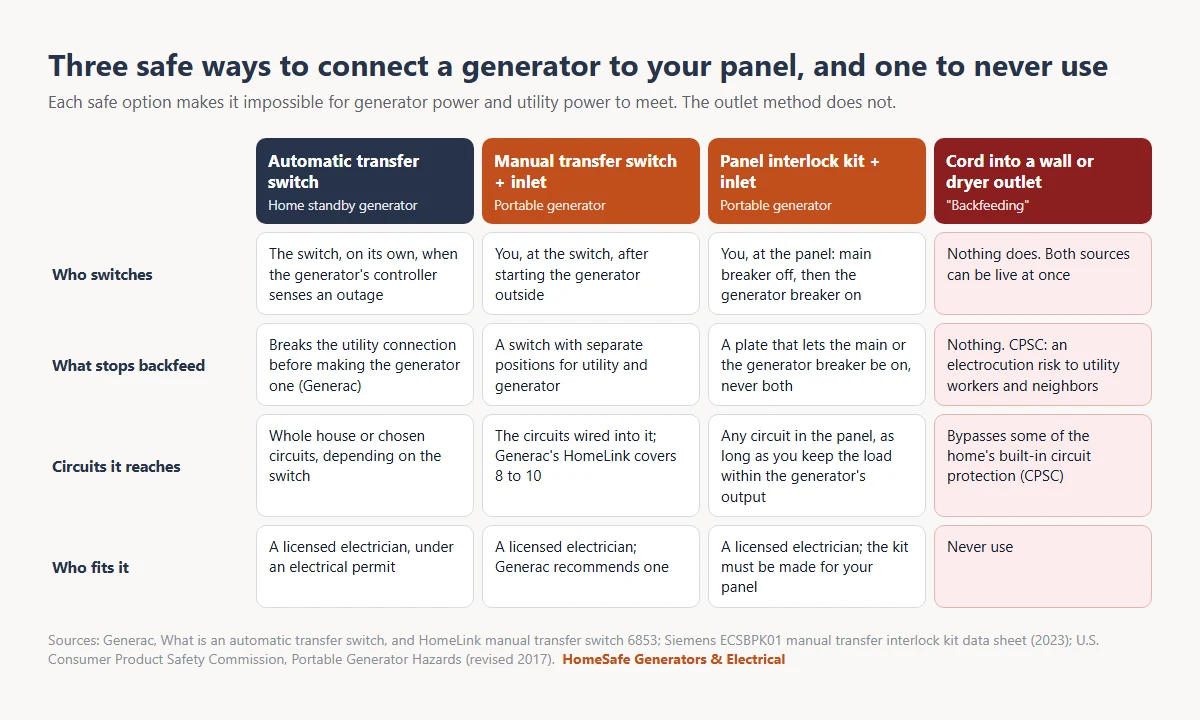
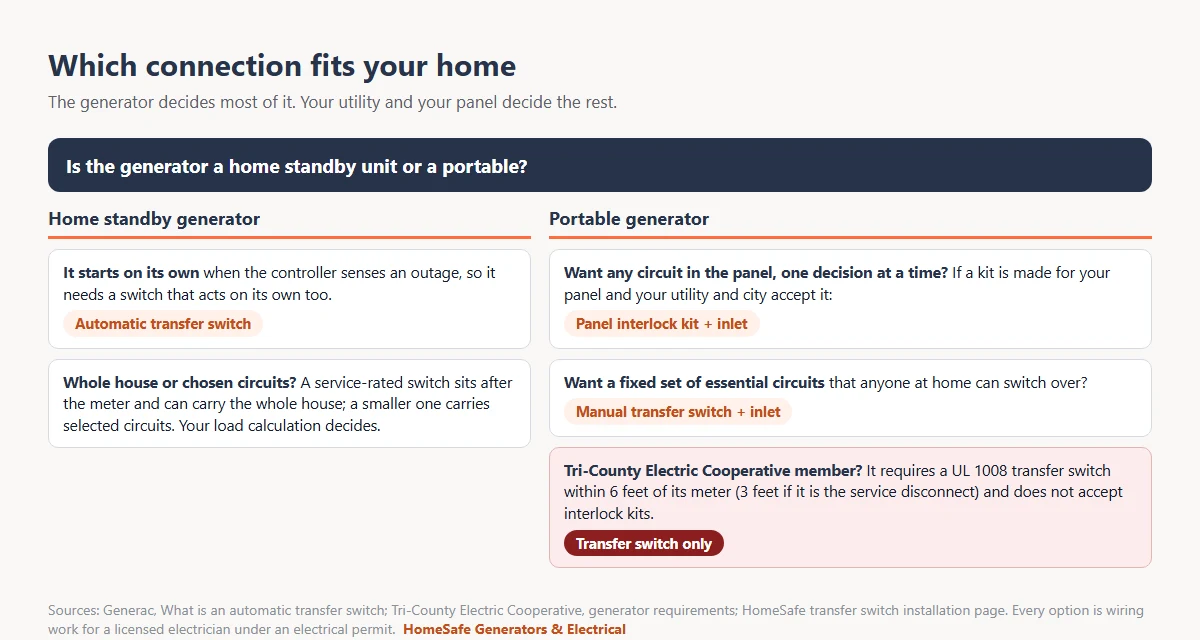
Here is the short answer. A home standby generator connects through an automatic transfer switch that moves your home from the utility to the generator on its own. A portable generator connects through either a manual transfer switch or a panel interlock kit, each fed from an inlet box on the outside wall. An interlock lets you run any circuit in the panel, as long as you manage the load. A manual switch runs only the circuits wired to it, and you switch over at the switch rather than at the main breaker. All three stop generator power from flowing back onto the utility lines. Plugging a generator into a wall or dryer outlet does not, and the U.S. Consumer Product Safety Commission says never to do it. Every option is wiring work for a licensed electrician under a permit.
This guide is for homeowners in Fort Worth, Dallas, Arlington, Plano, Frisco, Keller, Denton and across DFW and North Texas who own a portable generator or are weighing a standby one. If you already know which you need, our transfer switch installation page is where to book. For running a portable safely during an outage, see how to use a generator during a power outage.
1. Why the connection matters: backfeed
When the grid goes down, the lines outside your house are still connected to your panel. If generator power reaches your panel while it is still connected to the utility, it can flow out through your meter and onto those lines. That is called backfeed.
CPSC is direct about it: “NEVER try to power the house wiring by plugging the generator into a wall outlet, a practice known as ‘backfeeding.'” It says this is “extremely dangerous and presents an electrocution risk to utility workers and neighbors served by the same utility transformer,” and that it “bypasses some of the built-in household circuit protection devices” (CPSC, Portable Generator Hazards, revised 2017). Tri-County Electric Cooperative, which serves members across North Texas from Azle, warns that “if a generator is improperly installed, power from the generator could energize utility lines and injure linemen” (Tri-County, generator requirements, 2026).
Every safe connection does one thing: it makes it impossible for your home to be connected to the utility and the generator at the same moment. The three options below do that in different ways.
2. Automatic transfer switch: for home standby generators
An automatic transfer switch, or ATS, moves your home’s power from the utility to a backup generator. Generac says the switching happens when the generator’s controller senses an outage, and that “the switch must break a connection with one source of power before making a connection with the other,” which “eliminates the possibility of back-feeding” (Generac, What is an automatic transfer switch, 2026). When the utility returns, the switch moves your home back and the generator cools down and stops. Nobody has to be home.
That is why an ATS pairs with a standby generator and not with a portable one. Generac notes that portable generators lack the circuitry to control an ATS. Generac, Kohler and Champion all pair their home standby generators with their own automatic switches, and the seconds each one waits before it transfers are compared in how a standby generator works.
An ATS can carry the whole house or a chosen set of circuits. Many home switches are service rated, so they sit right after the meter and switch everything. Load management can then hold back big loads, such as the air conditioning, so a smaller generator can still cover the house. A load calculation decides which approach fits, and our generator sizing planner is a good place to start.

3. Manual transfer switch with an inlet: for portables, set circuits
A manual transfer switch is a small panel of its own, mounted beside your main panel and wired to the circuits you choose ahead of time. Outside, an inlet box takes the generator’s cord. In an outage you start the generator outdoors, plug the cord into the inlet, and move each circuit’s switch from utility to generator.
Generac’s HomeLink manual transfer switch is a typical example. Generac says it works with generators from 5kW with a 30 amp L14-30 outlet and “can safely deliver power to 8-10 of your most essential circuits,” that its inlet boxes come in 30 amp and 50 amp versions, and that “installation by an electrician” is recommended (Generac, HomeLink 6853, 2026).
- Strength: the circuits are labeled and fixed, so anyone at home can switch over without touching the main panel.
- Limit: only the circuits wired to it can run. A circuit you did not choose stays dark until an electrician adds it.
4. Panel interlock kit with an inlet: for portables, any circuit
An interlock kit is a sliding plate or bracket fitted to your existing panel. It sits between the main breaker and a breaker that takes generator power from the inlet. The plate lets one of them be on, never both, so the main breaker has to be off before the generator breaker can be turned on. Siemens, for example, sells its kit as a “manual transfer interlock kit” for load centers and meter combinations that accept two-pole breakers opposite one another (Siemens ECSBPK01 data sheet, 2023).
Using one is a set sequence: start the generator outdoors, plug in at the inlet, switch the main breaker off, slide the plate, then switch the generator breaker on. You then turn on only the circuits your generator can carry. When the grid comes back you reverse it.
- Strength: any circuit in the panel can run, one decision at a time, and the whole thing lives inside the panel you already have.
- Limit: you manage the load yourself. Turn on more than it can carry and you overload the generator.
- Fit: kits are made for specific panel lines and main breakers, and the panel needs room for the generator breaker. An older or full panel may need work first; see electrical panel upgrades, or book an electrical safety inspection if you are unsure what your panel is.
- Acceptance: under the electrical code, equipment is acceptable only once it is approved by the authority having jurisdiction, usually your city’s electrical inspector (IAEI Magazine, The Inspector’s Approval), and utilities set their own rules at the meter. Ask your city’s permit office before you buy a kit. Tri-County Electric Cooperative, for example, says plainly that “interlock kits are not acceptable” and requires a UL 1008 transfer switch within 6 feet of its meter, or 3 feet if the switch is also the service disconnect (Tri-County, 2026).
To be fair, if your outages are short and you only need a few circuits, a portable generator with an interlock kit may be all you need. Not every home needs a standby system. HomeSafe installs both automatic transfer switches and interlock kits, and the transfer switch page explains how a hookup visit works.
5. Side by side
| Automatic transfer switch | Manual transfer switch + inlet | Interlock kit + inlet | |
|---|---|---|---|
| Generator | Home standby | Portable | Portable |
| Who switches | The switch, automatically | You, at the switch | You, at the main panel |
| Circuits | Whole house or selected, by design | Only those wired to it (8 to 10 on Generac’s HomeLink) | Any circuit in the panel |
| Load control | Load management modules can shed big loads | Set by the circuits chosen | You decide, breaker by breaker |
| Works while you are away | Yes | No | No |
| Tri-County members | UL 1008 switch near the meter | UL 1008 switch near the meter | Not accepted |
| Best for | Long outages, large homes, hands-off backup | A fixed set of essentials anyone can switch | Flexible use of a portable on a compatible panel |
Sources: Generac ATS article and HomeLink 6853 page; Siemens ECSBPK01 data sheet (2023); Tri-County generator requirements (2026).
6. Rules in Texas and across DFW
The National Electrical Code deals with home backup generators that no law requires as optional standby systems, in Article 702, which covers permanent and portable systems alike. It requires the connection to your wiring to go through interconnection or transfer equipment that is “listed and installed to prevent the inadvertent interconnection of all sources of supply” (EC&M, Mike Holt, 2025). Texas adopted the 2026 edition of the code as the state electrical code from September 1, 2026 (TDLR, 2026).
Since September 1, 2025, Senate Bill 1252 stops cities from adopting or enforcing rules that regulate the installation or inspection of a residential backup system of up to 50kW, or 100kWh of storage. City-owned utilities keep that power in their own areas. Non-exempt work must still follow the NEC and be done by licensed Texas electrical contractors with licensed electricians (TDLR, SB 1252 notice, 2025). Cities still issue electrical permits for wiring changes, and our generator permit guide covers what Dallas, Fort Worth and other DFW cities ask for.
Who can do the work matters too. TDLR says a person working on a home they own and live in is not required by the state to be licensed, but adds that “municipal or regional regulations may override these exemptions” (TDLR, exemptions, 2026). Fort Worth’s Homestead Electrical Affidavit says homeowners “may not work on the service” and that such work “must be permitted and performed by a Master Electrician” (City of Fort Worth, homestead affidavits).
Utilities have their own rules at the meter. Where Oncor or CoServ delivers your power, HomeSafe pulls the meter where the switch connection needs it. On Tri-County lines the co-op handles that step on its own schedule, and as section 4 shows, it accepts transfer switches only. If the switch needs more capacity than your service has, the service itself may need an upgrade; our panel upgrade page explains how that is assessed.
7. What you can do yourself, and where to stop
Some of the preparation is yours, and it makes the electrician’s visit quicker.
- Know your generator. Note its running watts and the outlet it has, for example a 30 amp L14-30. That decides which inlet and switch fit.
- Photograph the panel label. The brand and amp rating are printed inside the door. Do not remove the cover to find them.
- List the circuits that matter. Refrigerator, furnace fan, well pump, a medical device, internet. This shapes whether a set-circuit switch or an interlock suits you. Medical equipment needs a review of your home first.
- Practice the sequence your electrician shows you, in daylight, before you need it.
- Keep the generator outside, at least 20 feet from doors, windows and vents, as CPSC advises.
Leave to a licensed electrician: fitting an inlet box, a manual switch or an interlock kit, adding the generator breaker, anything inside the panel or at the meter, and any cord with a plug on both ends. If you find a generator wired into a house without a switch or interlock, stop using it and call an electrician.
8. How HomeSafe handles it
HomeSafe installs automatic transfer switches for standby generators and interlock kits for portable generator hookups, including for a generator you bought elsewhere, whatever the brand. The visit starts at the panel and the generator, a load calculation sets the switch, and the written quote covers the switch, the permit and the inspection in one total. Estimates are free. If you also want surge protection, it is easiest to add while the panel is open; see whole-home surge protection.
The electrical work is led by Ty Shaver, a licensed master electrician, under Texas Electrical Contractor License #41809. For standby generators, HomeSafe is a Generac PowerPro Premier dealer, the Generac tier that requires at least four factory-trained technicians, and a dealer and installer for Kohler and Champion. See Generac, Kohler and Champion, or generator installation for how a standby install runs from the first visit. Our 6 technicians and 5 service trucks cover Tarrant, Denton, Collin and Dallas counties, from Dallas and Plano to Keller and Southlake.
Emergency service is available 24/7, every day including holidays. After-hours and emergency rates apply depending on the circumstances, and you are told what they are before a technician is dispatched.
Related guides: how a standby generator works · using a generator in an outage · the best generator for a power outage · safe, reliable generator installation · what an electrical safety inspection covers
Quick answers
Which is better, a transfer switch or an interlock?
Neither, in general. A home standby generator needs an automatic transfer switch. For a portable, an interlock kit reaches every circuit in the panel if you manage the load, while a manual transfer switch runs only the circuits wired to it and is switched at the switch, not the main breaker. Your inspector and your utility can decide it: Tri-County does not accept interlock kits.
Are generator interlocks legal?
They can be. The electrical code requires transfer equipment to be listed and installed so the generator and the utility can never be connected at once, and whether a given kit is accepted is decided by your local electrical inspector, the authority having jurisdiction, and by your utility. Check with your city’s permit office first. Tri-County Electric Cooperative does not accept interlock kits and requires a UL 1008 transfer switch instead.
Is it illegal to connect a generator to a house without a transfer switch?
Yes, if it means plugging into a wall or dryer outlet. CPSC calls that backfeeding and says never to do it, because it puts utility workers and neighbors at risk of electrocution, and the electrical code requires listed transfer or interconnection equipment instead. The legal ways are a transfer switch or, where accepted, a panel interlock kit, either one fitted by a licensed electrician. Cords from a portable straight to appliances do not involve the panel.
What is a generator interlock kit and how does it work?
A plate fitted to your panel that lets the main breaker or the generator breaker be on, never both. You switch the main off, slide the plate and switch the generator breaker on, so generator power cannot reach the utility lines.
How does an automatic transfer switch work?
In 2 steps: it breaks the utility connection, then makes the generator connection. Generac says this happens when the generator’s controller senses an outage, and that breaking before making eliminates backfeeding. When the utility returns, the switch moves your home back on its own.
What is a manual transfer switch?
A small panel wired to the circuits you choose, fed by an inlet box for a portable generator’s cord. You start the generator and move each circuit to generator power by hand. Generac’s HomeLink, for example, covers 8 to 10 essential circuits from a 5kW or larger generator.
Do you need an interlock for a generator?
No, not if you have a transfer switch, and not if you only run cords from a portable straight to appliances. You need one of the two, a transfer switch or an interlock, whenever a generator feeds your home’s wiring through the panel.
Can I install a transfer switch or interlock kit myself?
No, in most DFW homes. It is work on your panel and service, it needs an electrical permit, and Fort Worth says homeowners may not work on the service at all. TDLR says cities may override the state’s homeowner exemption. Generac recommends an electrician even for its manual switch.
To have a generator connected, contact HomeSafe or call (817) 439-9009, or book through the transfer switch installation page. HomeSafe holds Texas Electrical Contractor License #41809 and has a 5.0 rating across 200+ Google reviews, which you can read on our reviews page.