
Last reviewed: November 2026
Most homes in DFW now run on electronics: the thermostat, the AC controls, the fridge, the washer, the garage door opener, the router and everything plugged into it. A surge lasts a tiny fraction of a second, but it can damage any of them. That is why more homeowners in Fort Worth, Dallas, Plano and Frisco ask us whether a whole-house surge protector is worth fitting.
Here is the short answer. It depends on what you want protected, and most homes benefit from both a whole-house device and plug-in protection. A whole-house surge protector sits at your panel or transfer switch and diverts surges to ground before they reach every circuit, including hardwired equipment no plug-in strip can cover. It is not enough on its own: sensitive electronics still need plug-in protection. And under the 2026 National Electrical Code, which Texas adopted on September 1, 2026, a surge protective device is required on new home services and wherever service equipment is replaced.
This guide explains how the device works, what it cannot do, what the code now says and how to decide for your own home. It is written for homeowners across DFW and North Texas, from Keller and Southlake to Arlington. To book a free estimate, see our whole-home surge protection page.
1. What a surge is
The National Institute of Standards and Technology explains it plainly. Lightning, short circuits, “poles knocked down by cars, or some other accident can make the voltage jump to hundreds, even thousands of volts.” A surge “will last only a few millionths of one second”, yet “it is enough to destroy or to upset your appliances” (NIST Special Publication 960-6, Surges Happen!, 2001).
NIST names two origins:
- Lightning surges. A strike near the home, or one that reaches the power, cable TV or phone lines, can induce a surge that travels in along the wires.
- Switching surges. These happen “when electrical loads are turned on or off” inside your home, “as well as by the normal operations of the power company.”
The second kind surprises most people. Square D, a Schneider Electric brand, says surges generated inside the home are “the more common type of surge”, and that a home “may experience up to 100 surges per month” (Square D whole home surge protection). That is a maker’s own figure, but the point stands: surges are not only a storm problem.
2. How a whole-house surge protector works
The name is a little misleading. NIST notes that these devices neither suppress nor stop a surge. They “simply divert it to ground, where it can do no harm.” Square D describes the parts that do it, “Metal Oxide Varistors (MOVs)”, which send excess voltage “to the load center’s ground wire before it can reach your home’s connected electronics.”
The device mounts at the service, at your panel or at a generator transfer switch, so every circuit in the house sits behind it. The code recognizes two types for this job (Leviton, NEC 230.67 flyer, 2026):
| Type 1 | Type 2 | |
|---|---|---|
| Where it can go | Between the utility transformer and the line side of the service equipment, or on the load side | On the load side of the service equipment, typically at the panel |
| What Leviton says it protects against | External surges from lightning or utility capacitor bank switching | Residual lightning energy, motor-driven surges and other internally generated surges |
| Meets NEC 230.67 for a home | Yes | Yes |
Installation quality matters as much as the device. Siemens tells installers to mount its unit “as close to panel or equipment as possible to keep leads short”, because “long leads hurt performance” (Siemens FirstSurge data sheet, 2017). That is one reason it is electrician’s work.

3. Where surges come from in a DFW home
Every home sees switching surges from its own AC compressor, pool pump, dryer and garage door motor. On top of those, North Texas adds storm season and the occasional outage. When power drops and comes back, Ready.gov’s advice is to “Disconnect appliances and electronics to avoid damage from electrical surges” (Ready.gov, power outages).
You do not need to worry about every storm, but it helps to know when the risk is higher. Our guides to seasons of risk in DFW, spring storms and hurricane remnants and Texas grid reliability cover the weather and grid side.
4. What it cannot do
A whole-house device is a strong first layer, but it has limits, and an honest guide should say so.
- It does not cover everything that enters the house. Cable TV, satellite and phone lines are other paths for a surge. NIST calls equipment linked to both power and a communication line “two-link” appliances. It says these can be damaged even when there are surge protectors on each line, and points to a plug-in protector that carries both the power and the cable or phone line.
- It is not a lightning shield. NIST says direct strikes are rare, and that lightning rods protect the structure but “do not prevent surges from happening in the wiring”. A surge device handles what arrives on the power line.
- It wears. NIST notes that electronic components “will age and have a limited life”. Many whole-house units show their status with indicator lights, so you can see when one needs replacing.
- It depends on a sound ground and bond. Siemens calls neutral-to-ground bonding that is not to code the “#1 cause of SPD failures”. That matters most in older homes, where grounding and bonding may predate today’s code.
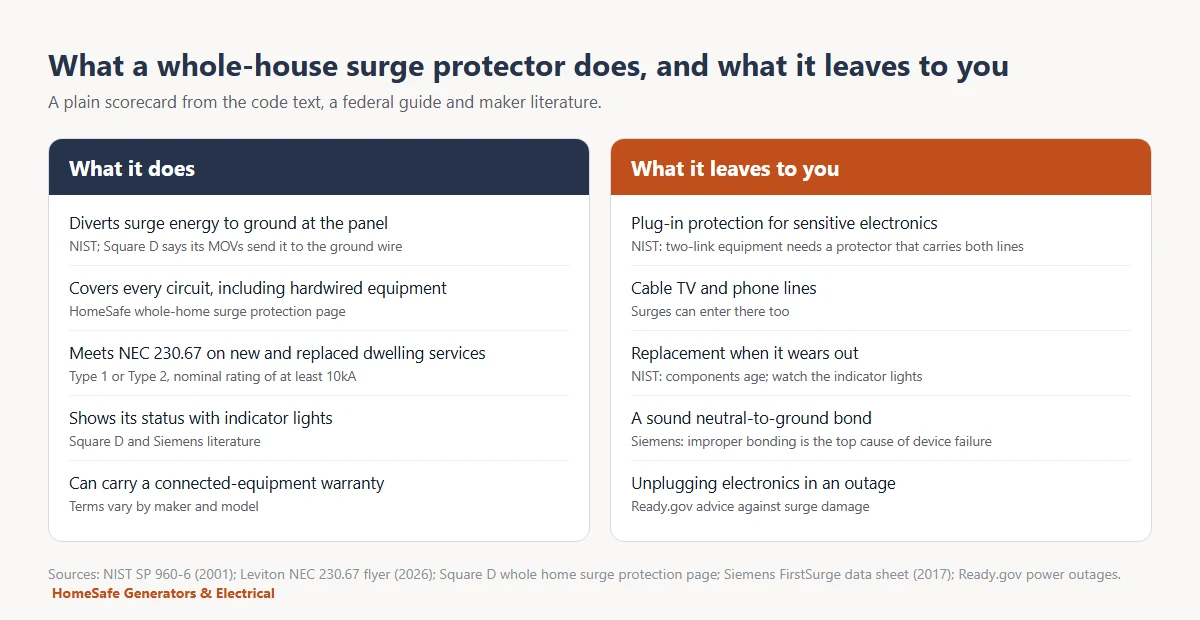
5. Is it worth it for your home?
It depends on what you want protected. One device covers every circuit, including the AC, range, water heater and other hardwired equipment that has no plug for a strip. It works with plug-in protectors rather than replacing them. The table shows where the case is strongest.
| Your situation | Our view | Why |
|---|---|---|
| Service equipment is being replaced, for example in a panel or service upgrade | Plan on it | NEC 230.67 applies where service equipment is replaced |
| A standby generator is being installed | Worth adding while the switch is open | It can be fitted at the transfer switch during the installation |
| Smart appliances, hardwired HVAC controls, a home office | Strong case | Hardwired equipment has no outlet for a plug-in strip |
| Expensive TVs, computers and networking gear | Yes, with plug-in protectors as well | NIST: two-link equipment needs protection at the device too |
| A rental, or few electronics and no hardwired equipment you worry about | Plug-in protectors may be enough | The whole-house device adds less where there is less to protect |
That last row is a fair concession. If there is little to protect, good plug-in protectors at the outlet may be all that is practical. Where there is hardwired equipment you want protected, the whole-house device is the layer that covers what strips cannot.
Some devices also carry a warranty on the equipment connected to them. Terms vary by maker and model, and the fine print matters. Square D, for example, offers “warranties up to 5 years and $100,000 in connected equipment” on its current US surge page, with LED indicator lights to show status. Read the warranty for the exact device you are getting before you count on it.
6. What the code says in Texas
Surge protection moved from an option to a code requirement for new home services in 2020. Leviton summarizes the history: “Article 230.67 of the 2020 NEC requires a Type 1 or Type 2 surge protective device (SPD) for all services supplying dwelling units, installed integral to or adjacent to the service equipment, including replacements.” The 2023 and 2026 editions widened it to other sleeping occupancies. Texas adopted the 2026 NEC as the state electrical code on September 1, 2026 (TDLR, September 1, 2026).
| NEC 230.67 (2026 edition) | What it says |
|---|---|
| (A) Surge-protective device | All services supplying dwelling units shall be provided with an SPD |
| (B) Location | Integral to the service equipment or immediately adjacent to it |
| (C) Type | Type 1 or Type 2 |
| (D) Replacement | Where service equipment is replaced, all of the requirements apply |
| (E) Ratings | Nominal discharge current rating (In) of not less than 10kA |
Text as reproduced in the Leviton NEC 230.67 flyer (2026). Cities can add local amendments.
In practice, the rule applies to new services and to service equipment that is replaced. If you are replacing service equipment, as part of a panel replacement or service upgrade, it comes with the job.
7. Ratings, size and lifespan
Two numbers matter on the label. The code minimum is a nominal discharge current rating of at least 10kA. The surge current capacity is the larger figure makers advertise. Siemens’s FirstSurge data sheet (2017), for example, lists 60,000, 100,000 and 140,000 amp versions, matched to a surge exposure map based on “thunderstorm frequency, geographic location, and home size”. Look for a UL 1449 listing, which the same data sheet names as the standard that addresses these devices.
There is no fixed lifespan. NIST says well-designed protectors “might reach their end of life prematurely if exposed to some exceptionally high and rare stress”, and that failure from high line voltage is more likely than from very large surges. That is why the indicator lights matter. Siemens’s 2017 data sheet says its FirstSurge units “will let you know when there is something wrong or when they are worn out.” If the lights on yours change, call an electrician to check it. Each device we fit is matched to your panel and carries its manufacturer’s warranty.
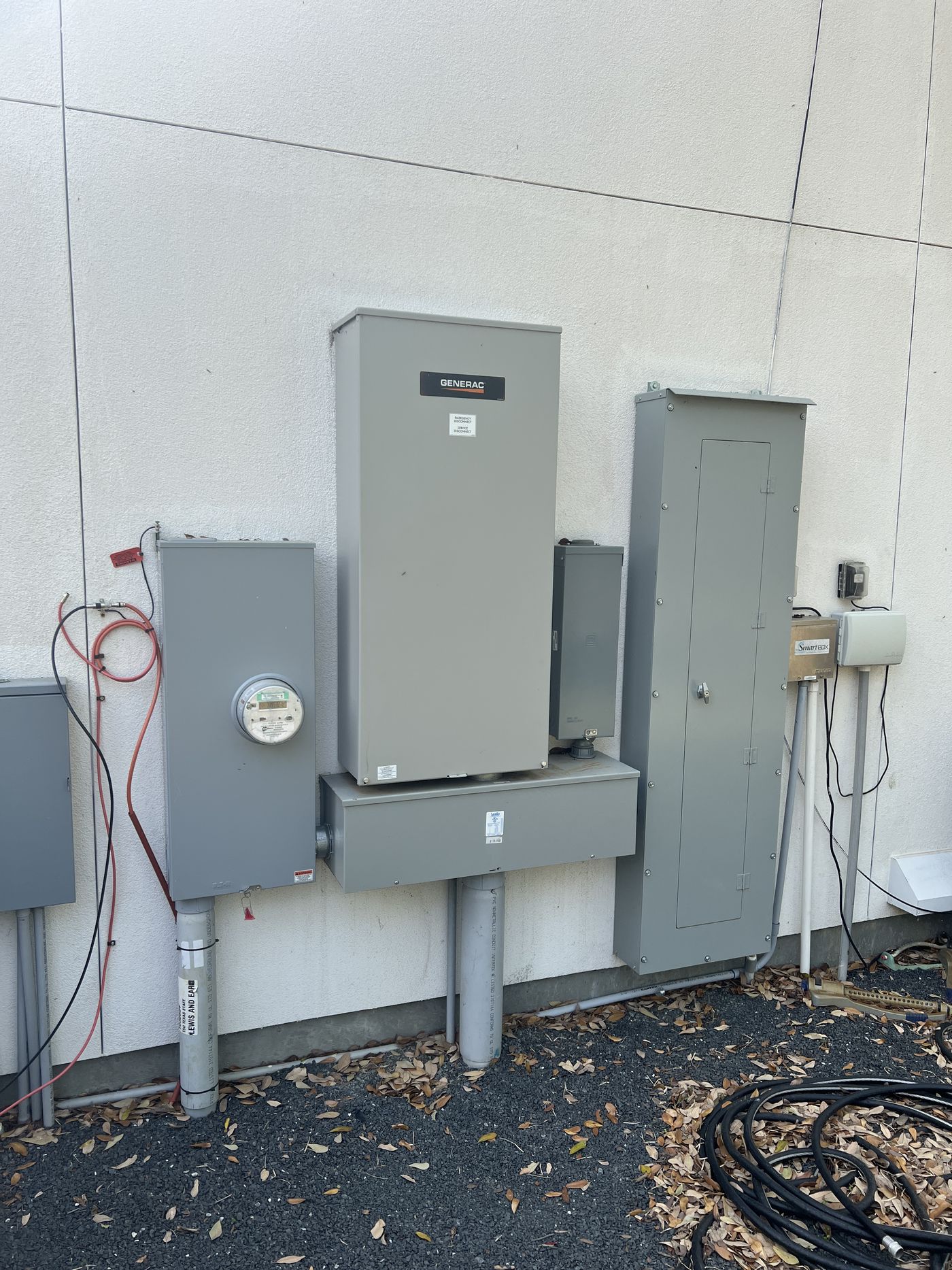
8. Getting it installed in DFW
A whole-house surge protector mounts at the panel or transfer switch, which is work on your service. NIST says this kind of installation “is best left to a licensed electrician.” In Fort Worth, the city’s homestead affidavit says homeowners may not work on the service, which “must be permitted and performed by a Master Electrician” (City of Fort Worth, Homestead Electrical Affidavit).
The easiest time is when the equipment is already open. That means a panel upgrade, a transfer switch installation or a standby generator installation, where we can fit it at the transfer switch during the installation. If you are adding an EV charger or having a $295 safety inspection, ask about it at the same visit.
HomeSafe fits whole-house surge protectors across DFW and North Texas, with the permit and inspection handled. Estimates are free, you get one written quote, and electrical work is billed at $200 per hour plus materials. Ty Shaver, a licensed master electrician, leads our electrical work, all done under Texas Electrical Contractor License #41809. We work from Dallas and Plano to Keller and Southlake. See all our electrical services.
In this series: what drives the cost of a panel upgrade · home electrical safety inspections · EV charger installation · electrical service upgrades and Oncor · 100 amp vs 200 amp service · signs you need a new panel · transfer switch vs interlock kit · older home electrical risks by decade
Quick answers
Is a whole house surge protector worth it?
It depends on what you want protected. It covers every circuit from the panel, including hardwired equipment a plug-in strip cannot reach, and most homes benefit from both. Pair it with plug-in protectors for sensitive electronics. Under the 2026 NEC it is required anyway on new services and when service equipment is replaced.
How does a whole house surge protector work?
It diverts surge energy to ground at the panel. Components called metal oxide varistors react to excess voltage and send it to the ground wire before it spreads to your circuits. A surge lasts only a few millionths of a second, so the device has to act that fast.
How long does a whole home surge protector last?
There is no set number of years. Its parts age with use, and a large surge or a fault on the power system can wear it out early. Many units have indicator lights that show when protection is lost, so check them and call an electrician if they change.
Do I need an electrician to install a whole house surge protector?
Yes. It mounts at the panel or transfer switch, which is work on your service. NIST says it is best left to a licensed electrician, and in Fort Worth homeowners may not work on the service at all.
Are whole home surge protectors required now?
Yes, for new home services and wherever service equipment is replaced. Section 230.67 of the National Electrical Code has required a Type 1 or Type 2 surge protective device on dwelling services since the 2020 edition, and Texas adopted the 2026 edition on September 1, 2026.
Will a whole house surge protector stop a lightning strike?
No, not on its own. It handles surges that arrive on the power line. Cable TV and phone lines are other ways in, and NIST notes that lightning rods protect the structure but do not stop surges in the wiring. Plug-in protectors and a sound grounding system cover the rest.
Do I still need plug-in surge protectors?
Often, yes, for sensitive electronics. NIST says equipment linked to both power and a cable or phone line, such as a TV, computer or router, can be damaged even when each line has its own surge protector, and points to a plug-in protector that carries both. The two do different jobs.
Who installs whole-home surge protection in DFW?
A licensed electrician. HomeSafe fits whole-house surge protectors at the panel or transfer switch across DFW and North Texas, under Texas Electrical Contractor License #41809, with free estimates and one written quote.
What size whole house surge protector do I need?
At least a 10kA nominal discharge rating, the NEC 230.67 minimum. Makers also advertise a larger surge current capacity; Siemens’s FirstSurge line, for example, came in 60,000 to 140,000 amp sizes matched to storm exposure and home size. An electrician matches the device to your panel and service.
Protect every circuit in your home
Tell us about your panel or your generator plans, and you get a straight answer on the right device and where it goes. Book a free estimate on our whole-home surge protection page, contact HomeSafe or call (817) 439-9009. HomeSafe has a 5.0 rating across 200+ Google reviews, which you can read on our reviews page.