
Last reviewed: November 2026
When the power goes out, most homeowners in DFW ask the same thing a few hours in: should I do something about this before it happens again, and if so, what? The honest answer is that there are four reasonable choices, a standby generator, a home battery, a portable generator, or doing nothing, and each one is the right answer for a different house.
HomeSafe installs standby generators, so that is the option this guide knows best, and it says so up front. All four are described fairly, including the situations where a battery or a portable unit is the better fit, because a choice made with the full picture holds up better than one made in the middle of an outage.
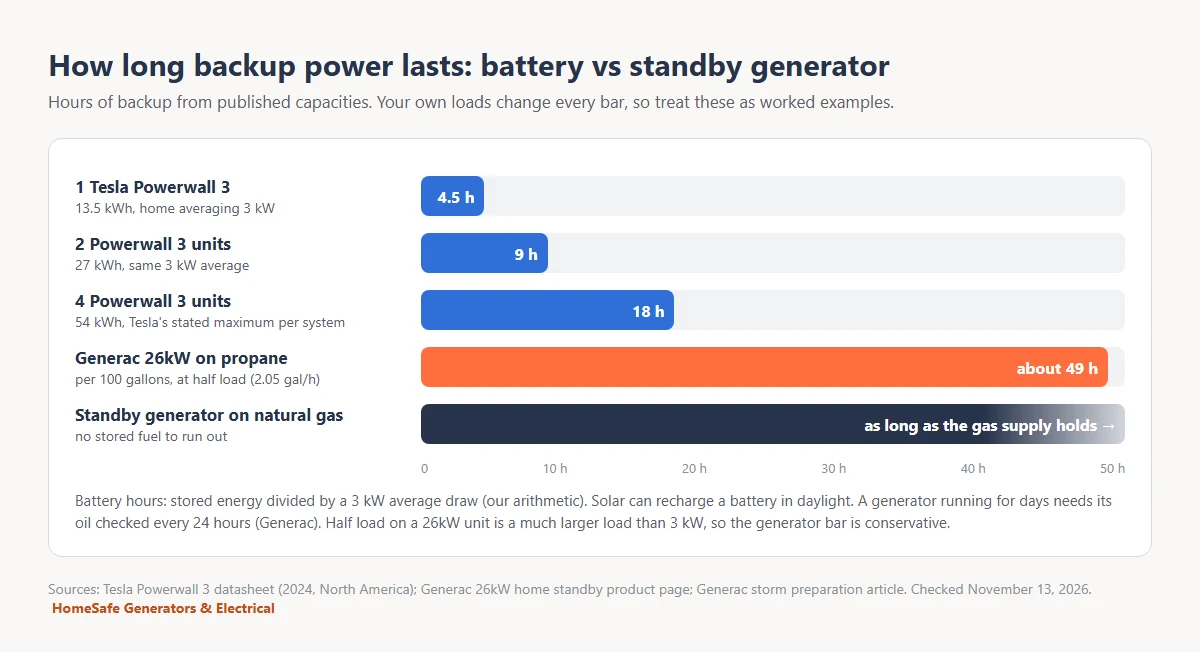
This guide is for homeowners in Fort Worth, Plano, Frisco, Southlake and across DFW who are deciding what, if anything, to install. The short answer: for most DFW homes, a standby generator suits outages that last days, and a home battery suits short outages, a home that already has solar, or a lot with no safe place for a generator. One Tesla Powerwall 3, for example, stores 13.5 kWh, about four and a half hours for a home drawing 3 kW on average. A portable generator covers a few essential circuits. Doing nothing is a real choice if you have a plan for a long outage.
1. Start with how your outages actually behave
The right backup depends on two things: how long the power is out, and what you need running while it is.
Texas runs its own grid, and most of us remember Winter Storm Uri in February 2021, with an official toll of 246 deaths (Texas DSHS mortality report, December 30, 2021). It is the reason many households began asking about backup power. Most outages are far shorter. Summer storms and hot afternoons that strain the grid in Fort Worth, Plano and Frisco usually mean hours, and the occasional ice event in Tarrant, Denton, Collin or Dallas County can mean longer. The grid background is in how reliable the Texas grid is for DFW.
Ask yourself three plain questions:
- How long? If the power is out for three days, what is your plan for day two?
- What must stay on? Refrigerator and lights only, or also heating and cooling, a sump pump, a well pump, internet for working from home?
- Who is in the house? Small children, older relatives, pets, or someone who relies on powered medical equipment all change the answer. Medical-equipment backup needs a job-specific review, so raise it at the first visit and with your doctor.
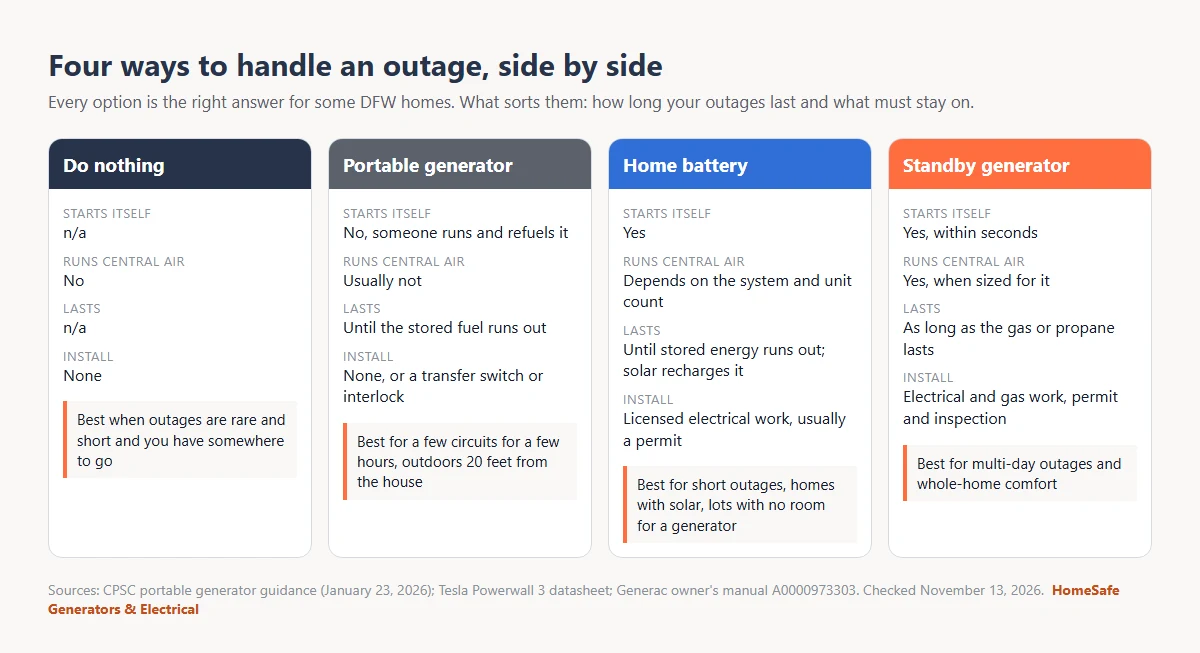
Your answers sort the four options below.
2. Your four options
Do nothing
This works if your outages are rare and short, you can stay with family or at a hotel for a day or two, and nobody in the house depends on powered equipment. It costs nothing up front. The trade-off comes during the outage: food to protect, a house that gets warm or cold, and no control over when it happens. If you choose this route, a cooler, a few days of water and a place to go are the minimum.
A portable generator
A portable unit can run a refrigerator, some lights and a fan or window air conditioner for a few hours. It does not start itself, so someone has to be home to run it and refuel it, and fuel has to be stored. It is a sensible stopgap when it is used correctly. The U.S. Consumer Product Safety Commission’s guidance is simple: run a portable generator outdoors only, at least 20 feet from the home, with the exhaust pointed away, and keep battery-operated carbon monoxide alarms on every level (CPSC, January 23, 2026, checked November 13, 2026). Follow that and a portable unit is a manageable tool. The wattage classes and the full standby comparison are in the best generator for a power outage.
A home battery
A battery is quiet, has no exhaust and needs no fuel. It switches on automatically and can be a good fit for short outages. Its limit is stored energy. One widely sold example, the Tesla Powerwall 3, is rated at 13.5 kWh of battery energy and 11.5 kW of continuous output, and Tesla supports up to 4 units in one system (Tesla Powerwall 3 datasheet, North America, checked November 13, 2026). Those are the maker’s numbers for one product, and other batteries differ. As a simple illustration, a home drawing an average of 3 kW would use 13.5 kWh in about four and a half hours. Add more batteries and the run time grows. With solar panels, the battery can recharge in daylight, which can stretch a long outage if the sun is out.
A battery is a good choice in the right house. For a home with solar, a short-outage pattern, or a lot with no room for a generator pad and gas line, it may be the better one. Ask a licensed electrician or a battery installer what it would take for your panel and your loads.
A standby generator
A standby generator is installed outside the home and connected to the electrical panel through a transfer switch. It senses an outage and starts within seconds, whether you are home or not. On natural gas it can run as long as the gas supply holds, and on propane it runs until the tank is low: Generac’s 26kW unit uses 2.05 gallons an hour at half load and 3.95 at full load (Generac 26kW product page, checked November 13, 2026). That is why it suits multi-day outages and central air conditioning or heating. The guide to how a standby generator works walks through each part.
It has trade-offs. It needs space, a gas or propane supply, a permit and annual maintenance. It makes noise when it runs. And gas supply can be affected in an extreme event: Generac links some low-voltage alarms to low gas supply when demand is very high in extreme cold (Generac, undervoltage alarm). A propane tank removes that dependency, and it brings a refill schedule of its own.
3. Side by side
| Question | Do nothing | Portable | Home battery | Standby generator |
|---|---|---|---|---|
| Starts itself | n/a | No | Yes | Yes |
| Runs central air or heat | No | Usually not | Depends on the system and battery count | Yes, when sized for it |
| How long it lasts | n/a | Until the fuel runs out | Until stored energy runs out, longer with solar | As long as the gas or propane lasts |
| Fuel | None | Gasoline or propane you store | None | Natural gas or propane |
| Noise and exhaust | None | Loud, exhaust must stay outdoors and away from the house | Quiet, no exhaust | Audible outdoors, exhaust directed away |
| Upkeep | None | Fuel rotation, starting checks | Low | Annual service |
| Installation | None | None | Licensed electrical work, usually a permit | Licensed electrical and gas work, permit and inspection |
| Best when | Outages are rare and short | A few circuits, a few hours | Short outages, solar, no room for a generator | Multi-day outages, whole-home comfort |
4. What you want to keep running decides the size
Every option is limited by how much power it can deliver at once and how long it can keep delivering it. A refrigerator, lights and a phone charger are a small load. A central air conditioner starting up in a July heat wave, an electric range, an electric water heater and a well pump are a large one. In Southlake, Colleyville and Flower Mound, larger homes with several air conditioning zones often add up to a bigger load than the same square footage elsewhere.
That is why sizing comes first. A generator that is too small trips under load, and one that is too large costs more than it needs to. HomeSafe recommends only what it will stand behind and explains why. Start with what size generator you need. The same logic applies to a battery: more loads means more units.
5. Fuel, space and neighbors
A generator needs a place to live. It needs a level pad, clearances from windows and doors, a short path to the gas meter and the panel, and room for a technician to open the enclosure. On small lots in Plano and Frisco, and in homeowner associations in Southlake and Colleyville, placement is often the first real question. The guide to where a standby generator can go covers it in detail, including what Texas law lets an HOA require. A home battery usually needs a wall or garage location and no exhaust clearance. A portable unit needs open air, away from the house.
Natural gas is convenient where a main is present. Some properties, especially on acreage in Argyle and parts of Denton County, run on propane, which adds a tank to place and refill.
6. Combining a battery and a generator
Many homes do. A battery can carry the first hours of an outage quietly, while a generator takes over for a long one. A portable unit can sit in the garage as a spare plan for a home that has no permanent system. The combinations are worth a conversation with whoever installs each part, so that the panel, the transfer equipment and the permits are planned together and not one after another.
7. What drives the cost, without the numbers
Cost is quoted per home, and any installer who gives you a firm number before seeing your property is guessing. These are the factors that move the cost in each case.
- Generator: the size you need, natural gas or propane, the length of the gas and electrical runs, the transfer switch, the pad, and your city’s permit requirements. What drives home generator cost walks through each one.
- Battery: how many units you need for the loads you want covered, whether panel work is required, and whether you are adding solar.
- Portable: the wattage class, and a proper transfer arrangement if you want to power circuits safely.
If you would rather spread a generator purchase over time, the financing page explains the Synchrony options, with terms up to 84 months. If you are weighing the cost against the benefit, is a whole-house generator worth it covers that question directly.
8. Permits, insurance and upkeep
Permanently wired equipment normally needs a permit and an inspection, and the rules vary by city. See generator permits in DFW, and check with your city before installing a battery. A generator can also affect your home insurance, so it is worth reading before you decide.
Then there is the long run. A standby generator is a machine that sits idle most of the year, so it needs regular care to start when you need it. Annual service, and a real outage simulation that tests the transfer switch and not only the engine, are what keep it dependable. What a professional maintenance visit includes lists the tasks. Batteries need far less care, and portable units need fuel rotation and a test run now and then.
9. Who should pick what
- Choose a standby generator if outages in your area run longer than a day, you want central air or heat to keep working, or you travel and want the house protected while you are away. Homes in Southlake, Colleyville and Flower Mound with larger electrical loads tend to land here.
- Consider a home battery if you already have solar, your outages are short, or your lot has no safe place for a generator. Get a quote from someone who installs them.
- Keep a portable unit if you rent, need a stopgap, or only need a few circuits for a few hours, and follow the safety distance above.
- Do nothing only if you have a plan for a long outage: somewhere to go, a way to protect food and pipes, and no one depending on powered medical equipment.
- If someone at home relies on powered medical equipment, say so at the first conversation with any installer. Medical-equipment backup needs a job-specific review before any recommendation is made.
10. What a good written quote covers
Whoever installs your backup power, a clear written quote lists what is included at one total price, so that nothing is left to be added later. For a standby generator, that means the answers to a few questions:
- How was the unit sized for my home, and can I see the load calculation?
- Does the quote list everything included: equipment, pad, transfer switch, surge protection, monitoring, electrical and gas work, permit and startup?
- Who pulls the permit, and who is my contact if the inspection raises a question?
- What is the maintenance plan, and what happens in an outage if something fails?
- What should I expect from the first outage test?
The anatomy of a generator quote goes through each line, and questions to ask a generator installer in DFW is a longer checklist. If you are leaning toward a particular brand, Generac vs Kohler vs Champion compares them. HomeSafe is a Generac PowerPro Premier dealer and a dealer and installer for Kohler and Champion.
11. How an installation works
If a standby generator turns out to be the right fit, it starts with a free estimate visit of 30 to 60 minutes, followed by an internal review, permitting, installation, startup, and a generator school and outage simulation so you know how everything works. Most installs are finished 3 to 5 weeks after the equipment arrives, and the work at your home usually takes one day. The permit office sets most of the pace, and your point of contact tells you each date as it is booked. One company stays accountable from the first call to the final walkthrough. The full walkthrough is on the how an installation works page, and the generator installation page lists the equipment installed: Generac, Kohler and Champion.
In this series: the best generator for an outage · using a generator safely in an outage
Quick answers
Should a 2,500 sq ft Texas home get a battery or a whole-house generator?
13.5 kWh is what one Tesla Powerwall 3 stores, about 4.5 hours at a 3 kW average draw, so square footage matters less than your loads and how long your outages last. For the same essential circuits, a battery suits short outages or a home with solar; for multi-day outages or central air, a standby generator on natural gas runs as long as the supply holds. A load calculation at your home settles it.
Is a Tesla Powerwall better than a generator?
Yes for short outages and homes with solar; no for long outages without sun. Tesla rates one Powerwall 3 at 13.5 kWh and 11.5 kW continuous, with up to 4 units per system. It is quiet and needs no fuel, but it stops when stored energy runs out. A standby generator keeps running on gas or propane for days.
What is the best backup power option for a home?
A standby generator, if your outages last days or you need central air or heat. A home battery fits short outages, solar homes and lots with no room for a generator; a portable generator covers a few circuits for a few hours, run outdoors at least 20 feet from the home; and doing nothing works only with a plan for a long outage.
How long does a battery last in a home generator?
3 to 5 years is the typical life Generac gives for a standby generator’s starting battery. A whole-home battery such as Tesla’s Powerwall 3 is a different product; Tesla gives it a 10-year warranty, and how long it runs in an outage depends on your loads.
If you are weighing a generator for your home in Fort Worth, Plano, Frisco or anywhere in DFW, request a free estimate or call (817) 439-9009. The visit looks at your loads, your lot and your outage history, and you are told what fits. HomeSafe has a 5.0 rating across 200+ Google reviews, all on the reviews page.