
Last reviewed: November 2026
For most homeowners, a standby generator quote is the first document in the process that feels real. Before it, you have been asking questions and reading about brands. After it, you are being asked to commit to a significant project on your own home. That is the moment when it helps most to know what you are looking at, and what should be on the page.
Quotes for generators are harder to read than they look. The generator is only part of the work. A permanent installation also involves a concrete pad, a transfer switch at your panel, a gas line, electrical wiring, a permit, an inspection and a startup. When a quote names a total without saying what it covers, you cannot tell what you are agreeing to.
This guide is for homeowners in Fort Worth, Southlake, Keller, Plano, Frisco and the rest of DFW who are holding a quote, or about to receive one. It explains what a complete quote lists, what moves each part, what a HomeSafe quote contains and what is good about it, how the free in-home estimate works and where financing fits. A good whole-home generator quote is a written document that lists everything included in the job, states one total price, and says what happens if the job turns out to need more. It contains no prices on purpose. A price on a page cannot know your panel, your gas line or your lot. It does not cover portable generators, and commercial projects are handled under the Texxas Power name.
1. What a complete generator quote lists
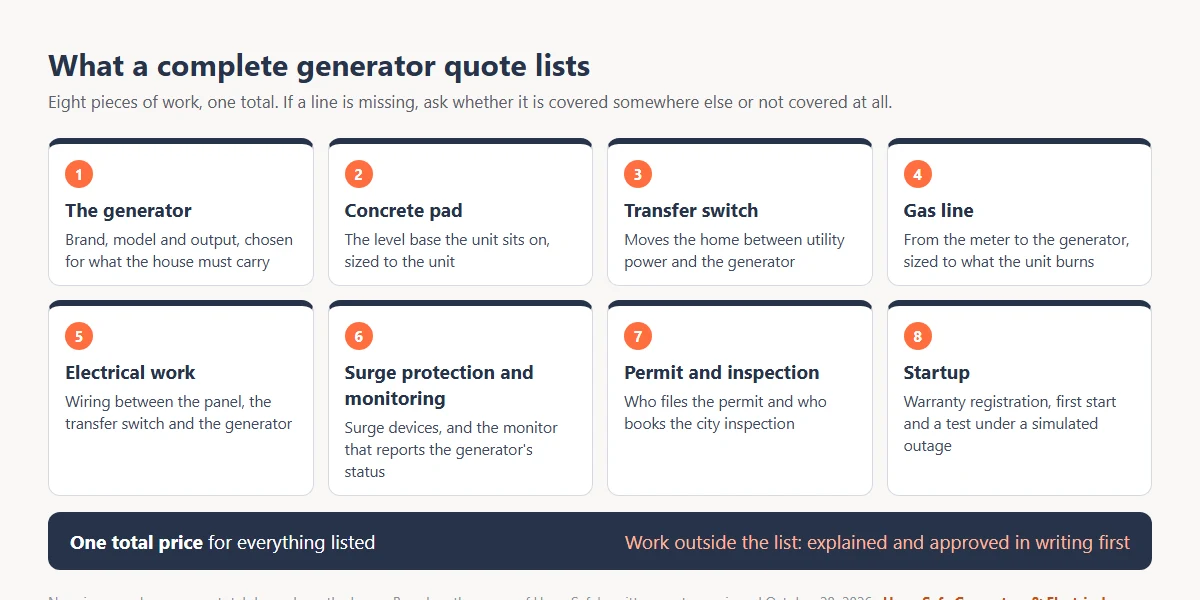
Each line below is a piece of work that has to happen before the generator carries your house. If one is missing from a quote, either it is covered somewhere else or it is not covered.
| On the quote | What it covers | What changes it |
|---|---|---|
| The generator | The unit itself, by brand, model and output | How much of the house it must carry, brand, natural gas or propane |
| Transfer switch | The switch that moves your home between utility power and the generator | The amperage of your service, and whether it covers the whole home or selected circuits |
| Concrete pad | The base the generator sits on | The size and weight of the unit, and the ground it goes on |
| Gas line | The pipe from your meter to the generator | The distance, the pipe size the unit needs, and the capacity of your meter |
| Electrical work | The wiring between your panel, the transfer switch and the generator | The distance, and the capacity and condition of your panel |
| Surge protection and monitoring | Devices that protect your electronics, and the app or monitor that reports on the generator | What the job includes and which brand’s monitoring the unit uses |
| Permits and inspection | The permit application and the city inspection | The city: each one has its own process |
| Startup | Warranty registration, the first start, a walkthrough of how it runs and a test under a simulated outage | Little: this should be on every quote |
To see why the “what changes it” column matters, take the gas line. Kohler’s own installation manual for its 14, 20 and 26kW home generators lists the minimum pipe size by run length: the 26kW unit on natural gas needs 1-inch pipe for a 25-foot run and 1¼-inch pipe for a 100-foot run, and each 90-degree elbow counts as another 8 feet (Kohler installation manual TP-7091, checked November 13, 2026). A unit placed farther from the meter can need a larger pipe. The guide to what drives the cost of a whole-house generator goes deeper on the “what changes it” column, including gas line sizing and panel work.
2. What a HomeSafe quote contains
A HomeSafe quote is a written list of everything included in your job, with one fixed total at the end. Here is what each part means in plain language.
- Equipment. The generator itself, chosen for your home at the visit, and the brand and output that go with it. HomeSafe sells and installs Generac, Kohler and Champion, and the recommendation comes with the reasoning. The guide to Generac vs Kohler vs Champion explains how the brands differ.
- The pad. The concrete base the generator sits on. It keeps the unit level and off the soil, and it is sized to the generator you choose.
- Transfer switches. The switch that moves your house from utility power to the generator when the power fails, and back again when it returns. It is what makes the system automatic. How a standby generator works shows the sequence.
- Surge protection. Surge devices that help protect your electronics when power changes.
- Monitoring. A monitor that reports on the generator, so you can see its status without walking outside.
- Electrical work. The wiring that connects the generator, the transfer switch and your panel. It is done under Texas Electrical Contractor License #41809.
- Gas work. The gas line from your meter to the generator, sized to what the unit needs.
- Startup. HomeSafe registers the generator for your manufacturer warranty and starts it up.
- Generator School and the outage simulation. You are walked through how to run the generator and what to do if something looks wrong. Then power is cut and the generator is confirmed to carry the load, in front of you.
Alongside the quoted work, HomeSafe pulls the permit and schedules the inspection, so you do not deal with the city. Generac’s own guidance is that all required permits must be in place before installation begins (Generac Help Center, checked November 13, 2026). Cities differ: Dallas and Fort Worth are usually the quickest to issue a residential generator permit, while Highland Park, University Park, Flower Mound, Frisco, Plano and Southlake take longer. The guide to generator permits in DFW explains how.
The quote is written for your home. A job with a longer gas run, an older panel or a tight lot reads differently from one without. Your quote states what is included for your address.
3. What is good about it
A quote earns trust by being easy to read and hard to misunderstand. These are the parts of a HomeSafe quote that do that.
- Everything included, at one fixed total. The installation expenses are included in the quoted total. You see the full scope before you approve anything, with no pieces to add up yourself.
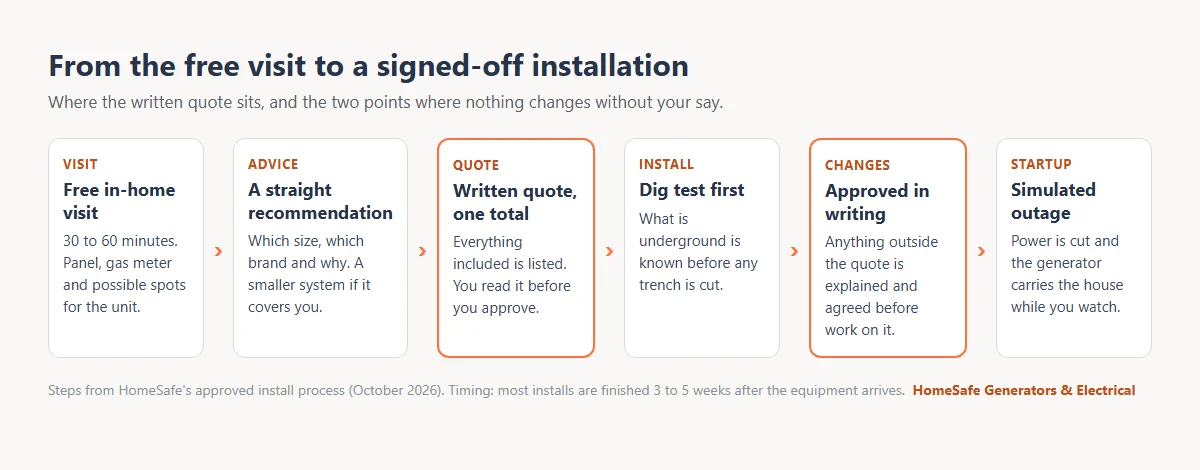
- A dig test before any trenching. Before any electrical or gas trenching begins, HomeSafe starts with a dig test, so what is underground is known before anything is cut.
- Changes are explained and approved in writing. If the work turns out to need something outside the quoted scope, it is explained to you and approved in writing before any work on it begins. Nothing is added quietly.
- Repairs from the installation are covered. If the installation requires drywall or sprinkler repairs, HomeSafe handles them and covers the cost unless your quote says otherwise.
- Permits and inspection are handled for you. A job that depends on a city office is easier when one company deals with it.
- Startup includes warranty registration and a simulated outage. You see the generator carry your house before the job is closed, and registration is done for you. The same simulation is part of every maintenance visit afterward.
It is fair to say what a quote cannot do. It cannot promise a date, because permitting, the utility’s schedule, the weather and equipment delivery all affect timing. Most installs are finished 3 to 5 weeks after the equipment arrives, and the work at your home usually takes one day. The permit office is the main variable, and your point of contact tells you each date as it is booked. How a HomeSafe installation works sets out the six steps and what can move them.
4. One total price, and what it should cover
The point of a single total is that the scope is visible. When you are holding a quote, ask what the total includes and whether anything is left out. A very low total often leaves one of the lines above to be added later, and a total with no list beside it tells you nothing.
The same applies to changes. If a job needs something outside the quoted scope, you should hear about it and agree to it in writing before the work happens. That is how HomeSafe handles it.
5. How the free in-home estimate works
The estimate is a visit to your home, it takes 30 to 60 minutes, and it is free with no obligation. HomeSafe looks at your electrical panel, your gas supply and meter, and the places a unit could realistically go, which in Southlake, Colleyville and Highland Park includes what your HOA will approve. The guides to what size generator you need and where a standby generator can go explain the sizing and placement logic behind the recommendation you receive, including HOA review.
It is quoted per home. Any installer who gives you a firm number before seeing your property is guessing. You leave the visit with a straight recommendation, and the written quote follows.
6. The decision that moves a quote the most
The biggest choice in any quote is how much of your house the generator carries. A system built around essential circuits, such as the refrigerator, lighting, internet and one air-conditioning system, can use a smaller generator and a smaller transfer switch. A whole-home system that keeps several air conditioners, the oven and the well pump running needs a larger unit, a larger switch and more gas.
Neither is automatically right. A smaller system that covers what you actually use is a sound answer, and HomeSafe recommends only what it will stand behind and explains why. A larger system makes sense when your loads call for it, for example several large air conditioners starting in a Frisco or Plano summer. If you are still deciding whether the investment makes sense, is a generator worth the investment covers that question.
7. Where financing fits
Financing is available through Synchrony Financial. It starts with a soft credit check that does not affect your score, approval takes minutes, terms run up to 84 months, there is no prepayment penalty, and 0% APR options are available. The financing page has the details.
8. Questions to ask about any generator quote
- Is it in writing, and does it list the generator, transfer switch, pad, gas, electrical work, permit and startup?
- Is it one total, and what, if anything, is excluded from it?
- Who pulls the permit and schedules the inspection?
- Does it include warranty registration and a test under a simulated outage?
- What happens if the job needs something that is not on the quote?
- Who services the generator in its first year?
- Is the electrical contractor’s license active? You can check it on the TDLR license search.
Take it with you: download the generator quote checklist (one-page PDF) to keep beside your quote while you read it. The guide to ten questions to ask a generator installer takes these further.
In this series: what affects home generator cost · ten questions for a generator installer
Quick answers
What should a generator quote include before I sign?
Eight things: the generator, the concrete pad, the transfer switch, the gas line, the electrical work, surge protection and monitoring where the job includes them, the permit and inspection, and startup with a test under a simulated outage. It should give one total and say how work outside the quote is approved.
What should you look for when buying a generator?
Three things before the brand: a size that matches what you want running, a written quote that lists everything at one total, and a licensed electrical contractor who pulls the permit. A home visit is the only reliable way to get the first one right.
Can I get a reliable price over the phone?
No. A firm number needs a look at your panel, your gas supply and your lot. The estimate visit is free and takes 30 to 60 minutes.
Is the in-home estimate free?
Yes. It is free, with no obligation, and a written quote follows the visit.
Does HomeSafe handle the permit and inspection?
Yes. HomeSafe pulls the permit and schedules the inspection as part of the job, so you do not deal with the city.
What happens if the job needs something the quote does not list?
Nothing is done until you agree. Work outside the quoted scope is explained to you and approved in writing before any work on it begins.
HomeSafe installs standby generators across Tarrant, Dallas, Collin and Denton counties, including Fort Worth, Southlake, Keller, Flower Mound, Plano and Frisco. Call (817) 439-9009 or request your free in-home estimate. HomeSafe has a 5.0 rating across 200+ Google reviews, which you can read on the reviews page. Before you decide, see recent installations.