
Last reviewed: November 2026
A standby generator has one job, and it is a job you only see when the lights go out. That is why so many homeowners in DFW ask the same quiet question before they buy one: how do I know it will be installed properly, and still work when I need it? It is a sensible question. The generator sits next to your house, connects to your gas and your electrical panel, and runs for hours without anyone watching it.
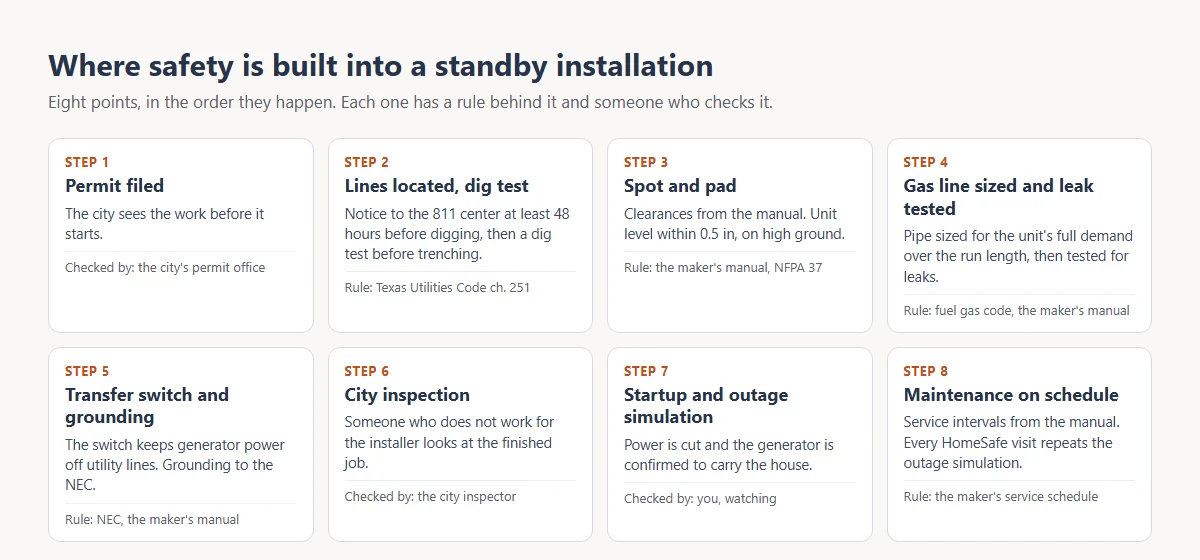
Here is the short answer. A standby generator is safe and reliable when it sits where its maker says it can, at least 18 inches from the wall behind a Generac unit and 5 feet from any window, door or vent; when its gas line is sized for the unit and tested for leaks; when a transfer switch keeps its power from ever feeding back into the street; when it is grounded to the electrical code; when the city permits and inspects it; when buried lines are located before anyone digs; and when it is proven under a simulated outage at startup and serviced on the manual’s schedule afterward. Each point has a published rule behind it, and this guide shows you where each rule comes from.
This guide is for homeowners in Fort Worth, Southlake, Plano, Frisco, Keller and across North Texas who want to know what a safe installation looks like. If you are choosing a company, the ten questions to ask a generator installer cover licenses, quotes and service plans; this guide covers the installation itself. It is not a do-it-yourself guide, it does not cover portable generators, and commercial projects are handled under the Texxas Power name.
1. Placement and clearances
Where the unit sits decides most of its safety. A generator is an engine, so it needs air around it, a clear path for its exhaust away from the house, and room for a technician to work. The distances are published, and they come from two places: the manufacturer’s installation manual and NFPA 37, the National Fire Protection Association’s standard for stationary engines, which your city’s adopted codes build on.
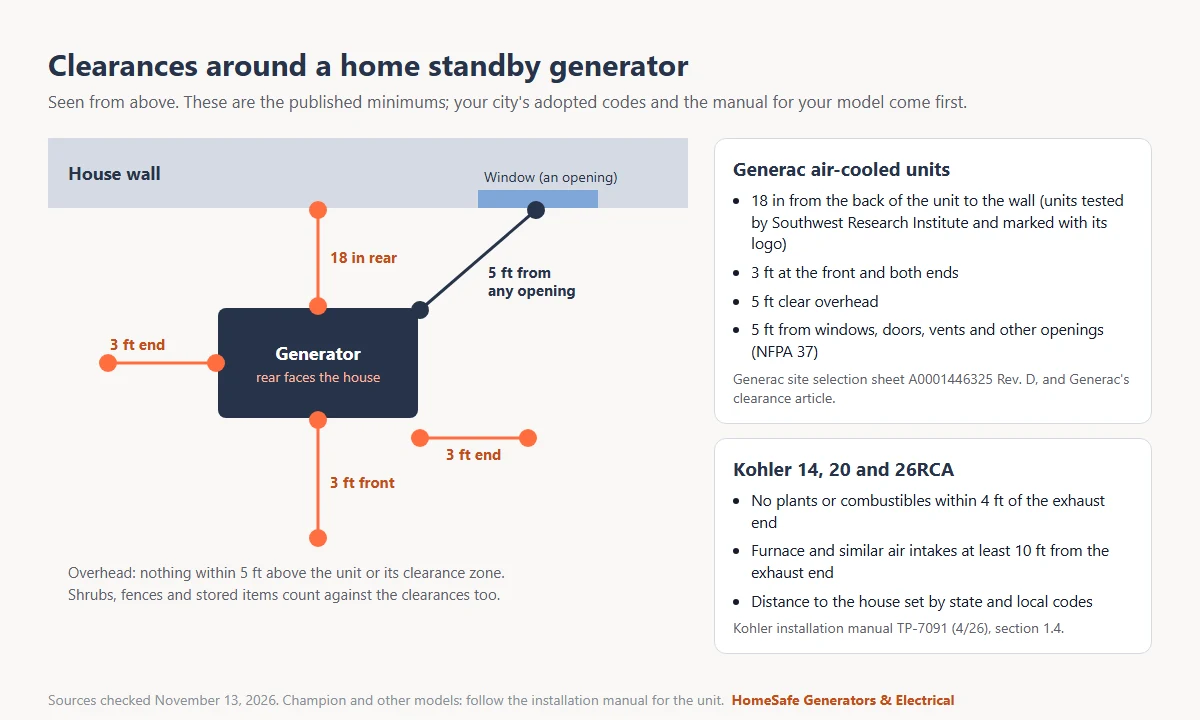
For Generac’s air-cooled home generators, the site selection sheet sets these minimums (Generac site selection instructions, A0001446325 Rev. D, and Generac’s clearance article, both checked November 13, 2026):
- 18 inches from the back of the unit to the wall, for units tested by Southwest Research Institute and marked with its logo. NFPA 37 otherwise asks for 5 feet from a wall that can burn.
- 3 feet at the front and both ends, and 5 feet clear above the unit. Shrubs, bushes and trees count.
- 5 feet from windows, doors, vents, window wells and other openings in the wall. The 18-inch reduction never applies to openings.
- A level base, within half an inch all around, on high ground where water will not pool, with downspouts and sprinklers pointed away.
Kohler’s installation manual for its 14, 20 and 26kW home generators adds its own rules: no plants or other combustible materials within 4 feet of the exhaust end, and furnace and similar air intakes at least 10 feet from it (Kohler installation manual TP-7091, checked November 13, 2026). Kohler’s power business now trades as Rehlko, so you may see either name. For Champion and other brands, the installation manual for the model sets the figures.
Both makers also tell owners to fit carbon monoxide detectors inside the home, and Generac notes that a unit placed to the minimums can still need to sit farther away on some lots, for example where prevailing wind pushes exhaust toward the house. That is why the first visit looks at where a unit can realistically sit before anyone talks about a model. On many lots the safest spot is not the one closest to the gas meter, and that can mean a longer, costlier run. In HOA communities such as Southlake, Colleyville and Highland Park, the spot also has to suit the association. The guide to where a standby generator can go covers placement, HOA review and property lines in detail.
These rules are different from the ones for a portable generator. The U.S. Consumer Product Safety Commission tells portable owners to run them outside, at least 20 feet from the house with the exhaust pointed away (CPSC portable generator safety alert, checked November 13, 2026). A standby unit’s shorter distances apply only because it is built, tested and installed as a fixed appliance. How to use a generator during a power outage covers portable safety.
2. The gas line: sized, then leak tested
A standby generator runs on natural gas or propane, and it burns far more gas at full load than a water heater or a furnace. The fuel gas code in Texas cities requires piping “of such size” that it supplies “the maximum demand” of every appliance on it (International Residential Code G2413.1, Texas edition, checked November 13, 2026). A pipe that is too small starves the engine under load, and the generator can stall or shut itself down at the moment it is needed.
Pipe size depends on the unit and the length of the run. Kohler’s manual shows how much: its 26kW unit on natural gas needs 1-inch pipe for a 25-foot run and 1¼-inch pipe for 100 feet, and every 90-degree elbow adds 8 feet to the count. Before startup, the manual has the fuel system checked for leaks with a soap solution while it is pressurized to 10 to 14 inches of water column. Generac’s Help Center says fuel line connections should be made by a contractor who knows the local codes (Generac Help Center, checked November 13, 2026).
Most DFW homes on natural gas are served by Atmos Energy. If the meter cannot supply the generator and your other appliances at once, the gas utility may need to change it, which is one reason the meter is part of the first visit. The guide to what drives the cost of a whole-house generator explains how gas line length and size show up in a project.
3. The transfer switch, and why power must never feed back
On the electrical side, the transfer switch is the key part. It moves your house between utility power and the generator, and it keeps the two from feeding each other. That separation protects you, and it protects the utility workers repairing the lines in your street, which in most of DFW belong to Oncor. Kohler’s manual puts it plainly: install a transfer switch so the generator cannot connect to other power sources, because backfeed into the utility system “can cause severe injury or death to utility personnel.” The NFPA’s generator safety tip sheet says a transfer switch should be installed by a qualified electrician to the National Electrical Code (NFPA generator safety tips, checked November 13, 2026).
This is the main reason a permanent installation is different from plugging a portable unit into the house. An automatic switch also means nobody has to go outside in an ice storm to make the change. How a standby generator works explains the sequence step by step.
4. Grounding and the electrical work
A generator becomes part of your home’s electrical system, so it has to be grounded like the rest of it. Kohler’s manual says the grounding method must comply with the National Electrical Code and local codes, and that the electrical connections should be made by an authorized dealer or a licensed electrician. In Texas, electrical contractors are licensed by the state, and you can confirm a license on the TDLR license search. HomeSafe’s electrical work runs under Texas Electrical Contractor License #41809.
The capacity and condition of your panel matter as well. An older or crowded panel may need attention before a generator is added, and the electrical safety inspection guide explains what a panel check looks at.
5. The permit and the city inspection
The permit and the inspection are the independent check on everything above. A permit tells the city that the work is happening. The inspection is a second person, who works for the city and not for the installer, looking at what was done. Generac’s guidance is that all required permits must be in place before installation begins. The guide to generator permits in DFW explains what cities ask for.
HomeSafe pulls the permit and schedules the inspection, so you do not deal with the city. Dallas and Fort Worth are usually the quickest to issue a residential generator permit; Highland Park, University Park, Flower Mound, Frisco, Plano and Southlake take longer. Most installs are finished 3 to 5 weeks after the equipment arrives, and the work at your home usually takes one day. The permit office is the main variable, and your point of contact tells you each date as it is booked.
A permitted, inspected installation is also easier to explain to an insurer or a buyer. The guide on whether a whole-home generator affects your home insurance covers that side.
6. Before anyone digs
The gas line and the electrical conduit run underground between the meter, the panel and the pad. Most yards hold more than you can see: utility lines, irrigation, sometimes things a previous owner never wrote down. Texas law requires anyone digging to notify an 811 notification center at least 48 hours beforehand, so the utilities can mark their buried lines (TxDOT, one-call requirements under Texas Utilities Code chapter 251, checked November 13, 2026), and Kohler’s manual lists the same step before installation.
Marked lines are not the whole picture, because private lines such as sprinklers are not on the utility’s map. Before any electrical or gas trenching begins, HomeSafe starts with a dig test, so what is underground is known before anything is cut. If something unexpected turns up and the job changes, the guide to reading a generator quote shows how changes are approved.
7. Startup and the outage simulation
Installation is not finished when the generator is in place. Startup is where it is brought into service, and it is where reliability is proven. At startup, HomeSafe registers the generator for your manufacturer warranty and starts the unit up. HomeSafe is warranty-authorized for Generac, Kohler and Champion.
Then comes the part that matters most. HomeSafe runs a power outage simulation: the power is cut and the generator is confirmed to pick up the load. It is a real transfer test, not just a run test. A run test shows the engine starts. A transfer test shows your house actually switches over, through the transfer switch, onto the generator. You see it work before the job is closed. Generator School follows: you are walked through how to run the generator and what to do if something looks wrong, so the first time you meet the controls is not at 2 a.m. How a HomeSafe installation works sets out all six steps.
8. Maintenance that keeps it reliable
A generator that sits for months between outages needs a schedule, and the manufacturers publish one. Generac’s air-cooled owner’s manuals set Schedule A (oil, oil filter and battery checks) every 2 years or 200 hours of running and Schedule B (adding the air filter and spark plugs) every 4 years or 400 hours, with a yearly fuel leak test and water intrusion check (Generac owner’s manual A0004332577, checked November 12, 2026). Kohler’s 24 to 38kW manual sets oil, filter, battery and regulator pressure checks yearly or every 120 hours, and more often in extreme weather (Kohler operation manual TP-6905). DFW summers and ice storms count as extreme weather.
To be fair, you do not need a plan to keep a generator in good order. Generac allows owners to do its yearly checks, as long as the work and the records are kept. What a plan adds is the transfer test. Every HomeSafe maintenance visit includes a power outage simulation, and load output testing is standard; load bank testing is available.
| HomeSafe plan | Visits | When |
|---|---|---|
| Single Service | 1 | When you book it |
| Annual | 1 a year | Fourth quarter |
| Bi-Annual | 2 a year | Second and fourth quarters |
| Quarterly | 4 a year | Every quarter |
A separate Generac Mobile Link monitoring program, over WiFi or cellular, includes a VIP tier with priority service within 48 hours of a monitoring-flagged fault, weather permitting. HomeSafe services Generac, Kohler, Champion, Briggs and Stratton and Cummins units, including ones installed by other companies. What generator maintenance includes compares the makers’ schedules, and the generator service page covers booking.
9. After an outage, and when to stop and call
When the power returns and the generator hands the house back to the utility, check the controller or monitoring app for any alert, and note roughly how long it ran. In a long outage, Generac’s guidance is to shut the unit down for at least 30 minutes in every 24 hours to check the oil and let it cool (Generac, continuous use maintenance). If something looks off, the guides to Generac error codes and what to check when a generator will not start explain the common causes.
Stop and call straight away if: you smell gas near the unit (move away and follow your gas utility’s leak instructions), the transfer switch or wiring shows damage or a wiring code, the unit has stood in water, or it will not carry the house during an outage. Do not open the transfer switch or work on the gas line yourself.
Emergency service is answered 24/7, every day including holidays, by a team of 6 technicians and 5 service trucks covering the metroplex. After-hours and emergency rates apply depending on the circumstances, and you are told what they are before a technician is dispatched. Generator service during a storm explains how that works in practice.
In this series: generator permits in DFW · where a standby generator can go · how a standby generator works
Quick answers
Do whole-home generators in Texas need a permit and an inspection?
Yes. DFW cities require a permit for a standby generator installation, and the city inspects the finished work. Generac’s own guidance is that permits must be in place before installation begins. HomeSafe pulls the permit and schedules the inspection.
How far should a standby generator be from the house?
18 inches from the wall behind it, for Generac air-cooled units marked as tested by Southwest Research Institute, and at least 5 feet from any window, door, vent or other opening. Kohler keeps combustibles 4 feet from the exhaust end and air intakes 10 feet from it. Your city’s codes and your model’s manual come first.
What is the safest generator to use at home?
A permanently installed standby generator, placed to its manual’s clearances and connected through a transfer switch, removes the two biggest risks of a portable unit: running it too close to the house and feeding power back into the utility lines.
What are the disadvantages of a standby generator?
Three practical ones: it needs space that meets the clearances, a permit and an inspection; it needs a gas supply sized for it; and it needs maintenance on the maker’s schedule. For a refrigerator and a few lights over a day or two, a portable generator can be enough.
How often should a standby generator be serviced?
Once a year at minimum. Generac lists yearly checks plus oil and filter service every 2 years or 200 hours, and Kohler sets most service yearly or every 120 hours. HomeSafe plans run annually, twice a year or quarterly, and every visit includes a power outage simulation.
What does a power outage simulation involve?
One real test: the power is cut, the generator starts, and the transfer switch moves your house onto it. It tests the whole system, not just the engine.
When should I stop and call a technician?
Right away if you smell gas near the unit, see damage to the transfer switch or wiring, the unit has stood in water, or it will not carry the house in an outage. Move away from a gas smell and follow your gas utility’s leak instructions first.
HomeSafe installs and services standby generators across Tarrant, Dallas, Collin and Denton counties, including Fort Worth, Southlake, Plano, Frisco, Keller and Flower Mound. Call (817) 439-9009 or request a free in-home visit. HomeSafe has a 5.0 rating across 200+ Google reviews, which you can read on the reviews page, and you can see recent installations.