
Last reviewed: November 2026
Installing a standby generator is one of the larger decisions you will make about your home. The unit sits outside, but the work reaches inside: a new transfer switch at your panel, a gas line, permits, an inspection and a piece of equipment you expect to start on the worst night of the year. Most homeowners in DFW have never bought one before, and it is normal to feel unsure about who to trust with it.
That uncertainty is reasonable, and a short list of questions can settle it. This guide is for anyone in Fort Worth, Southlake, Keller, Plano, Frisco or anywhere else in North Texas who is thinking about a permanent generator and wants to know what to ask before signing. You do not need to know anything about electrical work to use it.
The short answer is that you should ask ten things: whether the electrical contractor is licensed, whether the company is a dealer or installer for the brand, whether it visits your home before it quotes, what the written quote includes, who pulls the permit, what happens if the job changes, what happens before trenching, who handles the warranty, whether the unit is tested under a simulated outage, and who services it afterward. The rest of this page explains why each one matters, what a good answer sounds like and how to check it. Each check ends with a plain line on where HomeSafe stands, so you can run the same checks on HomeSafe first. The guide does not cover portable generators, and commercial projects are handled under the Texxas Power name.
1. Who a standby generator suits, and when something simpler is enough
A permanently installed standby generator is the right fit when outages in your area are long enough to matter, when you want the house to keep running without anyone setting anything up, or when the load is large: several air conditioners, a well pump, or home-office equipment you cannot easily move. It earns its keep on lots where placement is a real question, in HOA communities such as Southlake, Colleyville and Highland Park, and in finished homes where the panel and gas line need to be worked around.
If you only need to keep a refrigerator and a few lights running for a day or two, a portable generator can be enough, and it is simpler to set up. The guide to standby versus portable generators compares the two honestly, and is a generator worth the investment helps if the question is whether to buy at all. The HomeSafe visit is free and carries no obligation, so you can find out which side of that line your home falls on.
2. The ten-point checklist
Work through these in order. The first five tell you whether a company is qualified and organized. The last five tell you what happens when the work starts and after it ends.
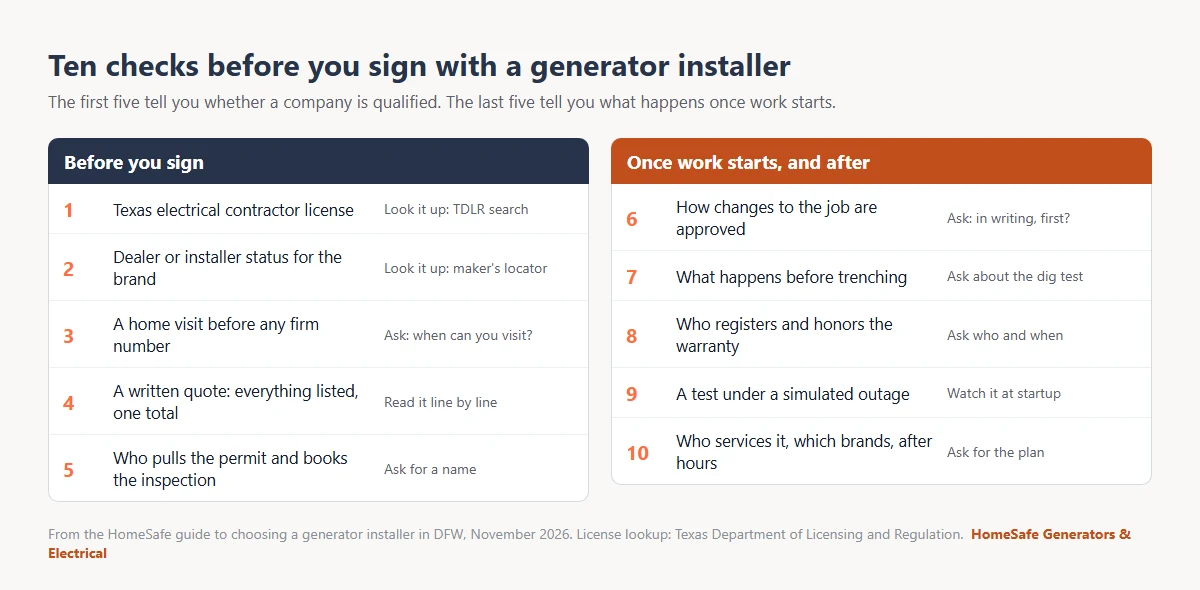
Check 1: License
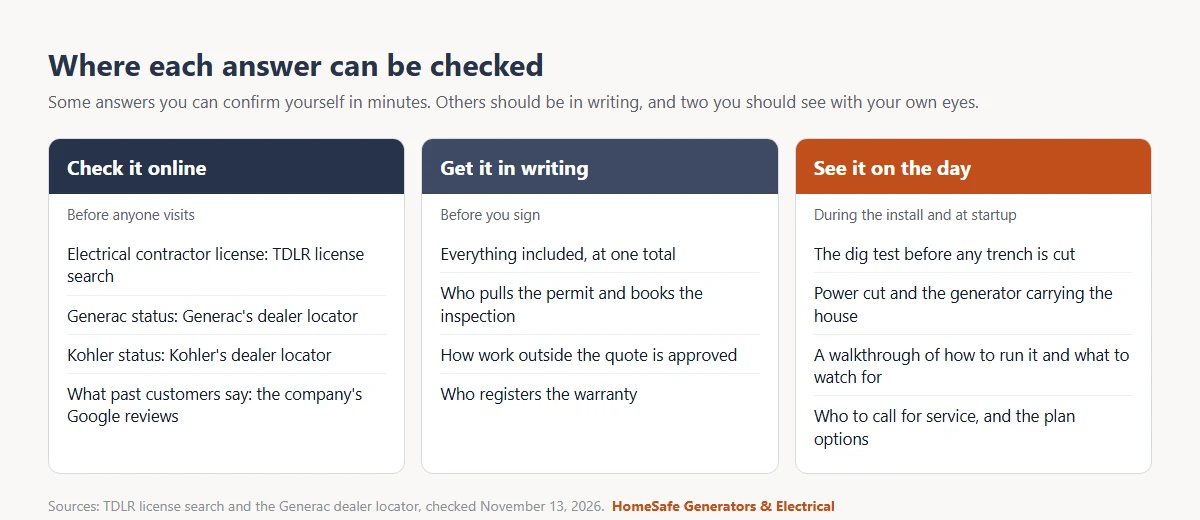
Is the electrical contractor licensed in Texas? A standby generator is wired into your home through a transfer switch, and that is electrical work. A license matters because it means the company meets the state’s requirements and answers to a regulator. A good answer is a license number you can read, not a promise. Look the company up on the Texas Department of Licensing and Regulation license search and confirm the name, the number and that it is active.
Where HomeSafe stands: HomeSafe works under Texas Electrical Contractor License #41809.
Check 2: Brand status
Is the company a dealer or installer for the brand, and can you check? Manufacturers set their own standards for the companies that sell and install their units, and the status a company holds affects parts, support and warranty handling. A good answer names the brand and the level, and points you to the manufacturer’s own list. Generac has a dealer locator and Kohler has one as well. The guide to choosing a Generac dealer explains what Generac’s tiers mean.
Where HomeSafe stands: HomeSafe is a Generac PowerPro Premier dealer and a dealer and installer for Kohler and Champion. PowerPro Premier is a Generac tier and applies to Generac only. The Generac, Kohler and Champion pages cover each brand.
Check 3: Home visit and sizing
Will they visit your home and size the system before they quote? Output depends on your panel, your gas supply and what you want running, and none of that can be read from a phone call. A good answer is a visit, and a recommendation that explains why. It is quoted per home, and any installer who gives you a firm number before seeing your property is guessing. What size generator you need explains the logic, and Generac vs Kohler vs Champion helps with the brand decision.
Where HomeSafe stands: the visit is free and takes 30 to 60 minutes. HomeSafe looks at the panel, the gas meter and the places a unit could realistically go, then recommends only what it will stand behind. If a smaller system covers what you need, HomeSafe says so.
Check 4: The written quote
Does the written quote list everything included, at one total? A quote that names a total but not what it covers leaves you guessing what is missing. A good quote is in writing, lists the generator, the transfer switch, the pad, the gas and electrical work, the permit and the startup, and gives one total. To verify, read it line by line and ask about anything you cannot find. What a generator quote should include walks through each part. For what drives cost in general, see home generator cost.
Where HomeSafe stands: HomeSafe quotes list what is included in the job and give one fixed total.
Check 5: Permit and inspection
Who pulls the permit and schedules the inspection? Permits exist so the city sees the work and a second person checks it. Every city runs its own process. Dallas and Fort Worth are usually the quickest to issue a residential generator permit; Highland Park, University Park, Flower Mound, Frisco, Plano and Southlake take longer. A good answer is a name and a plan, not “you will need to handle that”. The guide to generator permits in DFW explains what cities ask for.
Where HomeSafe stands: HomeSafe pulls the permit and schedules the inspection, so you do not deal with the city. Permitting is also the step most likely to take longer than you expect. Most installs are finished 3 to 5 weeks after the equipment arrives, and the work at your home usually takes one day.
Check 6: Changes to the job
What happens if the job turns out to need something that was not quoted? Older homes and crowded panels sometimes hold surprises, and the question is how the company handles them. A good answer is that you hear about it and agree to it before the work happens, in writing.
Where HomeSafe stands: anything outside the quoted scope is explained to you and approved in writing before any work on it begins. If the installation requires drywall or sprinkler repairs, HomeSafe handles them and covers the cost unless your quote says otherwise.
Check 7: The dig test
What happens before the trenching starts? Gas and electrical lines run underground between the meter, the panel and the pad, and cutting into something unmarked is how small jobs become large ones. Texas law requires anyone digging to notify an 811 notification center at least 48 hours beforehand so buried utility lines can be marked (TxDOT, one-call requirements, checked November 13, 2026). A good answer describes a step taken before anyone digs. The guide to what makes an installation safe covers the rest of the safety steps.
Where HomeSafe stands: before any electrical or gas trenching begins, HomeSafe starts with a dig test, so what is underground is known before anything is cut. You can ask to be told what it found.
Check 8: The warranty
Who registers the warranty, and who honors it? Registration is what activates the manufacturer’s warranty, so ask who does it and when, and confirm it is part of the job.
Where HomeSafe stands: HomeSafe registers the generator for your manufacturer warranty at startup and is warranty-authorized for Generac, Kohler and Champion. Registration follows each manufacturer’s own process.
Check 9: The outage test
Is the generator tested under a simulated outage? A run test shows the engine starts. A transfer test shows your house actually switches over. A good answer is that the installer cuts the power while you watch. An outage is exactly when you find out whether your generator works, and you should not find out then.
Where HomeSafe stands: HomeSafe does this at startup, confirms the generator carries the load, and repeats the simulation at every maintenance visit. It is a real transfer test, not just a run test.
Check 10: Service afterward
Who services it afterward, and who answers at 2 a.m.? Ask whether the installer services the unit itself, which brands, and whether it will work on a generator someone else installed. A good answer names the brands and the schedule. What generator maintenance includes and the generator service page list what each visit covers.
Where HomeSafe stands: HomeSafe services Generac, Kohler, Champion, Briggs and Stratton and Cummins units, including ones installed by other companies, on Single Service, Annual, Bi-Annual or Quarterly plans, and the same company that installs your generator is the one that services it. Emergency calls are answered 24/7, every day including holidays. After-hours and emergency rates apply depending on the circumstances, and you are told what they are before a technician is dispatched.
3. The ten checks at a glance
| Check | A good answer | How to check it | Where HomeSafe stands |
|---|---|---|---|
| 1. License | A Texas electrical contractor license number | TDLR license search | License #41809 |
| 2. Brand status | The brand and the level, named | The maker’s dealer locator | Generac PowerPro Premier; dealer and installer for Kohler and Champion |
| 3. Home visit | A visit before any firm number | Ask when they can come | Free, 30 to 60 minutes |
| 4. Written quote | Everything listed, one total | Read it line by line | Everything included, one fixed total |
| 5. Permit | A name and a plan | Ask who files it | HomeSafe pulls it and books the inspection |
| 6. Changes | Agreed in writing first | Ask how changes are approved | Explained and approved in writing first |
| 7. Before digging | Lines located and a step before trenching | Ask what happens first | Dig test before any trenching |
| 8. Warranty | Registration is part of the job | Ask who registers it and when | Registered at startup; warranty-authorized for all three brands |
| 9. Outage test | Power cut while you watch | Be there at startup | At startup and every maintenance visit |
| 10. Service | Brands and a schedule | Ask for the plan options | Five brands serviced; 24/7 emergency line |
Take it with you: download the ten-question installer checklist (one-page PDF) to fill in while you talk to an installer.
4. Signs to slow down
- A firm price over the phone, before anyone has seen your panel or your lot.
- A quote that does not say who handles the permit.
- No mention of what is tested before the company leaves.
- A total with no list of what it includes.
- No license number you can look up.
None of these means the company is a bad one. Each means you should ask the question out loud before you sign. Most good installers are glad to answer, and how readily a company does so tells you something too.
5. How the process runs once you decide
The steps from the first visit to the final walkthrough are set out in how a HomeSafe installation works: a visit, an internal review, permitting, installation, startup, and Generator School with the outage simulation. One company stays accountable from the first call to the final walkthrough, and you have one point of contact the whole way. If financing matters to your decision, the financing page explains the options.
In this series: what affects home generator cost · how to read a generator quote
Quick answers
Can I check a generator installer’s license online in Texas?
Yes. Search the company on the Texas Department of Licensing and Regulation license search. Generator wiring is electrical work, so the electrical contractor license is the one to look for, and it should be active and in the company’s name.
Does a generator installation need a permit in DFW?
Yes. Every city has its own process, and Dallas and Fort Worth are usually the quickest to issue one. HomeSafe pulls the permit and schedules the inspection.
Does HomeSafe install Kohler and Champion as well as Generac?
Yes. HomeSafe is a Generac PowerPro Premier dealer and a dealer and installer for Kohler and Champion.
Should the installer test the generator before leaving?
Yes. Ask for a test under a simulated outage, where the power is cut and the generator carries the house, not just a run test. HomeSafe does one at startup and at every maintenance visit.
Is a portable generator ever enough?
Yes. If you only need to keep a refrigerator and a few lights running for a day or two, a portable generator can be enough, and it is simpler to set up. A standby generator fits when outages are long, the load is large or you want the house to switch over on its own.
HomeSafe installs standby generators across Tarrant, Dallas, Collin and Denton counties, including Fort Worth, Southlake, Keller, Flower Mound, Plano and Frisco. Call (817) 439-9009 or request your free in-home visit. HomeSafe has a 5.0 rating across 200+ Google reviews, which you can read on the reviews page, and you can see recent installations.