
Last reviewed: November 2026
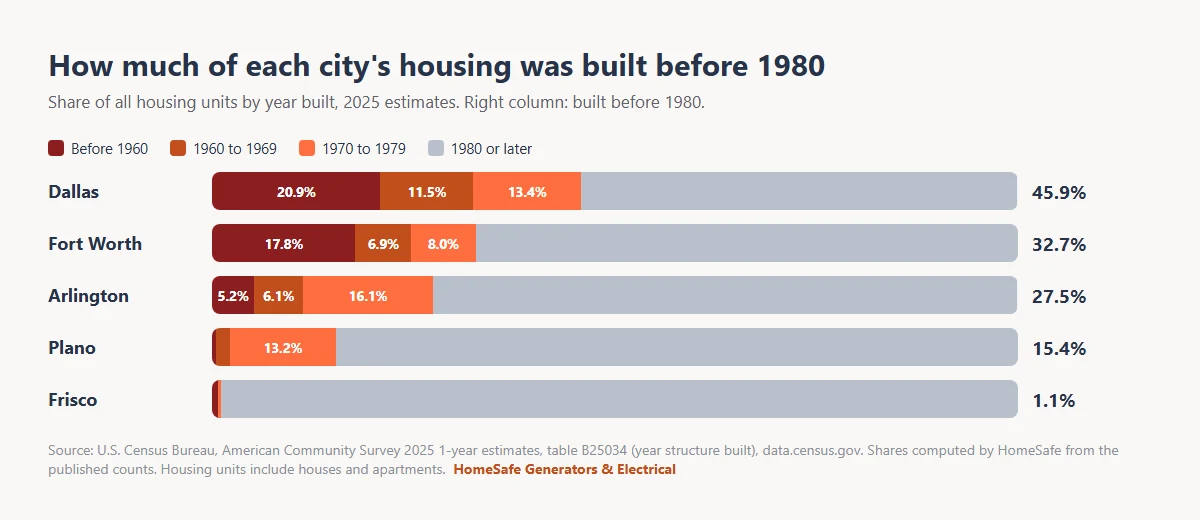
A house built in 1958 or 1972 can be perfectly safe to live in. It was also wired to the rules and materials of its decade, and some of those have since changed for good reasons. Knowing the year your home was built tells you what to look for, before you buy, before you add a big load like an EV charger or a generator, or when something starts to flicker. A lot of DFW was built before those changes: about 46% of housing in Dallas dates from before 1980.
Here is the short answer. Build year is a guide to what to check, not a verdict. Homes wired from 1965 to the mid-1970s may have aluminum branch wiring, which needs its connections checked and repaired. Homes built before the mid-1970s were not required to have ground-fault (GFCI) outlets, and homes built before 2002 were not required to have arc-fault (AFCI) breakers on bedroom circuits. Older panels, including Federal Pacific and Zinsco, are worth identifying by name. None of that means a home must be rewired. A licensed electrician’s inspection tells you what your home actually has, and at HomeSafe that is $295 through our electrical safety inspection.
This guide is for homeowners and buyers in Dallas, Fort Worth, Arlington, Plano, Highland Park, University Park, Keller and across DFW and North Texas. It walks through each era, the warning signs at any age, and what you can safely check yourself. For what an inspection covers and how it differs from a home inspection, see what a home electrical safety inspection covers.
1. How old is DFW’s housing?
Older housing is not spread evenly across DFW. The U.S. Census Bureau’s American Community Survey counts housing units by the year they were built. Its 2025 estimates show a wide spread between Dallas and the newer suburbs to the north (U.S. Census Bureau, American Community Survey 2025 1-year, table B25034).
| City (ACS 2025 estimates) | Housing units | Built before 1980 | Built before 1970 | Median year built |
|---|---|---|---|---|
| Dallas | 603,788 | 45.9% (276,850) | 32.4% | 1983 |
| Fort Worth | 402,216 | 32.7% (131,725) | 24.8% | 2000 |
| Arlington | 158,652 | 27.5% (43,640) | 11.4% | 1988 |
| Plano | 117,389 | 15.4% (18,092) | 2.2% | 1995 |
| Frisco | 90,661 | 1.1% (965) | 0.8% | 2012 |
Median year built from table B25035. Shares computed by HomeSafe from the Census counts. Housing units include houses and apartments. Figures are survey estimates with margins of error, widest for small counts.
Two details stand out. Fort Worth is newer overall, but it has about as many units from the 1950s alone (33,687) as from the 1960s (27,811) or the 1970s (32,171). Plano’s older housing is mostly from the 1970s, with 15,543 units built in that decade. If your home in Frisco or Prosper was built in the last 20 years, most of this guide will not apply to you, and that is good news.
2. What each era tends to have
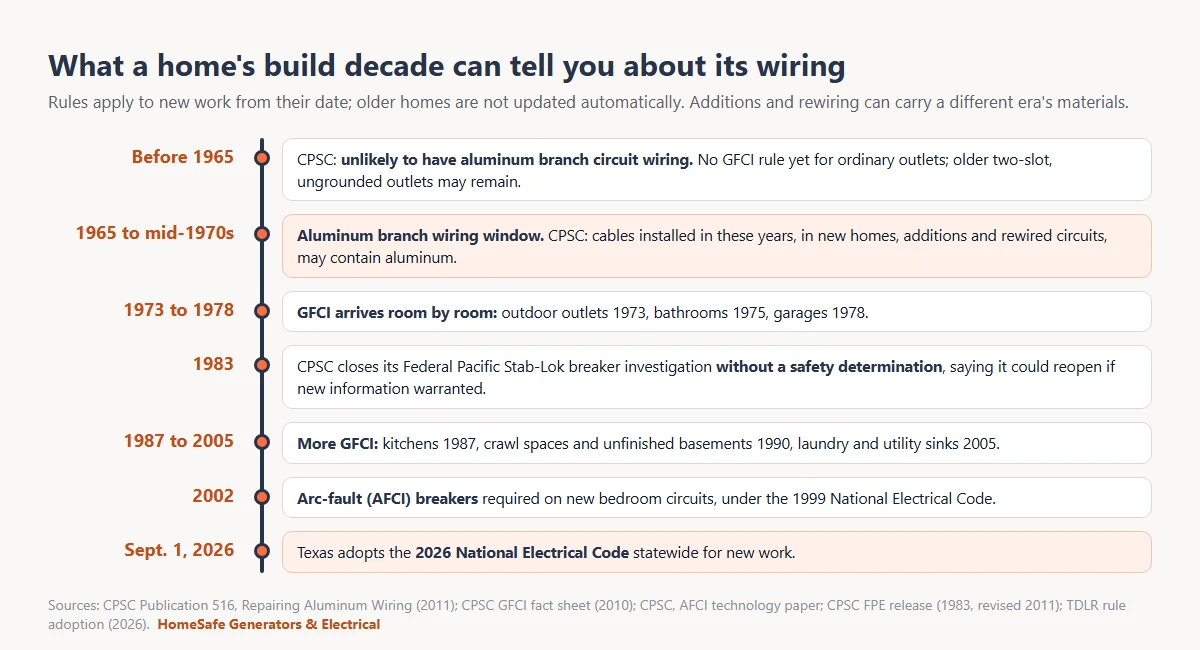
Electrical rules apply to new work from the date they take effect. CPSC notes that the National Electrical Code “typically only applies to new construction/major renovations” (CPSC, GFCI fact sheet, 2010). So an older home keeps the protections of its own decade unless someone has updated them. Additions and rewired rooms can carry a different era’s materials, so treat the year as a starting point.
Before 1950
Dallas has 59,855 housing units from before 1950 and Fort Worth 38,056. Wiring this old may have been extended or partly replaced over the decades, so what is behind the walls can be a mix. There was no GFCI requirement, and older two-slot outlets without a ground wire may still be in use.
1950s and early 1960s
This era is a large share of Fort Worth’s older housing, with 33,687 units from the 1950s, and Dallas has 66,561. CPSC says homes built before 1965 are unlikely to have aluminum branch circuit wiring (CPSC Publication 516, Repairing Aluminum Wiring, 2011). The questions here are more often capacity and protection. Our live inspection guide notes that older Fort Worth and Dallas neighborhoods still carry 100-amp service and fuse-box era equipment. A service that suited a 1955 kitchen can be tight for central air, an EV charger and a home office at once; see electrical panel upgrades.
1965 to the mid-1970s
This is the aluminum wiring window. CPSC says a copper shortage in the mid-1960s led builders to use aluminum for ordinary 15 and 20 amp circuits, and that “electrical cables installed between 1965 and the mid 1970s in new homes, in additions, and as part of rewired/new circuits may contain aluminum wiring.” Dallas has 150,434 housing units from the 1960s and 1970s together, Fort Worth 59,982 and Arlington 35,354, though the Census does not split out the exact years. Section 3 covers what aluminum means for you.
Mid-1970s to 1980s
GFCI protection arrived room by room. CPSC lists the National Electrical Code dates as outdoor outlets from 1973, bathrooms from 1975, garages from 1978 and kitchens from 1987 (CPSC GFCI fact sheet). A home finished in 1976 could have GFCI outside and in the bathrooms but not in the garage or kitchen. This is also the era of the panel brands buyers ask about, covered in section 4. Most of Plano’s and Arlington’s pre-1980 housing was built in the 1970s.
1990s and 2000s
GFCI kept spreading: crawl spaces and unfinished basements from 1990, wet bar sinks from 1993, laundry and utility sinks from 2005. Arc-fault (AFCI) breakers, which detect arcing in wiring, became required on bedroom circuits in new homes from 2002 under the 1999 National Electrical Code (CPSC staff paper, arc-fault circuit interrupters). A 1995 home in Plano or Arlington is newer than most of this list, but its bedrooms will not have AFCI unless someone added it.
Since 2026
Texas adopted the 2026 National Electrical Code as the state electrical code from September 1, 2026 (TDLR, 2026). New work follows it. Your existing wiring is not expected to look like a 2026 build. It is expected to be safe.
3. Aluminum wiring and two-prong outlets
Aluminum branch wiring
The concern is at the connections, not the wire along its length. CPSC says deterioration at aluminum connections raises resistance and causes overheating. A national survey for CPSC found that homes built before 1972 and wired with aluminum were 55 times more likely to have at least one outlet connection reach “Fire Hazard Conditions” than homes wired with copper (CPSC Publication 516, 2011).
How to tell: CPSC says aluminum cable is marked “AL” or “Aluminum” on its outer jacket every few feet, often readable where cable is exposed in an attic or garage. A cable also marked “CU-clad” or “Copper-clad” is copper-coated aluminum, which CPSC’s repair advice does not cover. If you cannot tell, an electrician can.
The fix is usually not a full rewire. As of its 2011 publication, CPSC approves three permanent repairs: replacing the aluminum branch wiring with copper, which it calls the best method but for many homes “impractical and/or prohibitively expensive”; the COPALUM connector method; and, where COPALUM is not available, the AlumiConn connector. Both connector methods join a short copper pigtail at every aluminum connection in the home. CPSC says to hire a qualified electrician for this and not to do it yourself.
Two-prong, ungrounded outlets
A two-slot outlet has no ground connection for plugged-in equipment. CPSC says a GFCI “works even on two-slot receptacles,” and that a GFCI receptacle can replace an older ungrounded two-slot one, as long as it carries the supplied label “No equipment ground, GFCI protected” (CPSC GFCI fact sheet). That is a common, practical upgrade. A three-prong outlet fitted on an ungrounded circuit without GFCI protection is the one to have checked, because it looks grounded and is not. Our electrical services include circuit work; estimates are free and the work is billed at $200 per hour plus materials.
4. Federal Pacific, Zinsco and older panels
The panel brand is one of the first things an inspection records in an older DFW home. Our inspection team finds Federal Pacific and Zinsco panels most often in Tarrant County homes built from the 1950s to the early 1980s, insurers and buyers’ inspectors in North Texas ask about them by name, and HomeSafe treats both as replacements rather than repairs.
The official record is calmer than much of what you will read online. CPSC investigated Federal Pacific Electric Stab-Lok breakers from 1980 and closed the matter in 1983 “without making a determination as to the safety of FPE circuit breakers,” saying the data “does not establish that the circuit breakers pose a serious risk of injury to consumers,” and that it could reopen the investigation “if further information warrants” (CPSC, 1983, revised 2011). If you have one of these panels, find out its condition from an electrician rather than from a forum.
Replacing a panel is a bigger job than a repair. Our guide to what drives the cost of a panel upgrade explains what changes the scope, and the panel upgrade page is where to get a free estimate.
5. Warning signs at any age
CPSC warns that failing aluminum connections “seldom provide easily detected warning signs,” so a quiet house is not proof. When there are signs, these are the ones to act on.
| Sign | What it can point to | What to do |
|---|---|---|
| Outlet or switch plates hot to the touch | An overheating connection (CPSC 516) | Stop using it and call a licensed electrician |
| Smell of burning plastic at an outlet or switch | Overheating at a connection (CPSC 516) | Switch off that circuit at the breaker if safe; call an electrician |
| Flickering lights or circuits that stop working | Loose or failing connections (CPSC 516) | Note which rooms; have it checked |
| A breaker that trips or a fuse that blows again | Often an overloaded circuit (CPSC) | CPSC: “Do not simply replace the fuse or reset the breaker”; find the cause |
| A GFCI that does not cut power when tested | A failed GFCI or wiring fault (CPSC fact sheet) | Have an electrician correct the wiring or replace it |
Sources: CPSC Publication 516 (2011); CPSC FPE release (1983, revised 2011); CPSC GFCI fact sheet (2010).
To be fair to older homes: many findings are repairs, not rewires. A GFCI here, a repaired connection there, a breaker matched to its wire. If an inspection finds nothing, that is a real result, and the written report says so.
6. What you can check yourself, and where to stop
- Test GFCI outlets monthly. CPSC says to test every GFCI at least once a month and after a power failure: press TEST, the power should cut, and RESET should restore it.
- Read cable markings where they are exposed. In the garage or from the attic hatch, look for “AL” or “Aluminum” on the jacket, using a flashlight at a low angle as CPSC suggests. Do not handle wiring, and avoid the attic in summer heat.
- Read the panel label through the panel door: brand and amp rating. Never remove the panel cover.
- Do not overload circuits. CPSC: “Never overload any electrical circuit by connecting too many products to the circuit.”
- Find your home’s build year on your county appraisal record or closing papers, and note any additions.
Where to stop: anything inside the panel, any outlet or switch replacement on aluminum wiring, and any work on the service. TDLR says a homeowner working on a home they own and live in is not required by the state to be licensed, but “municipal or regional regulations may override these exemptions” (TDLR, exemptions). Fort Worth’s Homestead Electrical Affidavit says homeowners “may not work on the service” (City of Fort Worth, homestead affidavits). CPSC’s advice for aluminum is blunt: “DO NOT TRY TO DO IT YOURSELF.”
7. How HomeSafe helps
A HomeSafe electrical safety inspection is $295 per inspection, anywhere we work across DFW. A licensed electrician checks the panel, visible wiring, outlets and switches, grounding and bonding, and smoke and CO alarm placement, and you keep a written report whether or not you hire us for the work. Anything it finds gets a free estimate. The electrical work is led by Ty Shaver, a licensed master electrician, under Texas Electrical Contractor License #41809.
An inspection is worth booking before you buy an older home, after you move in, when your insurer asks about the panel, or before you add a large load. If an EV charger or a standby generator is on your list, the panel and service need to carry it, and an older panel may need work before a transfer switch goes in. If the panel is open anyway, that is the efficient time to add whole-home surge protection. Our 6 technicians and 5 service trucks cover Tarrant, Denton, Collin and Dallas counties, including Dallas, Keller, Southlake and Plano.
Related guides: what an electrical safety inspection covers · what drives the cost of a panel upgrade · EV charger installation · generators and home insurance
Quick answers
At what age should you rewire a house?
No set age. Condition decides it, not the calendar. The electrical code applies to new work, so an older home is not required to match today’s rules, and even for aluminum wiring CPSC approves connection repairs as well as full copper replacement. An inspection tells you whether you need repairs, partial rewiring or nothing.
Does a 1960s or 1970s house have aluminum wiring?
Yes, it may. CPSC says cables installed between 1965 and the mid 1970s, in new homes, additions and rewired circuits, may contain aluminum, and homes built before 1965 are unlikely to have it. Look for “AL” or “Aluminum” printed on exposed cable, or have an electrician check.
Is aluminum wiring safe?
Its connections are the risk until they are repaired, and CPSC recommends a permanent repair. A survey for CPSC found pre-1972 aluminum-wired homes were 55 times more likely to have an outlet connection reach fire hazard conditions than copper-wired homes. CPSC approves three permanent fixes: copper replacement, COPALUM connectors or AlumiConn connectors, done by a qualified electrician.
Are ungrounded two-prong outlets dangerous?
No, not on their own, but they give plugged-in equipment no ground path. CPSC says a GFCI works even on two-slot receptacles and can replace an older ungrounded one if it carries the “No equipment ground” label. A three-prong outlet on an ungrounded circuit without GFCI protection is the one to have fixed.
How can I tell if a house needs rewiring?
4 signs from CPSC point to failing connections: outlet or switch plates hot to the touch, flickering lights, circuits that stop working, and a smell of burning plastic. Breakers that keep tripping are another. Any of them is a reason to call a licensed electrician, and many lead to repairs rather than a full rewire.
Is 40 or 70 year old wiring safe?
Yes, it can be, if its connections are sound and it is not overloaded. Age tells you what to look for: a 70-year-old home predates GFCI rules, and a home from about 1965 to the mid-1970s may have aluminum. An inspection by a licensed electrician answers it for your house.
Is there an alternative to rewiring a house?
Yes. For aluminum wiring, CPSC approves COPALUM and AlumiConn connector repairs at every connection, which keep the existing wire in the walls. For two-prong outlets, a labeled GFCI receptacle is a CPSC-recognized upgrade. Both are jobs for a licensed electrician.
Which repairs matter most in an older home?
3 come first: anything showing heat or a burning smell, unrepaired aluminum connections, and a breaker that keeps tripping. Next come missing or failed GFCI protection in kitchens, bathrooms, garages and outdoors, and an older panel’s condition. A written inspection report ranks them for your home.
To book an inspection, contact HomeSafe or call (817) 439-9009, or book through the electrical safety inspection page. HomeSafe holds Texas Electrical Contractor License #41809 and has a 5.0 rating across 200+ Google reviews, which you can read on our reviews page.