
Last reviewed: November 2026
“Do I need 200 amps?” usually comes up at a decision point: an EV in the driveway, a heat pump quote, a kitchen remodel or a generator on the list. The internet answers it with rules of thumb, and many of them quote an older code than the one Texas now enforces. We wrote this guide so you can see what actually decides it.
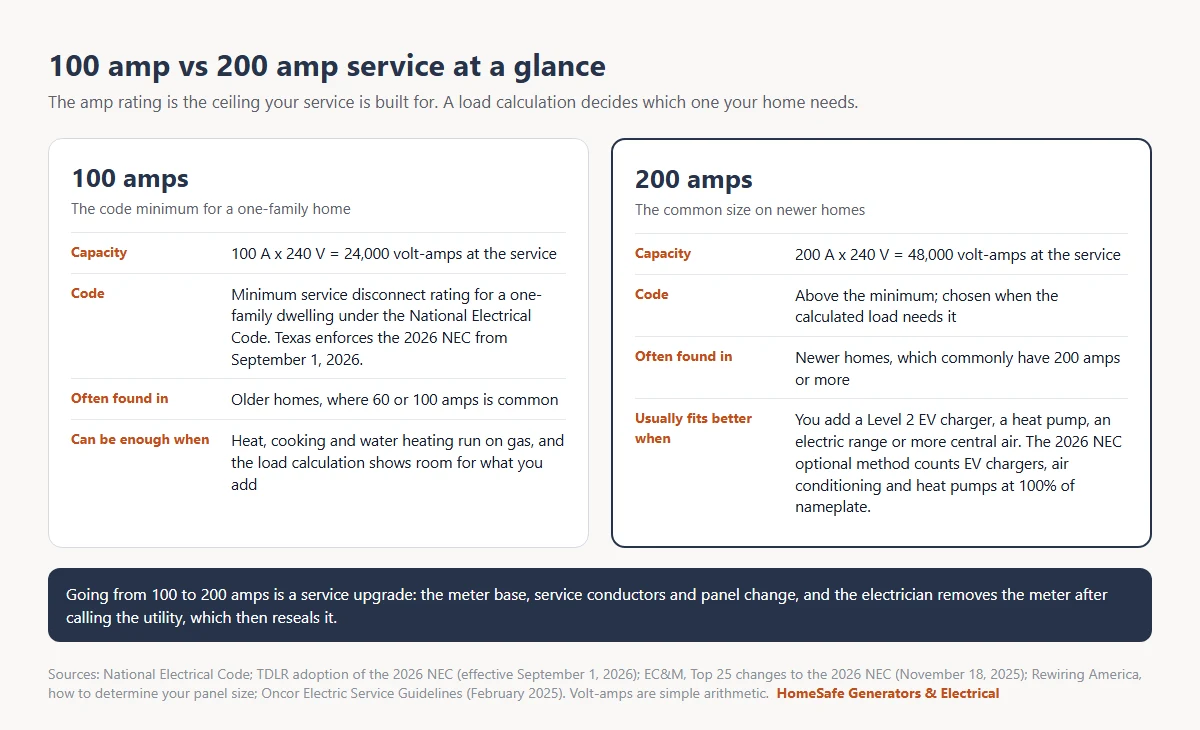
Here is the short answer. 100 amps is the minimum service the National Electrical Code allows for a one-family home, and it is still enough for some homes, mostly those that heat, cook and heat water with gas. 200 amps is the common size on newer homes and the better fit when you add a Level 2 EV charger, a heat pump, an electric range or more air conditioning. Neither the age of the house nor its size settles it. A load calculation does.
This guide is for homeowners in Fort Worth, Dallas, Arlington, Plano, Frisco, Keller, Southlake and across DFW and North Texas. It covers how to tell which service you have, what the 2026 code says, when 100 amps is enough, and what a 200 amp home means for a generator. When you are ready for a load calculation, our electrical panel upgrade service starts with one.
1. What the amp rating means
Your service rating is the most current your home is built to draw from the utility at once. At 240 volts, 100 amps works out to 24,000 volt-amps and 200 amps to 48,000. That is the ceiling, not what you use. Most of the day, a home draws far less.
The rating depends on the whole chain: the meter base, the service conductors and the main breaker. Oncor’s approved residential meter sockets, for example, come in 0 to 200 amp and 200 to 320 amp ratings (Oncor Electric Service Guidelines, February 2025, Table 5-C). Swapping the panel alone does not raise the service.
2. How to tell which service you have
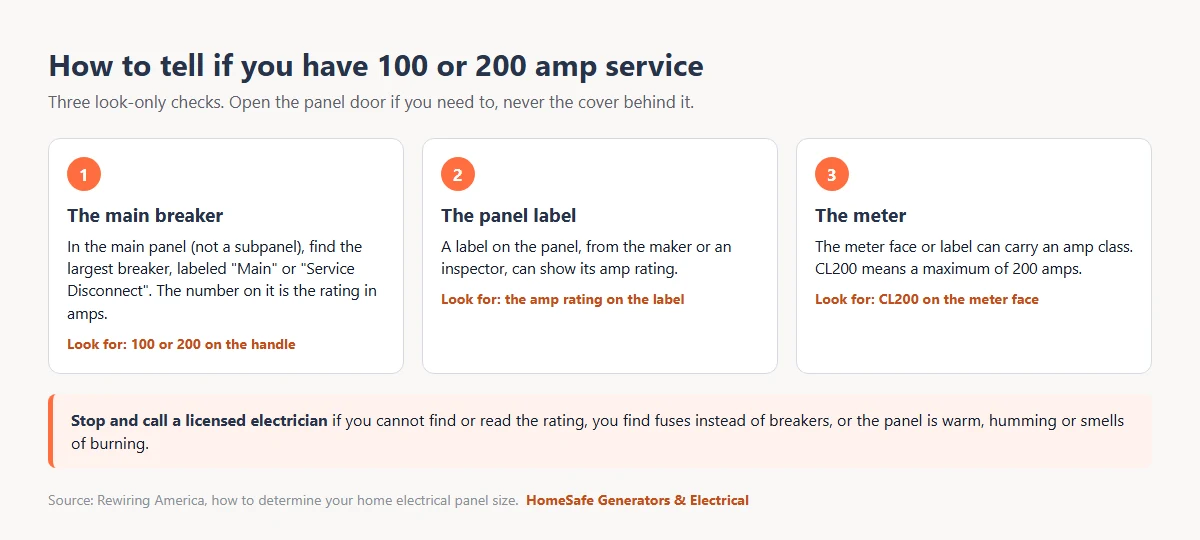
You can usually find out in a minute, without touching anything live. Rewiring America lists three checks (Rewiring America, how to determine your panel size):
- The main breaker. In the main panel, not a subpanel, the largest breaker may be labeled “Main” or “Service Disconnect”. The number on it is the rating in amps.
- The panel label. A label from the maker or an inspector may show the amp rating.
- The meter. The meter face or label may show an amp class. CL200 means a maximum of 200 amps.
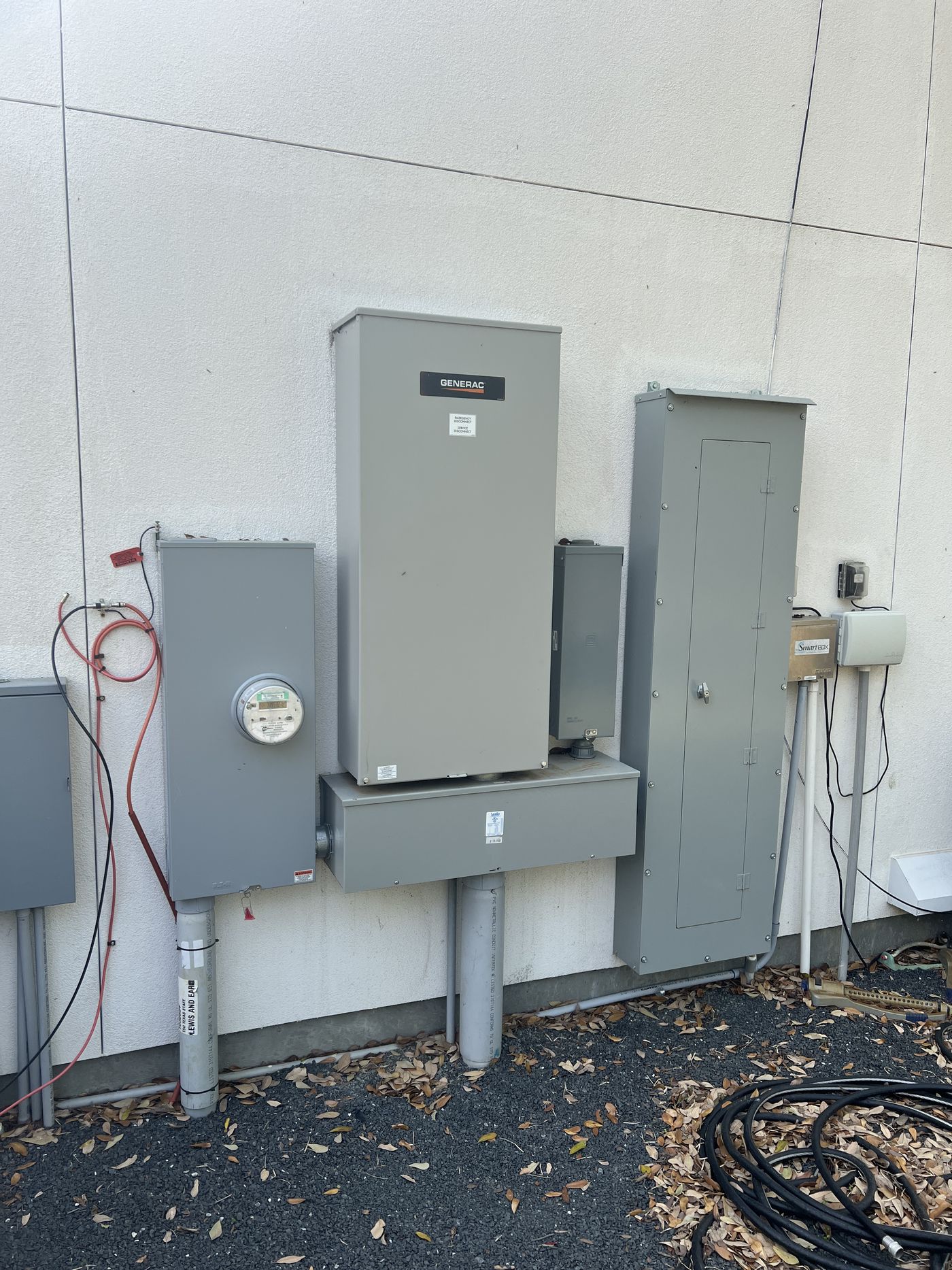
Open the panel door if you need to, but never the cover behind it. The 2026 NEC now puts the service disconnect for one- and two-family homes outdoors, so on newer work the main breaker may be at the outside wall rather than in the garage, in an enclosure marked “Emergency Disconnect” (EC&M, Top 25 changes to the 2026 NEC).
3. What the 2026 NEC says in Texas
Texas adopted the 2026 National Electrical Code as the state electrical code from September 1, 2026 (TDLR, Commission adopts rules, September 1, 2026). Advice written against the 2023 edition still circulates, so check the edition when you read about code minimums.
- The minimum is still 100 amps. Under the 2026 NEC, the service disconnect for a one-family home must still be rated at least 100 amps. Nothing in the code forces a home to 200 amps.
- The load calculation moved and changed. In the 2026 edition, the load calculation rules moved from Article 220 to a new Article 120. The optional method for homes now counts an EV charger at 100% of its nameplate rating, alongside air conditioning and a heat pump at 100%, and lowers the general lighting load from 3 to 2 volt-amps per square foot (EC&M, Top 25 changes to the 2026 NEC, November 18, 2025).
- Smaller can be allowed. NAHB says the updated optional calculations could allow a smaller service in some cases, for example 100 amps instead of 200 (NAHB, 2026 National Electrical Code).
- The disconnect goes outside. For one- and two-family homes, the service disconnect must be outdoors, either on the house or within sight of it and not more than 50 feet away (Section 230.70(A); EC&M, same article).
The practical point: the code sets a floor and a method. Your appliances decide the answer.
4. When 100 amps can be enough
To be fair to your budget, plenty of homes do not need an upgrade. A 100 amp service is more likely to have room in a home where the furnace, range, dryer and water heater run on gas, there is one central air system, and nothing large is being added. A load calculation may also show room for one new load.
EV chargers are the common test. Plenty of 100 amp panels take a Level 2 charger and plenty do not, so the calculation decides. The Department of Energy puts it the same way: some homes might have insufficient electric capacity for Level 2 equipment, and an electrician can tell you whether yours has enough (Alternative Fuels Data Center, charging at home). Our EV charger installation page and EV charger guide cover that side.
And a breaker that trips whenever one appliance runs usually points to that circuit, not the service. That appliance may need its own dedicated circuit rather than a bigger service.
5. When 200 amps fits better
The case for 200 amps is strongest when large electric loads stack up. Air conditioning is the big one in North Texas. Our generator sizing planner uses typical figures of about 3,500 watts to run a 3-ton system and about 9,000 to start it, and it notes that an all-electric home can need more than double the generator size of a gas home.
| What you are adding or have | Why it matters | What decides it |
|---|---|---|
| Level 2 EV charger | Long, steady draw; counted at 100% of nameplate in the 2026 optional method | Load calculation |
| Heat pump or electric heat | Heat pump counted at 100% of nameplate; supplemental electric heat adds more | Load calculation |
| Second or larger central air | Air conditioning counted at 100% of nameplate | Load calculation |
| Electric range, dryer or water heater replacing gas | Turns a gas home into a heavier electric load | Load calculation |
| Full panel, no spaces left | No room for new circuits; adding breakers to an undersized panel makes it worse | Panel assessment |
| Fuse box, Federal Pacific or Zinsco panel | Replaced, not repaired; the service size is chosen at the same time | Panel assessment |
Load treatments from EC&M’s summary of the 2026 NEC optional dwelling method (November 18, 2025). Panel types from HomeSafe’s electrical panel upgrade page.
Signs on the panel itself also point to a bigger conversation: breakers that trip across the house, lights that dim when the air conditioning starts, or a panel that is warm, humming or smells of burning. The last one is a stop sign: stop using those circuits and call a licensed electrician.
6. DFW homes: where 100 amps is still common
The split across the metroplex follows the age of the housing. Older homes might have 60 or 100 amp panels, while newer homes commonly have 200 amps or more (Rewiring America). The Census shows how much older housing DFW’s two biggest cities still have.
| City (ACS 2025) | Housing units | Built before 1980 | Median year built |
|---|---|---|---|
| Dallas | 603,788 | 45.9% (276,850) | 1983 |
| Fort Worth | 402,216 | 32.7% (131,725) | 2000 |
Source: U.S. Census Bureau, American Community Survey 2025 1-year, table B25034; median year built from table B25035. Shares computed from the year-built counts.
In older neighborhoods of Fort Worth and Dallas, a 100 amp service often sits alongside fuse-box era equipment. Newer builds in Frisco, Prosper and Celina, across Denton and Collin counties, are typically 200 amps from new, so the question there is usually whether a new load fits rather than whether to upgrade. If you are not sure what an older home has, a home electrical safety inspection identifies the panel and service first. Our safety inspection guide explains what it covers.
7. What about 150, 300 or 400 amps?
100 and 200 are not the only choices. Rewiring America lists 60, 100, 125, 150, 200 and 220 amps as common panel values, with 300 and 400 amps in some newer, larger homes. A 150 amp service can be the right middle step for some homes, and a few large homes go above 200. The load calculation sets the size; the round number does not.
Going from 100 to 200 amps is a service upgrade, not just a panel swap. It usually includes a new meter base and upsized service conductors. Oncor’s guidelines require the electrician to tell Oncor before the meter is pulled, and Oncor returns to inspect and reseal it. The price side is covered in what drives the cost of a panel upgrade.
8. A 200 amp home and a standby generator
A common search is “what size generator for a 200 amp service”. The amp rating does not set the generator size. It tells you the ceiling of what the house could draw, not what you need to run in an outage. The generator is sized to the loads you choose to keep on, and the air conditioner is the main reason the number moves.
Our generator sizing planner asks for your main panel size, printed on the panel door or main breaker, and then the loads you want covered. Most DFW homes need a standby generator between about 14 and 26 kW, and a free in-home assessment turns that range into one recommendation. On a 200 amp home, that usually means choosing between whole-house coverage and the circuits that matter most.
The generator connects through a transfer switch, sized by a load calculation. Oncor’s guidelines put the transfer switch on the load side of the meter base, never in series with the meter. Our transfer switch installation page covers that link, and generator installation covers the rest. HomeSafe is a Generac PowerPro Premier dealer and a dealer and installer for Kohler and Champion, and you can compare them in Generac vs Kohler vs Champion. If a panel upgrade is on the list too, it is quoted with the generator, not found halfway through.
9. How HomeSafe decides
We start with a free visit and a load calculation, so the answer fits what you run now and what you plan to add. If 100 amps has room, you hear that. If the panel or service is the limit, you get one written quote that covers the permit, the panel work and the inspection. While the panel is open, it is also an efficient time to add whole-home surge protection.
The electrical work is led by Ty Shaver, a licensed master electrician, under Texas Electrical Contractor License #41809. We serve homeowners across Tarrant, Denton, Collin and Dallas counties, including Dallas, Plano, Keller and Southlake. See all our electrical services.
In this series: what drives the cost of a panel upgrade · home electrical safety inspections · EV charger installation · electrical service upgrades and Oncor · signs you need a new panel · whether whole-home surge protection is worth it · transfer switch vs interlock kit · older home electrical risks by decade · fuse box vs breaker box
Quick answers
How can I tell if I have 100 or 200 amp service?
Read the number on the main breaker, the largest breaker in the main panel, labeled “Main” or “Service Disconnect”. A label on the panel or a class such as CL200 on the meter can confirm it. Open the panel door only, never the cover behind it, and call an electrician if you cannot read the rating.
Is 100 amp service enough for a house?
Yes, for some homes. 100 amps is the minimum the National Electrical Code allows for a one-family home, and it is more likely to be enough in a home that heats, cooks and heats water with gas. A Level 2 EV charger, a heat pump or electric appliances often push it past its limit, and a load calculation shows which side you are on.
Is 100 amp service outdated?
No, not by code. 100 amps is still the minimum under the 2026 NEC, which Texas enforces from September 1, 2026. It is less common on newer homes, which commonly have 200 amps or more, and older homes with 100 amp service often have other equipment worth checking.
Should I upgrade my 100 amp service to 200 amps?
Yes, if a load calculation shows the loads you have and plan to add will not fit. The usual triggers are a Level 2 EV charger, a heat pump, electric appliances replacing gas, a full panel or a fuse box, Federal Pacific or Zinsco panel. If the calculation shows room, an upgrade is not needed.
Is 100 amp service enough for central air, an EV charger or a heat pump?
Yes, sometimes. Plenty of 100 amp panels take a Level 2 charger and plenty do not, and central air or a heat pump adds to the same total. The 2026 NEC optional method counts air conditioning, EV chargers and heat pumps at 100% of their nameplate ratings, so the load calculation decides.
How long does it take to upgrade from 100 to 200 amps?
One day’s work in one house can be two in the next, which is why the job is quoted after a visit. The power is off for a planned window on the day, and the permit, the city inspection and the utility’s reseal set the calendar around it.
What does a 100 to 200 amp upgrade cost in Dallas-Fort Worth?
$200 per hour plus materials is how HomeSafe bills electrical work, and estimates are free. The total depends on your panel, the meter base and service conductors, the utility side, code work for the home’s age and the permit, so every job is quoted in writing after a visit.
Is 150 amp service enough?
It can be. 150 amps is one of the common panel ratings, between 100 and 200. Whether it covers yours depends on the same load calculation, especially if you plan to add an EV charger or a heat pump.
What size generator does a 200 amp service need?
14 to 26 kW covers most DFW homes, but the amp rating does not decide it. The generator is sized to the loads you want running in an outage, and air conditioning moves the number most. Our generator sizing planner gives a starting range, and a free in-home assessment sets one size.
To find out what your home needs, book a free estimate on our electrical panel upgrade page, contact HomeSafe or call (817) 439-9009. HomeSafe holds Texas Electrical Contractor License #41809 and has a 5.0 rating across 200+ Google reviews, which you can read on our reviews page.